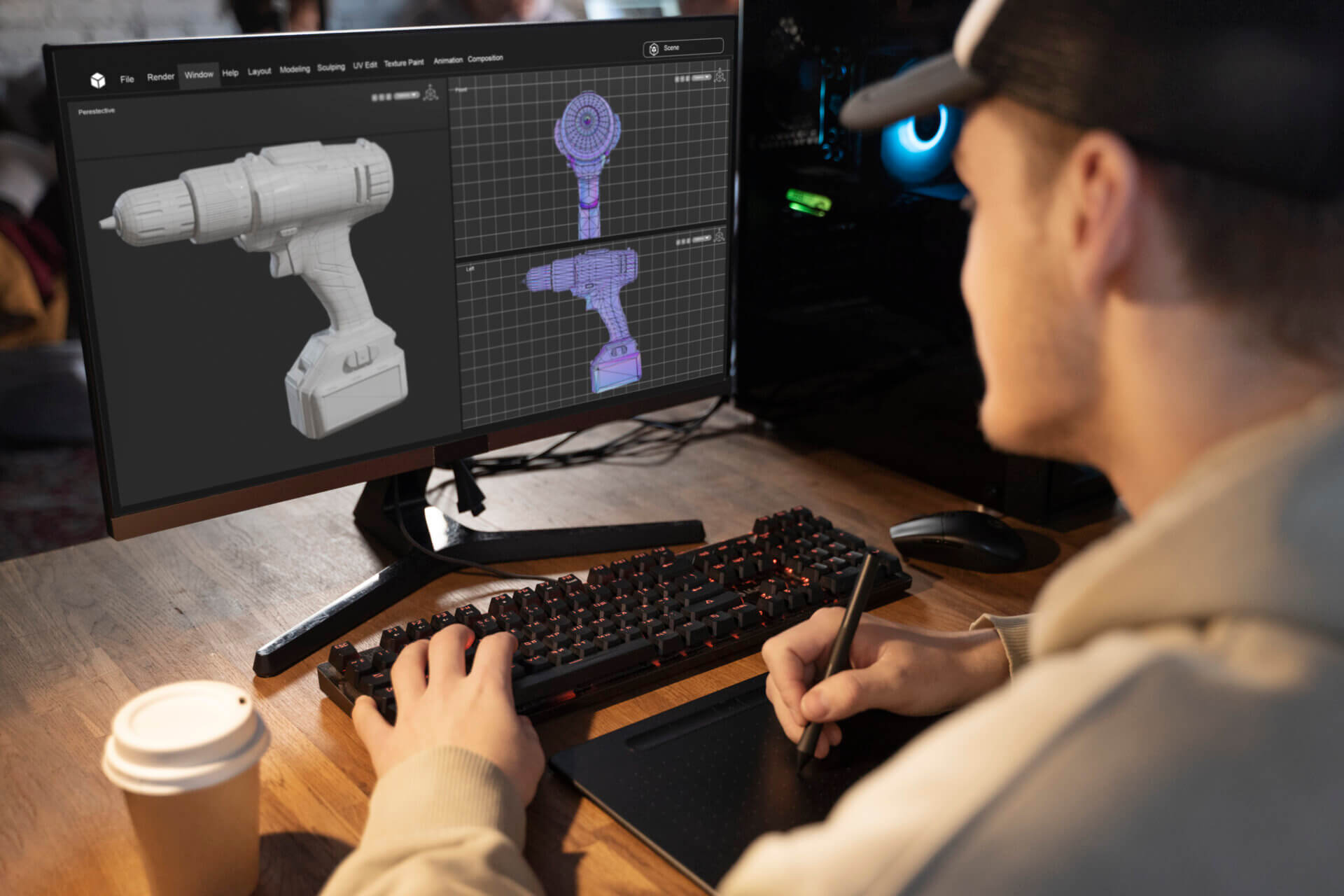
3D modeling sits at the core of modern digital creation, from the stunning landscapes of blockbuster films to the intricately detailed characters in current video games. In fact, the global 3D modeling market size in 2025 is $4.56 billion in value.
Thanks to this powerful technology, artists, architects, engineers, and game designers can shape virtual objects that look, move, and behave like real-world counterparts. In line with this, the 3D modeling process transforms imagination into functional digital assets, helping build a game-ready character, create lifelike graphics for a feature film, and much more.
Stay until the end of this article, as it breaks down what 3D modeling is, how it works, and where it is used. At the same time, it will explain how beginners can start building the skills necessary for jobs in game development, animation, and the like.
What is 3D Modeling?
By definition, 3D modeling is the process of using specialized software to make a mathematical and visual representation of a three-dimensional object. In simple words, 3D modeling is the use of computers to create images and graphics that look three-dimensional.
Advanced 3D animation software programs like Autodesk Maya and 3ds Max, as well as some coding knowledge, are required to be able to create your own 3D models.
The basic process involves connecting sets of points with lines, curved surfaces, and other geometric data to make wireframe models.
History and Evolution of 3D Modeling
It began in the 1960s with early CAD systems. Although it was not technically invented by one person alone, it evolved with key figures starting with Ivan Sutherland, the father of computer graphics. Through the years, polygonal modeling, NURBS, and solid modeling changed film and engineering. Nowadays, advanced modeling tools, procedural generation, and the like exist. Plus, there are even 3D Environment modeling studios in Europe.
Common Types of 3D Modeling Techniques
Core Techniques
1. Polygonal Modeling
2. NURBS Modeling
3. Subdivision Modeling
4. Digital Sculpting
5. Procedural Modeling
6. CAD Modeling
7. Photogrammetry
Supporting Techniques
1. Curve Modeling
2. Surface Modeling
3. Wireframe Modeling
The 3D Modeling Process and Workflow
Oftentimes, the following structured workflow is employed in most 3D projects:
1. Conceptualization
2. Blocking / Modeling
3. Texturing & Material Setup
4. Rigging & Animation (Optional)
5. Simulation & Testing
6. Rendering
7. Post-Processing
Comparing 3D Modeling With 2D Methods
Both 2D and 3D are widely used by many artists. The use depends on the purpose and objectives. For instance, 2D art focuses on height and width. On the other hand, 3D incorporates depth that highlights realistic shading, accurate texture mapping, and more.
Is 3D Modeling for You?

One of the most common traits found in professional 3D modelers is creativity.
Much like drawing and animation, 3D modeling requires a lot of imagination and innovation to create characters and worlds that will stand out from the rest.
This includes having sharp attention to detail so your work is always polished and of the highest quality possible.
3D modelers also usually need to have some familiarity with computer coding, and sometimes scripting languages as well.
3D software programs aren’t the easiest to learn, and 3D modeling itself can have a sharp learning curve, which means having a talent for using computers to perform tasks appropriately is a must.
Last but not least, people who thrive and enjoy working in a team setting will enjoy 3D modeling.
Whether you’re in a top game studio like Blizzard Entertainment or working on Pixar’s next masterpiece, you can expect to work closely with artists, animators, and several other members on projects.
Since the video game industry, in particular, can be very demanding, people who don’t do well with tight schedules and long hours probably shouldn’t become 3D modelers to make video games.
Learn 3D Modeling for Games.
While there are people out there doing 3D modeling for a living without ever going to school, most break into the industry after earning a degree from a reputable computer animation school or college program.
In fact, it’s getting harder and harder to break into the video game and film industry as a 3D animator without a college degree or proof that you’ve gone through a good program.
This is because a degree is proof to employers that you’ve received hands-on training with 3D programs while being trained by people capable of educating others.
Want to Learn Online?
Any good degree or program will teach you the fundamental principles of 3D modeling, leaving you with a solid foundation in what you need to stand out from the crowd and get hired. Graduates also usually end up with a good demo reel to show potential employers their work.
Possible Careers
Today, 3D modeling is used in a vast number of fields.
The medical industry uses detailed 3D models of organs, including 2-D image slices from a CT or MRI scan. Architects and engineers also make use of 3D software programs to show proposed buildings, landscapes, devices, structures, vehicles, and more. Even scientists have begun using 3D geological models. Seismologists, for example, use them to predict events within the crust of the Earth due to shifting plates, erosion, etc.
Of course, most people find an interest in 3D modeling thanks to two of the biggest entertainment industries today. The first is movies and motion pictures, which use computer-generated characters, objects, and environments in animated and live-action films as well as 3D imaging to create an optical illusion of depth. The other industry is none other than video games. Most modern games use 3D models and environments to create the virtual worlds that players interact with and explore.
Anyone interested in any of the above fields will want to learn how to use 3D modeling software programs.
Tips and Best Practices for 3D Modeling

- Make use of strong references, such as 3D scans, photos, or sketches.
- Master keyboard shortcuts and how to optimize workflow.
- Learn about topology and edge flow.
- Leverage tutorials and case studies.
- Hone skills in rendering and photorealism.
- Practice with 3D virtual reality models.
- Organize assets in 3D asset libraries.
- Keep learning about new industry trends and tools.
Frequently Asked Questions
Q: Is there good 3D modeling software for beginners?
A: Yes. The popular choices in terms of accessibility and large support communities are Blender, SketchUp, and Tinkercad.
Q: Can 3D modeling be used for animation?
A: Yes. 3D modeling serves as the foundation for character and environment creation in animation, games, and VFX.
Q: Do I have to learn how to code to do 3D modeling?
A: While it is not needed for most modeling tasks, it can be an advantage to have basic coding or scripting skills.
Q: In which industries is 3D modeling used?
A: Some of the industries that use it are architecture, education, engineering, fashion, games, medicine, movies, and more.
Q: Can you earn money with 3D modeling?
A: Yes. You can sell models online, do freelance work for studios, or develop 3D printing products.
Key Takeaways
In today’s digital age, 3D modeling is a vital skill. It is a key component of the constant innovation in games and animation, fueling creativity across countless industries. Mastering the 3D modeling workflow opens a world of opportunities, regardless of whether you are aiming to design characters or create immersive game worlds. Moreover, it is more doable nowadays since there are modern tools, accessible tutorials, and an ever-growing industry that can help anyone start learning 3D modeling.
If you reached this part, it is your sign to start transforming ideas into stunning digital creations!

