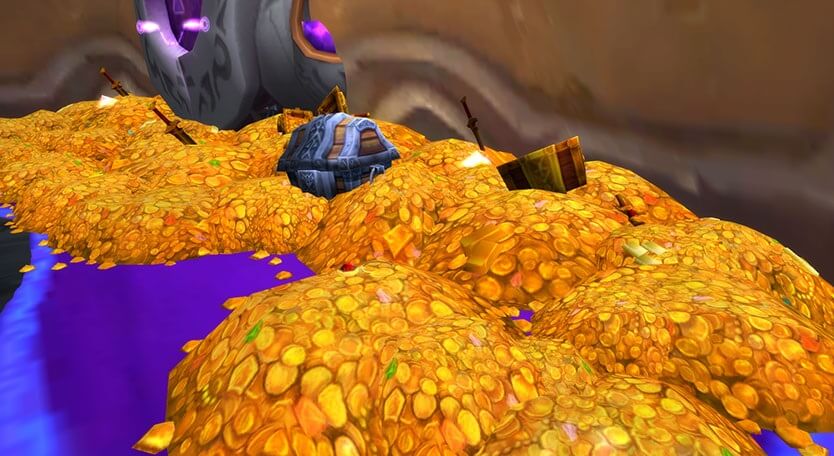
Gold has been the silent currency of boss kill, professions and prestige in all World of Warcraft eras. It primarily funded repairs and raid preparation in early expansions, and nowadays the list of items it can purchase is much longer, and it is no wonder that many players sometimes consider whether to buy WoW gold or not and grind all the coins manually.
This paper breaks out of hype and panic to examine the ways of earning and spending WoW gold over the lifetime of the game, between Classic-style budgets and the enormous menu of services in The War Within. This is not to dictate to anyone what they should do, but to enable the players to open their eyes and see where their currency goes in order to balance time, goals and money.
In broad strokes, we will:
- revisit the meaning of gold in early World of Warcraft expansions;
- visit the contemporary gold sinks that are competing with your wallet;
- use current The War Within systems and Patch 11.2.7 as a case study.
What Gold is in the Early World of Warcraft.
In the primitive forms of the game, the vast majority of gamers considered money very simply. “Enough” World of Warcraft gold was enough to train new skills, repair after wipes and have at least one or two professions in motion without leaving every night in pieces.
The simple comfort zone did not entail massive stockpiles. With the basic costs taken care of, there was not much urgency to pursue every potential farm avenue or to tap every drop to keep afloat.
Common early-game gold sinks were:
- training of new skills and mount riding;
- repairs after dungeons and raid progress;
- crafting mats and recipe unlocks for professions.
Pre-raid gear, flasks and enchants
The second level of demand was preparedness of raids. Players would farm five-player dungeons to get pre-raid gear, make the key items and fill the gaps with reputational rewards that would regularly need a steady stream of WoW gold as reagents, enchants and consumables.
Week after week, flasks, potions, food and enchants transformed an ordinary character into a solid raider. The significant aspect is that most expenditure was foreseeable and restricted to a few areas such that a small income could make you raid-ready without huge windfalls.
GDKP runs and early “pay-to-join” structures
When server economies became mature, GDKP runs emerged: raids, where players can place direct bids with gold on dropped items, and the pot would be divided between all participants. To most of them this was the first occasion that gold had turned into a long term project and not a short term instrument.
It might take weeks to save up enough money to go to a large GDKP night, but even there the emphasis remained small: gear and raid progress. Beyond some eye-catching acquisitions, though, there were still comparatively limited locations where you could expend genuinely huge sums of cheap WoW gold in a single purchase.
Modern Gold Sinks – From Mounts to Professional Teams
The seasons nowadays are different. The list of items available to purchase with WoW gold has gone through the roof, including cosmetic systems and features resembling housing, services that will presumably take you through endgame content.
Cosmetics, rare mounts and pets
Cosmetics in themselves, to collectors, will consume a fortune. Trading Post sets, auction-house-only mounts, rare recipes and battle pets provide players with endless motivation to save, speculate and spend World of Warcraft gold much more than the old repair-and-flask budget.
Common modern cosmetic sinks include:
- mounts only found in the Auction House or Black Market;
- prestige transmogs and toys from time-limited events;
- costly battle pets and crafted vanity products.
Paying for performance – carries and boosting
Even performance has been commoditized. In most areas, raid spots, Mythic+ chain of dungeons and achievement runs are sold by organized teams in in-game currency, and what once was a purely social favor is now a structured service.
It may be tempting to the player who has limited time to consider these options as an alternative to slow progression. One night of professional roster can compress weeks of wiping into one clean sheet smooth, and that is why offers that combine with World of Warcraft gold for sale attract such attention, particularly towards the close of a season.
Tokens, markets and real-world time
The final layer is the in-game money to real money connection. The boundaries between farm time and work time are blurred even with the players who never plan to spend any money on it because of the constant influx of websites that offer WoW gold for sale at a decent price.
Some players silently estimate the price of buy gold WoW on a third-party market against the time they would otherwise spend grinding; others evaluate the official alternatives and conclude the safest path is to still go out and farm their own savings. Either way, the question shifts from “how much can I earn?” to “how much is my time actually worth?”
One Life, Two Chairs – Time vs. Gold for the Modern Player
When real-life time comes into play, improvements must be counted in other than coins. A student who has free evenings can earn WoW gold by completing world content and keys with little to no stress, whereas a working parent with limited play time might have the sense that each time they log in they get one step closer to their objectives, rather than simply refilling their repair fund.
It is not difficult to understand why a person may find cheap WoW gold or even the cheapest WoW gold in that case when frustration is at its highest point. The issue is that, without a more comprehensive strategy, such impulse purchases will hardly address the problem: attempting to do more in the game than a weekly schedule can sustain.
Planning instead of panic spending
Any simple one-week plan can usually do more than a shortcut. It is easy to estimate how many hours you can actually play, how you would divide them between raids, Mythic+, open world and side projects by writing it down, and it becomes immediately clear whether your ambitions can fit within your calendar.
A basic planning checklist might include:
- how many sessions you have of pure progression;
- how many hours, for relaxed farming or collections;
- how much WoW gold you would like to add to or you would like to drain out of your reserve.
Healthy use of services
Having such context in mind, the services are only one of the many options. Becoming a member of a guild-organised carry, hiring a crafter or having a curated key night can all be fine things to spend your savings on, provided it does not lead to temptation to dangerous offers or sellers of unknown fidelity.
The most healthy one is to retain the majority of the progress directly connected to your own play. When you sometimes buy World of Warcraft gold in legitimate ways or even pay a group to assist you in-game, it must be a part of a strategic decision and not a response to anger or the feeling of being disadvantaged.
The War Within as a Case Study
In several significant aspects, The War Within changes the picture. Systems such as Warbands, delves and the Manaforge Omega raid alter the distribution of rewards through an account, thereby influencing the amount of The War Within gold that you can actually have sitting in your bags at any particular time.
The major structural changes are:
- Warbands that allow you to transfer gear and resources between several characters;
- account-friendly upgrade paths that minimize wastage on alts;
- endgame content that was focused on a common progression, and not an individual main.
A common pool of WoW TWW gold is more advantageous than a stack of gold that is spread thinly across the roster to players who raid or push keys on multiple characters. One character being a kind of bank of raid consumables, crafted items and high-priced upgrades will enable you to even out how much you spend, and it will be easier to notice whether your account is on an upward or downward trend.
Events and catch-up systems
Catch-up mechanisms and seasonal events also vary the amount of currency you actually require. Legion Remix phases, Turbo-Boost windows and the likes add additional gear, upgrade tokens and cosmetics to the game, making it not as essential to go after each and every drop using hard currency.
You may leave these windows to share part of the burden, however, when you think of them not as excuses to spend faster. The small WoW gold buffer will typically suffice to take care of consumables and opportunistic offers and the systems themselves provide most of your power and style.
Patch 11.2.7 – housing, events and new ways to spend
The last content update of The War Within is patch 11.2.7, The Warning, and a prelude to the next expansion Midnight. It pushes the narrative forward, gives players pre-orders of Midnight early-access housing, refreshes the Reach of Exile to new players and reintroduces events like the Brawler’s Guild and Turbulent Timewalking with Shadowlands Timewalking.
Currency wise, neighbourhoods such as Founder’s Point and Razorwind Shores, decor hunts and limited time events all provide new incentives to have some World of Warcraft gold in liquid form. Another possible sink is each new feature, which is competing with raid prep, profession upgrades and collection goals.
Examples of 11.2.7 gold sinks include:
- investing in housing plans and investing in decoration projects and so on;
- grinding new mounts, Brawler’s Guild or Timewalking event toys and titles;
- buying materials when the WoW gold price falls on the downslope during the busy weeks.
Choosing Your Own Balance
During early expansions, you spent the majority of your money on a list of necessities that were short: professions, pre-raid gear, flasks, enchants and maybe the GDKP night. The cosmetics, housing, seasonal events and paid carries are added to modern WoW on top of the same limited pool of WoW gold.
No right or wrong answer exists to the question of whether you should farm everything yourself, sometimes buy WoW gold cheap via official means or rely on in-game services. It is the knowledge of the trade-offs: how long you have, what are the goals that really matter to you and how comfortable you feel committing your entertainment budget to your achievements in World of Warcraft.
A good rule of thumb is to:
- track your time and spending for a few weeks before making big decisions;
- prioritise upgrades and experiences that genuinely improve your sessions;
- treat any large one-off purchase—of items, carries or currency—as an exception, not a habit.
Looking at your situation in that perspective, gold ceases to be a perpetual cause of stress and instead becomes yet another means of creating the kind of World of Warcraft experience that you really desire. Grind it, trade it or even buy WoW gold, the best thing is that the game remains a game, not a second job.

