Creating video games is widely regarded as one of the most fulfilling jobs one can have in this digital era. It is fulfilling in the sense that creators go through the 7 stages of game development, which entail complex processes and several hurdles before finally turning their ideas into reality. And yes, turning those concepts into something playable is where things get interesting and challenging.
Behind games like Fortnite and Overwatch lies a structured, multi-stage process involving multiple specialists (e.g., game designers, game programmers, game producers, etc.). More specifically, these phases require discipline, planning, and execution rather than mere creativity to transform a vision into interactive experiences played by millions of players.
Let us dive into the 7 stages of game development along with a few tips to optimize the process, so you can finally learn how to bring video games to life.
Understanding Game Development Stages
Game development does not allow anyone to do things in any order. The process is far from being random, at least if you want to do things the right way and succeed. Without a concrete framework, even the best ideas can go downhill due to poor execution.
That said, it is important to know that game development is a complex and multi-stepped journey. Understanding that it is a lengthy process, even for simple games, sets expectations. Some say there are only 3 or 4 stages of game development. While they are not wrong, breaking down the pipeline into more specific steps can help ensure the completion of critical functions.
By following the 7 stages of game development, you can navigate the process more vividly as if zooming in on a map to get a better view of the terrain. More specifically, you can define goals clearly, allocate resources effectively, determine problems early on, and ensure a smooth workflow.
Exploring the Seven Stages of Game Development
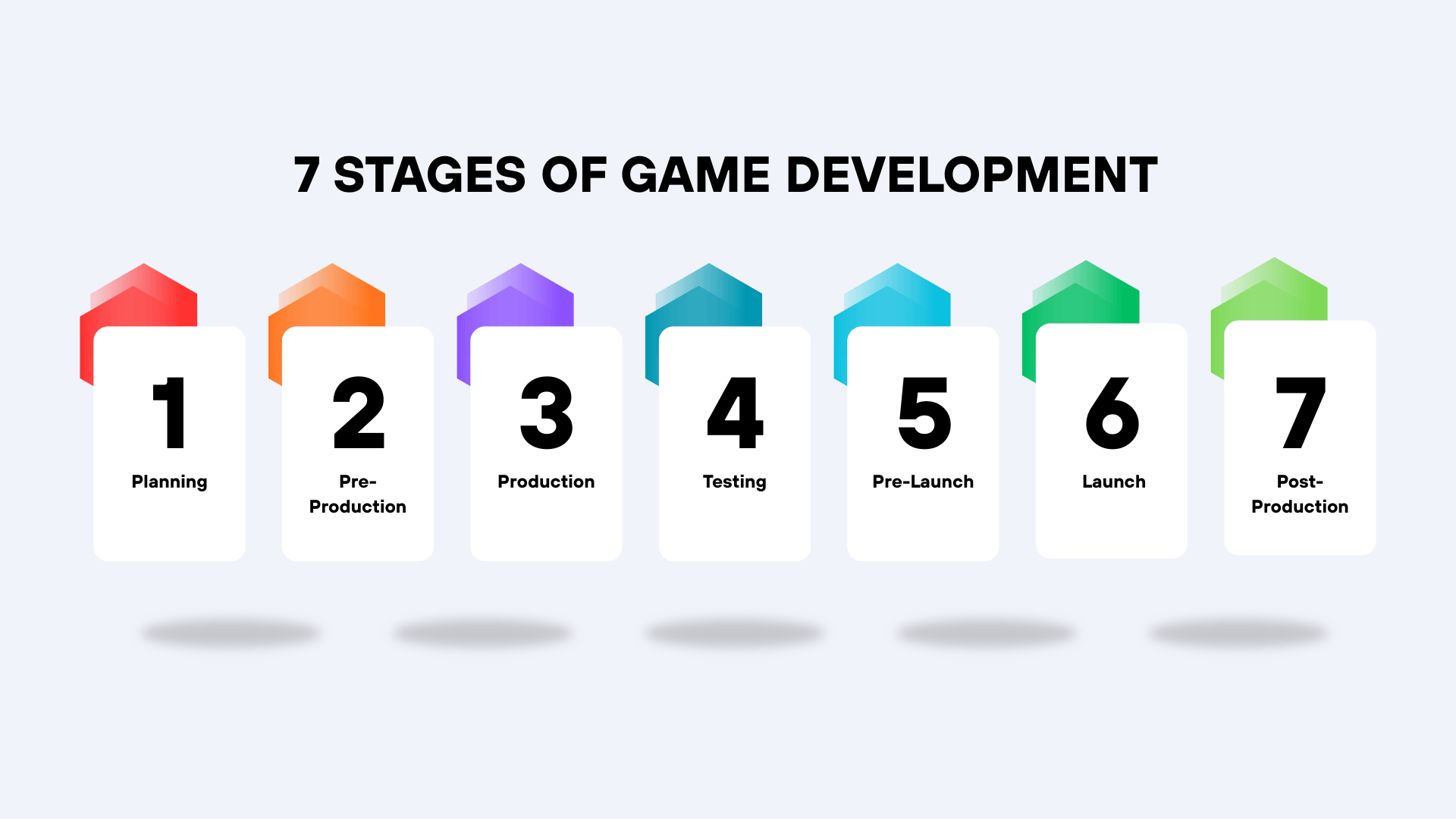
Let us now delve into the 7 stages of game development to see what happens in each phase, why every step matters, and how all stages contribute to the overall game creation process.
Stage 1: Planning
Effective planning is a vital first step in the 7 stages of game development. At this stage, market research is necessary to determine industry trends and what existing games already offer. Once the potential gaps and opportunities are identified, creators can proceed to asking and answering key questions. It is where you outline the game’s overall style, target audience, intended platforms, and player experience. This part leads to the creation of the proof of concept, which helps determine other essentials. Moreover, the planning stage entails deciding on the timeline, budget, funding methods, and whether you have the skills and team to accomplish the project, or if there is a need to hire game design and development services.
Stage 2: Pre-Production
Once planning is completed, it is time to flesh out the ideas and shape the foundations of the game. The most important thing in this phase is the Game Design Document, which enables every team member to get on board with the vision throughout the process. By creating this document, the team determines which ideas are going to be used and which will be cut. With art style, mechanics, characters, and narratives in place, the pre-production stage is also where the initial creative work starts. Building rough concept arts and prototypes shows the feasibility of the project, the necessary tools, the specific number of specialists needed for each phase, and the overall scope.
Stage 3: Production
The next step in the 7 stages of game development is production, and it is the most crucial and demanding phase. It is where everything comes together, meaning the core creation of every component of the game. Due to the nature of this stage, specialists are required to collaborate while performing their assigned roles, such as coding game mechanics and features, generating animations, visual assets, and 3D models, integrating audio elements, and more. From programmers to animators, everyone works tirelessly in the production phase with the goal of building and refining the features, story, characters, and game world.
Stage 4: Testing
After the lengthy production process, thorough testing is next in line. The main reason behind employing this systematic process of rigorous testing is to evaluate functionality, usability, compatibility, performance, and regression. By following scenarios and test cases, developers and quality assurance testers identify bugs, exploits, glitches, and other issues that may affect the overall gaming experience. At the same time, the testing stage also enables getting a general feel for the game. In here, developers find out whether a game is fun, accessible, and engaging.
Stage 5: Pre-Launch
The pre-launch stage is where an almost-ready version of the game exists. At this point, the game is often put out for beta testing with select players for a more informed iteration. Pre-launch also entails advertising and marketing, wherein you build hype around the project through teasers, trailers, press releases, and other promotional gimmicks. In addition, this is a great time to connect with the community. By participating in forums and answering questions from players, you can build positive relationships that can contribute to the success of the game. Also, pre-launch involves creating avenues where players can ask questions, report concerns, and submit suggestions. It ensures that players have the proper support systems, which can enhance retention.
Stage 6: Launch
When developers complete a game, launching is right around the corner. It is finally time to let the world experience your offering. While it is less complex than earlier stages, doing a few steps is essential to solidify a game’s launch. A few extra things to consider are picking a strategic release date, making a final marketing push, and preparing to engage with the community. The launching phase is a nerve-wracking moment, but the presence of mind is necessary. You have to stay in the zone to monitor launch issues and address them rapidly.
Stage 7: Post-Production
The final chapter of the 7 stages of game development is post-production. Yes, the work does not end after producing and launching the game. Every developer or studio should be on the lookout for post-launch bugs and player feedback. Similarly, debriefings take place during this stage, as continued player engagement and retention often call for additional content, regular updates and patches, and sequels. The goal is for players to remain interested in playing the game and want more out of it.
How to Streamline Game Development Workflow

Although the core of the 7 stages of game development largely stays the same, some strategies can help optimize the process and boost efficiency. To help in understanding the ideas, we present the three Cs.
- Conducting Research – Do not waste time developing a game that already exists in the market. Evaluate competitors and find out what makes their games work and, more importantly, what is missing from their products and what needs improvement.
- Checking Feasibility – Innovation is a good thing, but too much of it can break a project. Balancing creativity and practicality helps developers come up with a game idea that is groundbreaking but achievable.
- Choosing the Appropriate Tools – Leveraging the right development tools that fit the game project saves productions from dealing with overly complex options and inadequate picks that can limit and slow down the process.
Frequently Asked Questions
Q1: What are the 7 stages of game development?
Answer: The structured stages that guide game creation, from ideation to release and beyond, include planning, pre-production, production, testing, pre-launch, launch, and post-production.
Q2: What is the difference between the 4 stages of game development and the 7-stage model?
Answer: Honestly, they are essentially the same. The only difference is that the former is more of a simplified version, whereas the latter breaks the stages into more detailed phases.
Q3: What is the first step in the game design process?
Answer: Setting the foundation of the game design pipeline is planning, which involves conceptualization and ideation. This phase is where developers establish the gameplay, target audience, and other initial aspects of the project.
Conclusion
After reading this, it is probably easier to understand why even big AAA video games take time to produce updates or new versions. You can now be a little more patient when waiting for developers to bring something fresh to the table. With the 7 stages of game development blending creativity, technology, and collaboration, it is certainly a process that requires greatness and a significant amount of time and effort.
While no article can truly reflect the intricacy of game creation, as every project varies depending on the goal and has different unexpected issues, we hope our guide on the 7 stages of game development has provided invaluable insights into how games evolve from simple ideas into immersive experiences.
Ultimately, understanding every phase of game development is only half the battle. Acquiring the skills, mastering the tools, and staying committed are what truly lead to success in this field.
Of course, we also have guides to help you with these. You can check our articles about the essential skills for building your first game and the game design tools every game designer should know.

