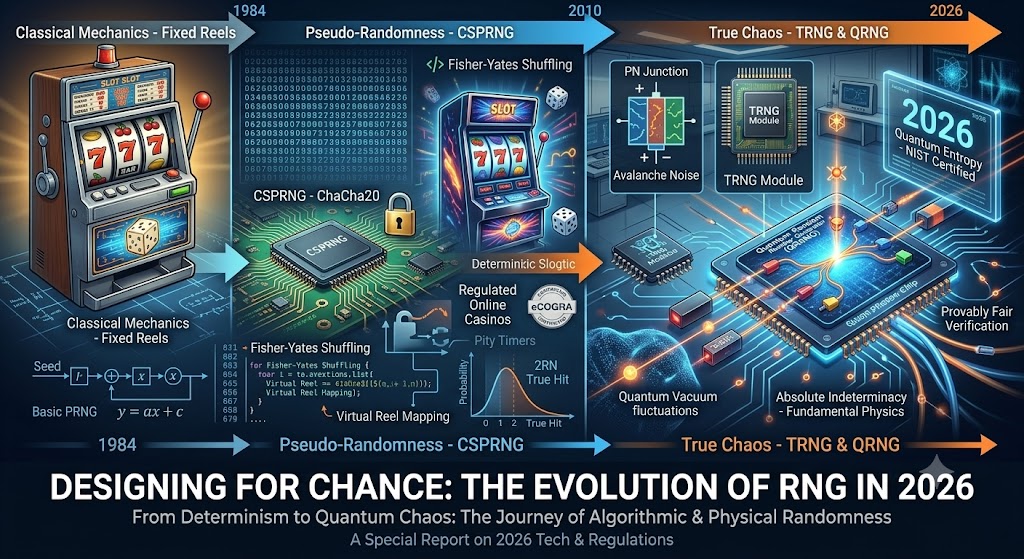
The Deterministic Lie
Computers are fundamentally stupid machines when it comes to chaos. You can engineer a silicon chip to execute a billion sequential instructions with terrifying precision, but asking that same hardware to pick a truly random number is roughly equivalent to asking a calculator to write poetry. The global digital economy—spanning from the cryptographic handshakes securing your banking app to the procedural generation in the latest blockbuster RPG—runs entirely on an artificial synthesis of unpredictability. The industry slaps the label Random Number Generation (RNG) on this architecture; frankly, “calculated illusion” hits much closer to the truth.
The reality of 2026 is brutally simple. How we architect chance today depends entirely on whose bank account is funding the development. Consumer video game developers just want randomness to feel fair to a highly irrational human brain. Post-quantum cloud network architects, on the other hand, require mathematics that are physically unassailable and physically guaranteed.
Silicon Math and Avalanche Noise
Most developers just want cheap, fast entropy. Deterministic mathematics inside a standard Pseudo-Random Number Generator (PRNG) handles this perfectly. You drop a seed value into the algorithm, the internal state cranks forward, and the system spits out a digit. The catch? If an adversary knows your seed, they know the entire future of your software’s universe. The old Mersenne Twister algorithm was mathematically brilliant for scientific simulations but cryptographically shattered. An adversary only needed to capture 624 consecutive 32-bit outputs to shatter the illusion and rebuild the entire internal state array from scratch. Security teams patched that bleeding wound by migrating to Cryptographically Secure PRNGs (CSPRNGs) such as ChaCha20. Even so, that nagging ghost of determinism never actually leaves the room.
Systems requiring absolute unpredictability have to abandon software and embrace literal physical chaos. True Random Number Generators (TRNGs) do not ask math for a favor; they tear their entropy directly from the fabric of the universe. Hardware designers rely heavily on a phenomenon called avalanche noise locked inside reverse-biased PN junctions. You essentially torture a semiconductor with a massive electric field, forcing electrons to smash into the crystal lattice and trigger an unpredictable cascade of secondary particles. Think of a cheap plastic pool slowly filling from a hose. Pressure builds until the water violently collapses a section of the plastic wall, spilling out just enough volume for the rim to snap back into position. That jagged, unpredictable electrical waveform gives us genuine entropy.
Hardware degrades over time, unfortunately. Temperature spikes and electromagnetic interference eventually introduce subtle biases into the physical components. We rarely output TRNG data directly to an application for this very reason. Instead, architects use that raw physical chaos to constantly re-seed a high-speed CSPRNG, blending physical unpredictability with digital throughput.
Skinner Boxes and the “True Hit” Illusion
Code obeys logic perfectly. Human psychology, on the other hand, falls apart at the slightest breeze. Players simply do not understand probability. If a gamer misses an attack with a 90% success rate three times in a row, they don’t blame statistical variance. They immediately accuse the developer of writing broken code. Game designers realized decades ago that pure mathematical randomness destroys engagement and drives churn.
Studios built complex manipulation algorithms to protect players from actual chance. The Pseudo Random Distribution (PRD) system—made famous by the Warcraft III engine and critical to the multi-million dollar esports economy of Dota 2—operates like a dynamic pity timer. An ability with a nominal 20% trigger chance doesn’t actually roll a flat twenty. The baseline probability starts much lower, hovering around 5.57%. Every time the player fails the roll, a mathematical constant gets tacked onto the next attempt. The odds forcefully climb to 11%, then 16%, deliberately compressing the variance to prevent massive losing streaks or game-breaking lucky runs.
Tactical RPGs like the Fire Emblem franchise take this psychological manipulation even further with the “True Hit” (or 2RN) system. Rather than relying on a single 100-sided digital die, the engine rolls two numbers, averages them together, and compares the mean to the displayed hit rate. This invisible math creates a Bates distribution curve. When the user interface displays a 70% hit chance, the underlying code is secretly rolling an 82% probability—and a 30% threat functionally plummets down to 18%. Studios aggressively lie to their audiences to manage emotional volatility. Gamers feel violently cheated by a missed 85% shot, yet they interpret dodging a 30% strike as pure tactical genius.
The House Edge in Code
You cannot pull those psychological tricks when actual money is on the line. Regulators will instantly hit you with federal charges and revoke your licenses if you modify probability curves on the fly to engineer “near misses” or pace a game. The algorithms deployed by regulated online casinos operate under a completely different, heavily audited mathematical reality.
The structural shift started back in 1984 when a man named Inge Telnaes patented virtual reel mapping. Mechanical slot machines were historically limited by their physical geometry, usually capping at 22 stops per reel. This hard physical limit made massive, life-changing jackpots mathematically impossible for the house to offer safely. Telnaes decoupled the physical display from the math. A modern microprocessor now runs a PRNG the exact millisecond a player hits spin, selecting a number from a virtual reel that could contain millions of combinations (e.g., 256³)
The act of scaling those raw hexadecimal outputs down to a usable game board introduces its own nightmare known as modulo bias. If a raw 32-bit integer is scaled down to a 37-pocket digital roulette wheel using a simple division remainder, the numbers at the lower end of the wheel possess a microscopic mathematical advantage. Multiply that microscopic math glitch across tens of millions of commercial spins, and the house actively bleeds millions of dollars in untracked equity. To survive the brutal GLI-19 certification audits, developers must implement strict rejection sampling. If the RNG spits out a number in the biased remainder space, the system trashes the output entirely and draws again. Independent Testing Laboratories like eCOGRA routinely demand datasets of 50 million discrete draw records just to verify that a standard deck of digital poker cards shuffles with absolute, uniform perfection.
Kleptography and Inside Jobs
Blind faith in a centralized black box has historically been a terrible idea. Compromised RNG acts like digital termite damage. Everything looks statistically pristine on the surface, while an attacker quietly predicts every single output from the outside.
You only have to look back at Ron Harris in the 1990s to see how quickly this fails. Harris worked as an engineer auditing RNG source code for the Nevada Gaming Control Board. He used his insider access to write backdoors directly into the physical EPROMs of slot machines prior to deployment. His partners on the casino floor just needed to drop a hyper-specific sequence of coins into the slot. That bizarre sequence tripped the backdoor, hijacking the PRNG and locking the virtual reel exactly on the grand prize.
Government intelligence agencies run these exact same sabotage campaigns across global infrastructure. NIST aggressively standardized the notorious Dual_EC_DRBG algorithm back in 2006 for federal cryptography. It utilized elliptic curve mathematics based on specific, completely unexplained constants. Cryptographers Dan Shumow and Niels Ferguson eventually proved those constants harbored a kleptographic backdoor. Snowden’s later leaks confirmed the worst: the NSA engineered the math and paid RSA Security millions to make it the default standard. This backdoor allowed the agency to silently predict the internal state of the generator after observing just 32 bytes of public output. They owned the encryption keys before the digital locks were even built.
Quantum Silicon and Provable Hashes
The industry is finally and aggressively pivoting away from blind institutional trust. Blockchain-native platforms normalized Provably Fair (PF) systems over the last decade, effectively replacing server-side secrecy with cryptographic transparency. The operator generates a hashed server seed, the player provides a client seed, and a basic nonce tracks the iteration. Once the hand concludes, the plaintext server seed is revealed. Anyone with a basic open-source script can run the trio through a SHA-256 hash to prove mathematically that the outcome was locked in before the bet was placed, permanently breaking the black-box paradigm.
Simultaneously, the enterprise security sector is bracing for the looming reality of practical quantum computing. Standard PRNGs and classical cryptographic frameworks will not survive an adversary armed with Shor’s algorithm. We are now integrating Quantum Random Number Generators (QRNGs) directly into mobile phone architectures and cloud APIs. The hardware fires individual photons directly at a semi-transparent beam splitter. This completely bypasses mathematical equations. Instead, the chip rips its entropy straight out of the fundamental, unresolvable indeterminacy of quantum physics.
The old paradigm of using chaotic algorithms to simulate chance is rapidly dying. When adversaries possess enough compute to reverse-engineer any mathematical construct, the only viable defense is leveraging the physical laws of the universe itself. The future of digital chance is no longer about mimicking unpredictability—it is about forcing the universe to guarantee absolute entropy at the subatomic level.

