
Do you like reading books? Are you interested in game design? Have you ever heard of the art of game design? If yes, keep on reading, as meaningful insights await!
Most of the time, people say that doing something with passion brings out the magic in everything. It makes jobs easier and allows people to turn their dreams into reality. In line with this, the idea of being passionate about something is also true when it comes to creating a game. However, realistically speaking, it is going to take more than that. Making games goes beyond combining graphics, sound, and mechanics. It is a deeply creative process that calls for understanding human psychology, storytelling, and interaction. That is where the art of game design enters the picture.
From the earliest video games, such as Computer Space (1971) by Nutting Associates and Pong (1972) by Atari, to today’s modern open-world titles like Assassin’s Creed: Shadows (2025) by Ubisoft Quebec, and The Elder Scrolls 5: Skyrim (2011) by Bethesda Game Studios, game designers continue to balance challenge, reward, and engagement. It proves that successful games are not simply about fun. They are also about creating meaningful and immersive experiences that keep players invested.
This guide ensures that you gain a deeper understanding of what it takes to make engaging and meaningful games. In detail, it will explore the key concepts of the art of game design, the impactful work and insights of Jesse Schell, the advantages of reading his book, its use, and much more.
Exploring The Art of Game Design
The art of game design offers more than career preparation; it introduces systems thinking, creative problem-solving, and the ability to empathize with the experience of players. Whether you are already a seasoned professional in the gaming industry, an aspiring game designer or a student taking his first steps into the field, understanding these principles helps in making sure that every game you create is designed to captivate audiences and stand out in an already-saturated gaming market.
Key Lessons from Jesse Schell

Who is Jesse Schell?
Before we dive into the specifics and intricate details, it is best to know the mind and the writer behind the work in focus. The person who created The Art of Game Design: A Book of Lenses is Jesse Schell. He is a well-known author, educator, and game designer. Additionally, Schell is popular for his contributions to the interactive entertainment industry. He is essentially a master in combining creativity with technology, leading the development of several games that have turned out to be award-winning.
Aside from working as a game design professor at Carnegie Mellon University, where he trains the next generation of artists and creators, he is also the chief executive officer of Schell Games. Specifically, it is a full-service game development company that has bagged more than 100 awards.
What does Jesse Schell say about game design?
Jesse Schell essentially teaches that games are experiences molded by various elements of design rather than a product of a collection of rules. Through his book about the art of game design, he underlined the importance of focusing on the player, iterative design, choosing meaningful elements, and many more. Most importantly, he emphasizes that ensuring all disciplines work well together is critical in creating successful games.
Game Design Lenses Explained
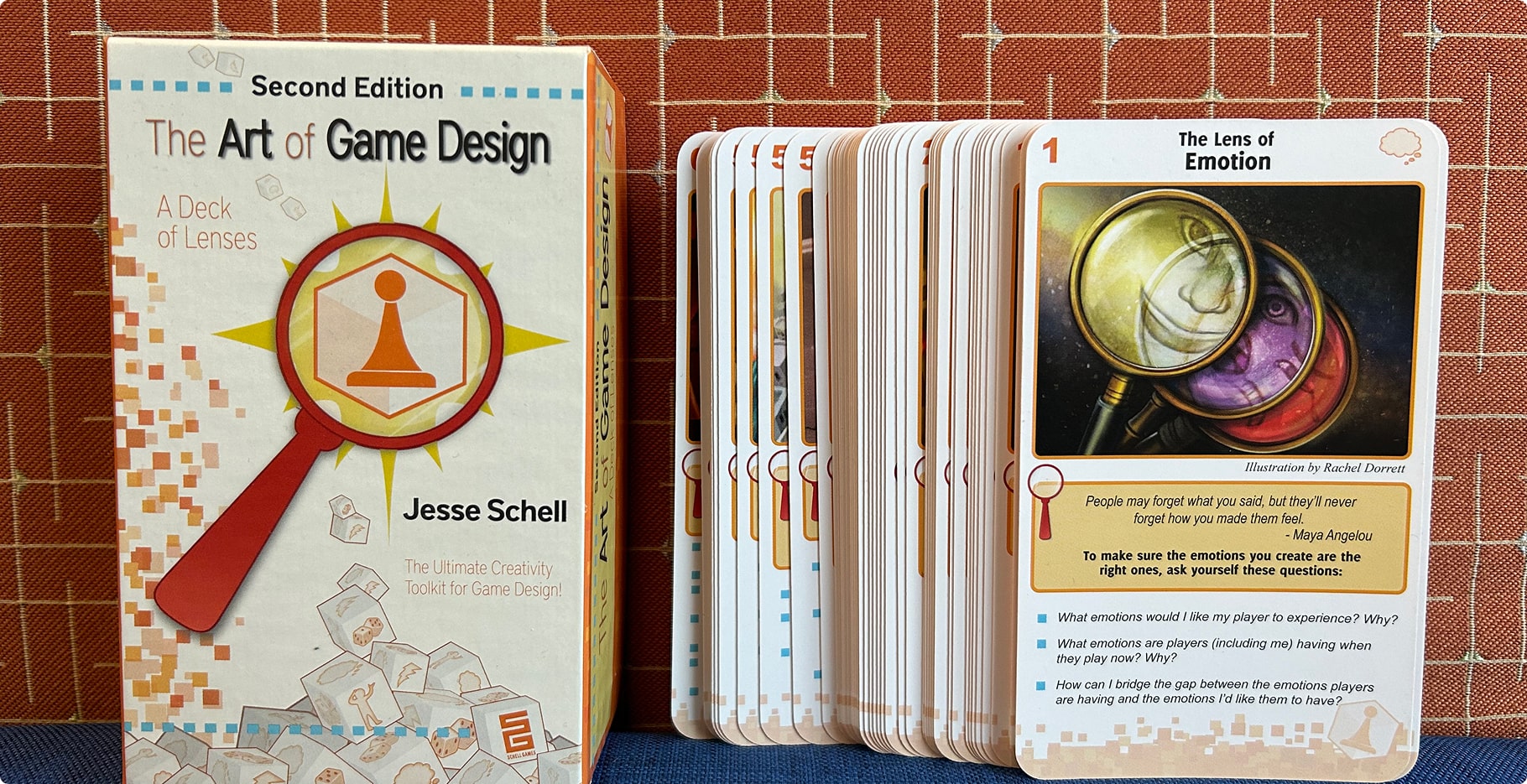
At the core of The Art of Game Design: A Book of Lenses are 100 lenses that provide detailed information on how to examine games from various perspectives effectively. However, explaining all of them would require a book of its own. Instead, we will highlight the first ten lenses for a detailed overview of the kind of insights the book actually offers.
- The Lens of Essential Experience
Rather than focusing on your game, concentrate on the player experience. Make sure that the game you are creating matches the experience you desire.
- The Lens of Surprise
Enhance the entertainment aspect of your game by incorporating elements of surprise.
- The Lens of Fun
Design parts of your games that contribute to the fun features, as this makes most games appealing.
- The Lens of Curiosity
Always include elements that would spark questions in the mind of every player and make them care more about the things to come. The curiosity that builds upon them often leads them to play more.
- The Lens of Endogenous Value
Improve your game by considering what players find valuable. You want to include features like items, scores, and objects that would make them want to succeed.
- The Lens of Problem Solving
Your game should entail solving problems, as this can cause players to become eager to return and find the answers.
- The Lens of the Elemental Tetrad
Check if the game possesses all four elements (i.e., mechanics, story, aesthetics, technology). Determine if you need to improve how your game utilizes them or if they embody a shared theme.
- The Lens of Holographic Design
Assess your game holographically to identify what works well and what needs improvement in the context of playing experience.
- The Lens of Unification
Ask yourself whether your game includes the essentials to have a unified theme.
- The Lens of Resonance
Dig deeper into the core of your game and evaluate the aspects that make people excited or what resonates well with the intended audience and purpose.
For a more complete view, here are the rest of the lenses covered by Schell’s work on the art of game design:
| Lens of Infinite Inspiration | Lens of Chance | Lens of Balance | Lens of the Story Machine |
Lens of The Nameless Quality
|
| Lens of the Problem Statement | Lens of Fairness | Lens of Accessibility | Lens of the Obstacle |
Lens of Friendship
|
| Lens of the Eight Filters | Lens of Challenge | Lens of Visible Progress | Lens of Simplicity and Transcendence |
Lens of Expression
|
| Lens of Risk Mitigation | Lens of Meaningful Choices | Lens of Parallelism | Lens of the Hero’s Journey |
Lens of Community
|
| Lens of the Toy | Lens of Triangularity | Lens of the Pyramid | Lens of the Weirdest Thing | Lens of Griefing |
| Lens of the Player | Lens of Skill vs. Chance | Lens of the Puzzle | Lens of Story | Lens of Love |
| Lens of Pleasure | Lens of Head and Hands | Lens of Control | Lens of Freedom |
Lens of the Team
|
| Lens of Flow | Lens of Competition | Lens of Physical Interface | Lens of Indirect Control |
Lens of Documentation
|
| Lens of Needs | Lens of Cooperation | Lens of Virtual Interface | Lens of Collusion |
Lens of Playtesting
|
| Lens of Judgment | Lens of Competition vs. Cooperation | Lens of Transparency | Lens of the World |
Lens of Technology
|
| Lens of Functional Space | Lens of Time | Lens of Feedback | Lens of the Avatar |
Lens of the Crystal Ball
|
| Lens of Dynamic State | Lens of Reward | Lens of Juiciness | Lens of Character Function |
Lens of the Client
|
| Lens of Emergence | Lens of Punishment | Lens of Channels and Dimensions | Lens of Character Traits |
Lens of the Pitch
|
| Lens of Action | Lens of Simplicity/Complexity | Lens of Modes | Lens of the Interpersonal Circumplex | Lens of Profit |
| Lens of Goals | Lens of Elegance | Lens of the Interest Curve | Lens of the Character Web |
Lens of Transformation
|
| Lens of Rules | Lens of Character | Lens of Inherent Interest | Lens of Status |
Lens of Responsibility
|
| Lens of Skill | Lens of Imagination | Lens of Beauty | Lens of Character Transformation |
Lens of the Raven
|
| Lens of Expected Value | Lens of Economy | Lens of Projection | Lens of Inner Contradiction |
Lens of Your Secret Purpose
|
Benefits of The Book of Lenses
Jesse Schell’s book about the art of game design is comprehensive and practical, translating theory into actionable guidance that offers countless benefits.
- Structured Game Evaluation
The lenses provided by Jesse enable game designers to have a concrete system of assessing aesthetics, mechanics, narrative, and the like.
- Idea Generation
Reviewing each lens discussed in the book sparks fresh ideas to approach game design.
- Enhanced Player Focus
Each lesson indicates that every design choice should benefit player experience.
- Universal Application
All the concepts and ideas covered by the lenses are applicable to any kind of game.
Why Read The Art of Game Design
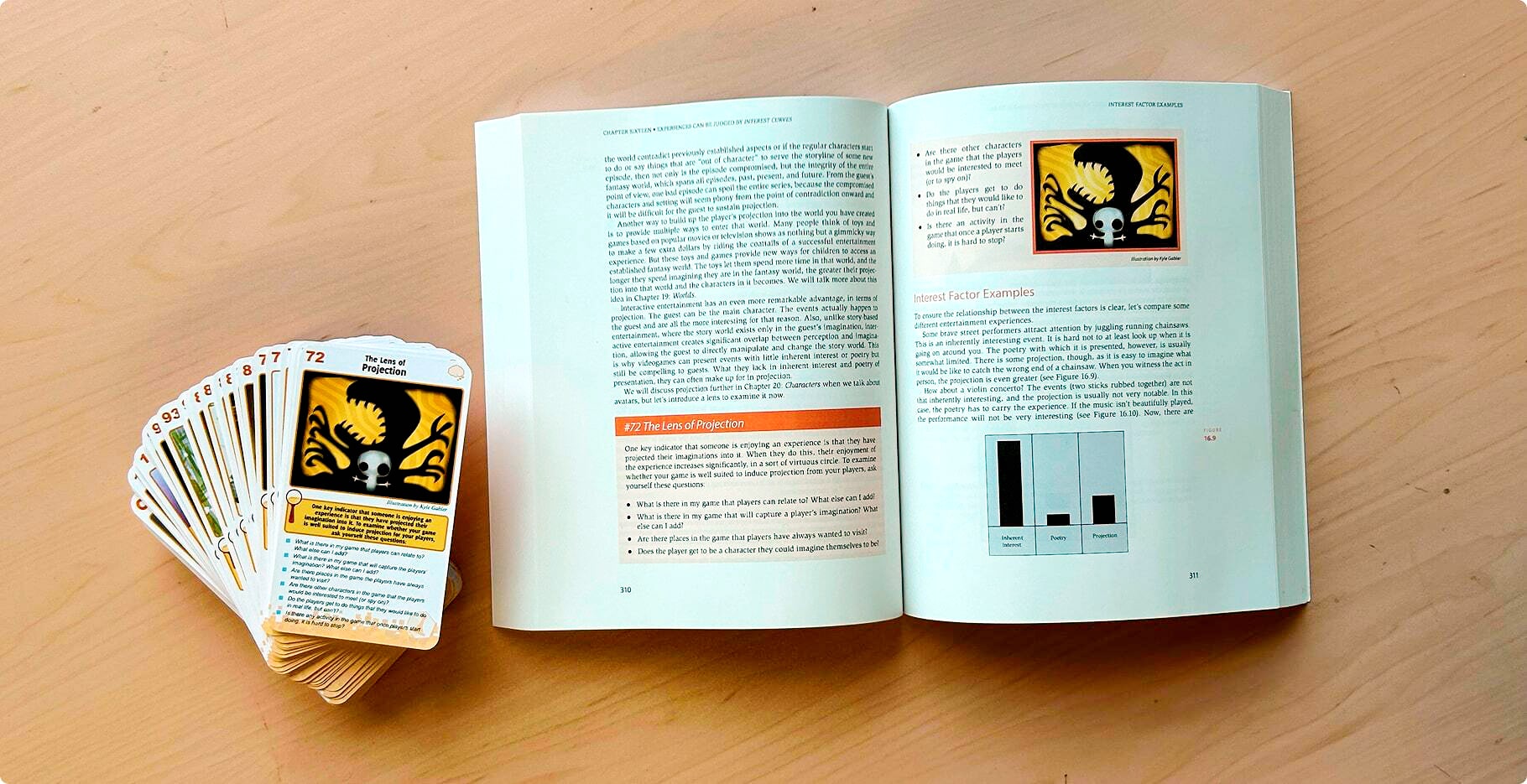
Reading the art of game design is critical for both beginners and game industry professionals.
First, it provides a holistic perspective by teaching how mechanics, story, visuals, and player psychology work together.
Second, the book delivers practical examples, showing real-world cases to illustrate abstract principles.
Third, Schell’s work beams with industry relevance, covering information that is applicable to various genres, platforms, and even non-entertainment gamification projects.
Fourth, it serves as a long-term reference, as many designers can frequently revisit specific parts or exercises during development.
All in all, Jesse Schell’s The Art of Game Design: A Book of Lenses is not only theoretical; it is a practical guide that informs decision-making in every stage of game creation. Until this day, with new editions of the book published, it is one of the most cited resources in game design courses and professional studios. As a matter of fact, it is also trusted by more than 50 colleges and universities, underlining the book’s credibility and usefulness.
Aside from these, Jesse Schell’s book positions itself as a good read, since it has a score of 4.39 out of 5 on Goodreads and 4.7 out of 5 on Amazon. To give you actual feedback from people who have read the book, check out some of these comments:
- Michael Burnam-Fink (Goodreads): “This is a work of love by someone who clearly understands why games are fun, and how to manage the tricky business of coordinating all the people required to build one.”
- Constantino Bolaños Araya (Amazon): “The author goes in depth about all the key elements you must mind in order to make your game design as consistent and enjoyable as you can…”
- George Kaslov (Goodreads): “This book is an excellent resource for the whole process of making a game.”
On top of these remarks from regular readers, the book about the art of game design has also received praise and good reviews from industry experts. For instance, Sims creator Will Wright said that it is the most comprehensive game design book he has ever seen. In the same way, Naughty Dog studio head Neil Druckmann shared that it is one of the few works he always references during production. He even said that it is a must-have.
Top Insights from Game Design Books

By reading widely, designers gain diverse perspectives and strategies that can enhance their ability to make innovative and engaging games. Here are some of the best insights from other game design books:
Actions must have discernible, meaningful outcomes
- Source: Rules of Play: Game Design Fundamentals by Eric Zimmerman and Katie Salen
- Focus: Meaningful play
The physical “feel” of control is a distinct aesthetic
- Source: Game Feel: A Game Designer’s Guide to Virtual Sensation by Steve Swink
- Focus: Virtual sensation
Fun is the feedback the brain gives when learning
- Source: A Theory of Fun for Game Design by Raph Koster
- Focus: Cognitive mastery
How to Use Game Design PDFs
Game design PDFs refer to digital documents that contain content about game design, including case studies, examples, frameworks, guides, principles, theories, tools, and tutorials. In other words, these are versatile instruments in improving one’s understanding and execution of game design or game development in general. Once you get hold of these kinds of readings, always make sure to get the most out of them. Here is how to:
- Study Core Principles
- Follow Step-by-Step Exercises
- Use Templates and Frameworks
- Reference during Development
- Combine with other Resources
- Iterate and Review
A skilled game designer knows how to use game design PDFs as active tools rather than merely passive reading materials. For example, approaching the art of game design pdf deliberately, you can practice game design in a structured and efficient way.
Frequently Asked Questions
Q1: What is the art of game design?
Answer: It is the craft of making interactive experiences that combines aesthetics, mechanics, narrative, and player psychology.
Q2: What is The Art of Game Design: A Book of Lenses all about?
Answer: Jesse Schell’s book about the art of game design delves into the core of game design, exploring what world-class designers use to create unique and outstanding games across different genres.
Q3: Do I need to read Jesse Schell’s book to begin my journey in game design?
Answer: While it is not mandatory nor necessary, it can be of huge help in getting structured guidance, practical exercises, and principles that are very valuable for both beginners and professionals alike.
Q4: Why is The Art of Game Design: A Book of Lenses important?
Answer: It is widely considered one of the most influential resources for learning game design, as it provides numerous insights and information that help game designers analyze gameplay, storytelling, player engagement, and more from various perspectives.
Q5: Can beginners use Schell’s lenses effectively?
Answer: Yes. However, it would be best to start with two to three lenses before gradually exploring more, as the lenses are designed to scale with experience.
Q6: How long does it take to master the art of game design
Answer: Honestly, complete mastery can take up to several years of experience, studying, and exposure to the field. Nonetheless, noticeable progress can be seen within 6 to 12 months with dedicated study and practice.
Q7: Can I learn game design from PDFs alone?
Answer: While PDFs like the one about the art of game design can serve as supplements for learning, they cannot replace hands-on experience or formal education in game design schools.
Final Thoughts
The art of game design is a creative, iterative, and multi-disciplinary practice. By studying the book about the art of game design by Jesse Schell, exploring game design lenses, utilizing game design PDFs, and reading complementary books, game designers are sure to acquire the knowledge and skills to create extraordinary games that can be enjoyed by millions of gamers worldwide.
Furthermore, a game designer must keep in mind that mastery emerges from practice as much as from study. So, one must experiment, playtest, and refine continuously. At the same time, aspiring and experienced game designers will be able to produce projects that challenge, delight, and resonate by giving importance to the factors that shape how players perceive and enjoy a game, including but not limited to levels, mechanics, and narrative.
Of course, like in any form of art, do not forget to enjoy the process!
Note: This article is for educational and informational purposes only. Although we aim to ensure accuracy and reliability, insights and outcomes may vary.

