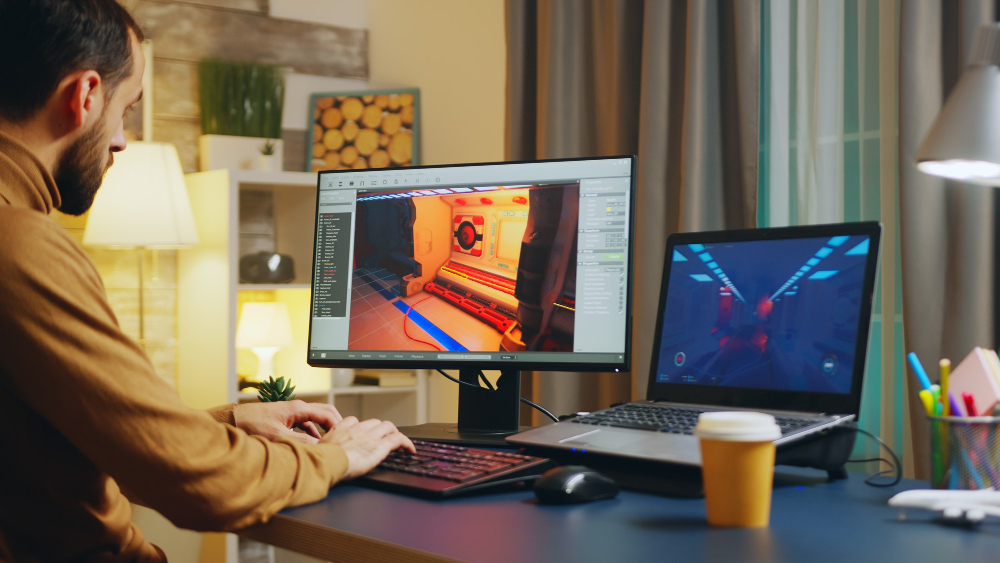
There’s a moment a lot of game design professors describe the same way. A freshman walks into office hours, sits down, and spends the first ten minutes apologizing for wanting to be there. They’ve already rehearsed the defense: I know it sounds unserious, I know my parents were hoping for something safer, I know, I know. And then somewhere around minute eleven they start talking about the first game that wrecked them. Hollow Knight, Outer Wilds, Journey, whatever it was. Their whole face changes.
That moment is most of what this article is about. Because the question of why students pick a video game design major isn’t really answered by brochures or labor statistics, even though both matter. It gets answered in that shift, when somebody stops apologizing and starts describing the thing they actually want to build.
The motivation nobody puts on the application essay
Most applicants write some version of “I’ve loved games since I was six.” It’s true, but it’s also the surface which is why many students look for essay editing help to better articulate what actually drives them. Underneath, the real reasons tend to cluster into a few patterns that admissions readers at places such as USC’s Interactive Media & Games Division and the NYU Game Center start to recognize after a few admissions cycles.
Students choose the major because:
- They want to make the thing, not just consume it. Passive fandom stopped being enough somewhere around age fifteen.
- They’ve already been teaching themselves. Unity tutorials on YouTube, a Godot prototype, a Twine interactive fiction piece nobody played. The major is a way to stop doing it alone — and for some, to avoid the temptation to simply pay someone to do homework when the technical parts get overwhelming.
- They want permission. This one is underrated. Many eighteen year olds have been quietly told that games are a hobby, not a career. A degree program is, among other things, institutional permission to take the work seriously.
- They’re chasing a specific craft within games. Narrative design, systems design, technical art, audio, producer track. The umbrella term “game design” hides enormous specialization.
None of those answers alone is sufficient. All of them showing up together tends to predict a student who thrives.
Is video game design a good major, honestly?
A program is worth paying for to the extent that it produces that portfolio and students often supplement their workload with external support, whether that’s peer collaboration or platforms like WriteAnyPapers.com. The honest answer to the question of is video game design a good major is this: it depends on what the student actually does with it, and on which program they pick. That sounds like a dodge. It isn’t.
The industry is genuinely large. The Entertainment Software Association’s 2024 data pegged U.S. consumer spending on video games at roughly $58 billion. Newzoo’s global market estimates have hovered north of $180 billion for several years running. Employment at studios such as Epic Games, Riot, Insomniac, and Naughty Dog is competitive but real, and the growth of mid sized studios in Austin, Montreal, Helsinki, and Raleigh means the “move to California or give up” era is over.
At the same time, 2023 and 2024 were brutal for game industry layoffs. Estimates compiled by Game Industry Layoffs and Obsidian Publish put the two year total above 25,000 jobs lost. A student pretending that volatility doesn’t exist is a student who’s going to be blindsided.
So the accurate framing for parents reading along: a game design degree is neither a lottery ticket nor a punchline. It is a legitimate technical and creative credential in a cyclical industry, and the students who succeed tend to treat it that way.
What the curriculum actually looks like
Prospective students are often surprised by how much of a game design program is not, strictly speaking, about playing games. A reasonable four year curriculum at a serious program includes substantial coursework in:
| Area | Typical course examples | What it’s really teaching |
| Programming | C#, C++, scripting, data structures | How to make anything interactive work at all |
| Design theory | Level design, systems design, player psychology | Why a mechanic feels good or doesn’t |
| Art and production pipelines | 3D modeling, rigging, shaders, animation | How a visual idea becomes a shipping asset |
| Writing and narrative | Interactive storytelling, dialogue systems | How story survives contact with player choice |
| Production and business | Agile, scrum, publishing, IP law basics | How a project ships instead of dying in year three |
| Critical studies | Game history, ethics, accessibility | How to make things that don’t embarrass you later |
RIT’s School of Interactive Games and Media, DigiPen’s BS in Computer Science and Game Design, USC’s BA in Interactive Entertainment, and Full Sail’s Game Design BS all share roughly this shape, with different emphases. The pure arts student looking for four years of concept sketching is going to be unpleasantly surprised. So is the pure code student who expected to skip writing classes. The major rewards generalists who specialize late.
The best colleges for game design, and what separates them
When students ask about the best colleges for game design, the Princeton Review’s annual list is the usual starting point. For years it has featured USC, DigiPen, NYU, the University of Utah’s EAE program, Michigan State, Becker (before its closure), and a rotating cast of others. The list is useful but slightly misleading, because prestige in this field is weirdly uncoupled from employment outcomes.
A few things that actually separate strong programs from weaker ones:
- A capstone that ships. Programs where seniors ship a real playable game, on Steam, on itch.io, in a showcase that real studios attend, produce graduates with portfolios. Programs where the capstone is a PDF produce graduates with résumés nobody reads.
- Faculty with recent industry time. A professor whose last shipped credit was on a 2007 title is teaching a version of the industry that doesn’t exist anymore.
- Proximity to studios or a strong remote network. Montreal, Los Angeles, Austin, Seattle, and the Raleigh Durham corridor are dense with employers. Schools outside those areas compensate with alumni networks, or they don’t.
- Honest attrition data. Good programs will tell a family that some students don’t finish, and why. Programs that won’t share that number are usually hiding something.
Video game design career opportunities beyond “game designer”
The phrase video game design career opportunities sounds narrow, and one of the things a good program does early is break that narrowness. The Bureau of Labor Statistics doesn’t even track “game designer” as its own category. The closest is “Special Effects Artists and Animators,” which the BLS projected to grow 8% from 2022 to 2032, faster than average.
Graduates end up in roles including:
- Level designer, systems designer, combat designer, economy designer
- Technical artist (a perpetually understaffed role, and one of the most hireable)
- Gameplay or engine programmer
- Narrative designer or game writer
- Producer or project manager
- QA lead, then design (a common back door path)
- UX researcher for games
- Tools programmer
- Community manager and player support
- Adjacent industries: simulation, medical training, defense visualization, architectural visualization, themed entertainment at companies such as Walt Disney Imagineering
The student who graduates convinced they will only ever be a Lead Designer at FromSoftware is usually the student who ends up unemployed. The student who graduates willing to take a tools programming role at a mid sized studio in Raleigh is usually the student working in games three years later.
Is a game design degree worth it?
This is the question parents actually want answered. Framed as game design degree worth it, the search traffic is dominated by skeptical adults trying to figure out if tuition is being lit on fire.
The defensible answer has three parts.
First, the portfolio matters more than the diploma. A strong portfolio from a state school beats a weak portfolio from USC every single time. Hiring managers at studios such as Respawn and Double Fine have said this in public, repeatedly. A program is worth paying for to the extent that it produces that portfolio.
Second, the skills transfer. Students who don’t stay in games often land in adjacent industries: enterprise software (Unity and Unreal are used for car configurators, architecture previews, and film previsualization), ed tech, UX, product design. The skills are genuinely general purpose, which is not true of every creative major.
Third, debt discipline matters more here than in almost any other field. A student graduating with $120,000 in debt to enter an industry whose entry level salaries often start in the $55,000 to $70,000 range is in a worse spot than a student at a state school with $30,000 in debt doing the same work. Parents asking whether it’s “worth it” should be asking that question at the level of the specific program and the specific financial aid package, not the major in general.
The quiet reason it keeps growing
There’s a last piece that rarely shows up in rankings lists or salary charts. Games have become, for a meaningful percentage of people under twenty five, the medium they think in. They don’t experience games as a subset of entertainment. They experience novels and films and music as adjacent to games, not the other way around.
A generation that grew up inside Minecraft servers and Roblox economies and Animal Crossing islands does not need to be convinced that interactive design is a serious art form. They already know. The major exists because the question shifted, quietly, from is this legitimate to how do we get good at this.
That’s the real reason enrollment in game design programs has roughly tripled since the mid 2000s, while a lot of traditional humanities enrollments have flattened or fallen. It isn’t hype. It’s a cohort of eighteen year olds reaching for a medium that’s been central to their imaginative lives since they were small, and finding that universities, finally, imperfectly, are set up to meet them there.
Whether any individual student should make that choice is a narrower question, and it comes back to the opening scene. The freshman in office hours, done apologizing, describing the thing they want to build. If the description keeps getting more specific the longer they talk, they’re probably in the right major. If it gets vaguer, they’re somewhere else’s problem. Most professors can tell inside of fifteen minutes. The student usually can too, if they’re paying attention.

