
Super Smash Bros, The Legend of Zelda, Stardew Valley — what makes a game truly unforgettable?
Great games don’t happen by accident. It’s not like game developers just press a magic button to create games in an instant. They carefully follow the 7 principles of game design. Yes, graphics and budget also play a big role. But these principles lay the foundation for how mechanics are structured, how players are challenged, and how the experience evolves over time. They are the reason why the “just one more level” moment exists, turning video games into experiences players remember for years.
Whether intentionally or not, these 7 principles of game design provide a practical framework for popular video game companies today, such as Tencent, Nintendo, and Sony Interactive Entertainment. It’s what enables them to produce the most successful and critically acclaimed games.
Below, we unpack each of the 7 principles of game design with practical insights, real examples, and techniques you can apply immediately.
Exploring the 7 Principles of Game Design
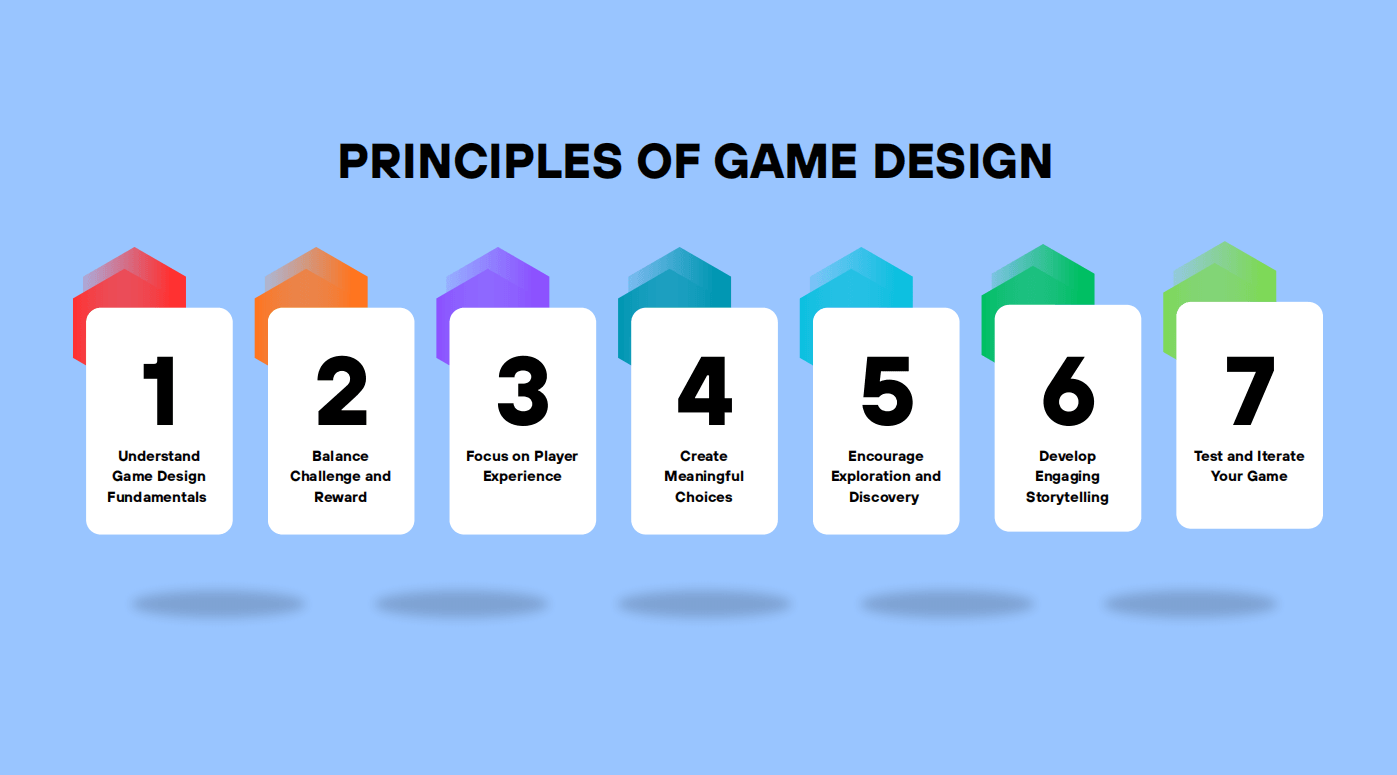
1. Understand Game Design Fundamentals
Before you jump into advanced game development areas, it’s your duty as a game designer to master the fundamentals. Why? These are the building blocks that determine how a game functions at its core. In fact, ignoring them often results in confusing or inconsistent gameplay. At a minimum, strong game design is built on a clear foundation of rules, systems, and player interactions. In short, players should always understand what they can do, what the goal is, and how outcomes are determined.
For example, the classic Nintendo game Super Mario Bros has literally simple mechanics: run, jump, avoid enemies, and reach the flag. That’s it. But why is it that these mechanics create increasingly complex gameplay? Well, the game teaches players everything. Goombas introduce danger, blocks introduce reward, and level layout teaches timing.
Practical tips:
- Define your core mechanic (e.g., explore and upgrade to power up and beat bosses).
- Build depth instead of adding random features.
- Allow players to learn through interaction, not just lengthy tutorials.
2. Balance Challenge and Reward
One of the most vital elements of the 7 principles of game design is achieving the right balance between difficulty and reward. In other words, your game should sit right in the middle of too easy and too hard. Otherwise, you’ll end up boring or frustrating players. And neither of these two means success. In fact, research revealed that game difficulty should achieve the concept of flow, where players are fully immersed in the experience. And one effective way to do so is to carefully balance challenge and reward, ensuring that tasks align with players’ current skills.
To illustrate, both fans and critics largely agree that the game Dark Souls is defined by its difficulty. But it works because it avoids unfairness and reliance on luck. Its real strength is balance: delivering challenges that players can overcome by observing enemy patterns, victories that feel earned, and opportunities to develop skills.
Practical tips:
- Introduce mechanics gradually, rather than overwhelming players in one go.
- Provide clear feedback to let players understand why they won or lost.
- Combine fixed rewards and variable rewards with the right pacing.
3. Focus on Player Experience
Game design is not just about the game itself or the systems. It’s also about how players feel while interacting with the game or those systems. Instead of thinking about building what you think is awesome, focus on creating something that players would actually enjoy. After all, you’re making games for them and not for personal consumption (at least for the most part). So, when designing, the goal should be to maintain game flow. You can do it by implementing a simple user interface that makes controls and other elements accessible to a player in a seamless way that doesn’t interrupt immersion.
Nintendo is widely regarded as one of the companies that prioritize player experience. For instance, their game The Legend of Zelda: Breath of the Wild allows players to explore the world in any order, giving them a sense of freedom and ownership.
Practical tips:
- Optimize your game for different devices or platforms.
- Ensure controls are intuitive and responsive.
- Offer direction and objectives without restricting choice.
4. Create Meaningful Choices
Another essential in the 7 principles of game design is allowing players to make choices that affect their journey in the game. And don’t mistake this for just giving them the illusion of choice. Players, especially modern gamers, are smart. They can easily tell when their decisions don’t actually impact outcomes. And that often reduces engagement. However, keep in mind that strong game design entails choices that have clear consequences that influence gameplay, strategy, or narrative.
One game that embodies this is The Witcher 3: Wild Hunt. It lets players make meaningful choices by offering quests with unclear good or bad outcomes. Instead, choices lead to consequences that unfold later in the game. Such a design creates investment, as players feel like they are actually shaping the game world.
Practical tips:
- Add mechanics that make players active decision-makers instead of passive participants.
- Ensure choices actually affect the game’s direction.
- Introduce trade-offs for every decision.
5. Encourage Exploration and Discovery
Studies show that curiosity is a powerful driver of engagement. And what better way to tap into this than by allowing players to explore and discover things on their own? Sure, having structured objectives is essential for players to get a sense of direction. But offering optional exploration can boost engagement by giving them a sense of agency. It’s one of the key elements of game design. To put it simply, incorporating discovery turns any gameplay into an experience rather than a checklist they need to complete.
One very famous title that excels at this is Grand Theft Auto (GTA). You have assigned missions, but you are free to go around a massive, interactive open world. It is what made knocking someone out, stealing a car, flying an aircraft, some of the iconic moments in the history of video games.
Practical tips:
- Integrate optional challenges with rewards.
- Place rewards off the main path that reveal hidden areas or secrets.
- Guide players with visual design, not just instructions
6. Develop Engaging Storytelling
Among the 7 principles of game design, one that stands out in making a game more meaningful is narrative. Nothing would make sense without it. But you should also be mindful that storytelling comes in different forms. On the surface, a way to make this happen is to add dialogue or cutscenes. But to take it a step further, you can also tell a story through the game world, mechanics, and player actions that convey meaning. Narrative engagement can make repetitive tasks feel purposeful and exciting.
This characteristic is the primary reason why The Last of Us works and is enjoyed by many. The relationship between the protagonists evolves not just through cutscenes but also through the actual gameplay (e.g., gathering resources and surviving together). It demonstrates how storytelling and gameplay can work together.
Practical tips:
- Keep every mechanic or the overall gameplay aligned with the narrative.
- Reveal the story gradually rather than disclosing the entire exposition.
7. Test and Iterate Your Game
No game design is perfect on the first attempt. If there is, it’s probably the closest thing you can get to a miracle. Here’s the thing: interview findings suggest that game developers see iteration as an integral part of game creation. Clearly, testing reveals issues and problems that signal the need for refinement before launching anything to the public. It’s basically what turns good ideas into great, polished experiences.
For instance, Baldur’s Gate went through a serious process of iteration. Director Swen Vincke directly stated that testing and refinement were a big part of the game’s development pipeline. In fact, he said that the early builds looked nothing like what players got to play. That means successful studios use iterative design cycles to improve a game. So, don’t expect to have it all early on.
Practical tips:
- Observe how actual players react and respond to your game.
- Try different versions of a feature.
- Ensure a design grows with the players.
Final Thoughts: Design Beyond the Game
At this point, it’s settled that the 7 principles of game design are not abstract ideas. They are not a figment of a designer’s imagination. They actually exist. But they are not rigid rules.
More importantly, there is no reason to skip them. Even major studios like Nintendo, Rockstar, and Valve take these principles seriously, consistently shaping games at a high level. That means applying every principle thoughtfully, from learning the basics to relentless iteration, ultimately elevates game design. It’s what made games like Baldur’s Gate 3 among the most-played on Steam and earned around $260 million in PC sales.
Hence, if you are serious about game design, it’s important that you treat them as guiding frameworks or a design mindset that helps create experiences players enjoy and remember.

