
What are educational game design principles and how do they shape effective learning experiences?
Gone are the days when passive lectures could capture students’ attention and help them absorb the lessons. Today, this traditional method is no longer enough on its own. Modern learners want to be active participants. They want to learn by doing rather than just receiving information.
Educational games are one effective solution. They are now a growing part of modern learning ecosystems used in schools, training programs, and digital platforms worldwide. In fact, research shows that game-based learning increases emotional involvement, enjoyment, and motivation. From language learning titles like Wordscapes to simulations like Universe Sandbox, games are being used to teach in ways that traditional methods often struggle to match.
Central to this shift are educational game design principles that guide the integration of learning content into games without disrupting either engagement or gameplay. They effectively align with the learning preferences — doing, experimenting, failing, and improving. Given this, making sense of these principles is essential for those who want to create meaningful game-based learning experiences.
With that said, this article will introduce educational game design and get into the details of all educational game design principles to see how one can create games that do not separate learning time from playing time.
Understanding Educational Game Design

Educational game design sits at the intersection of pedagogy and interactive entertainment. It is a multidisciplinary practice of building games that do not treat learning as just an “add-on.” It embeds it into the core mechanics, systems, and player experience. As a result, the created games tap into the motivation brought by gameplay and direct it toward learning goals. In other words, the mindset is that players should learn from how the game is played, not in spite of it.
Unlike traditional educational tools, these games rely on interaction loops (i.e., decision, feedback, consequence, adaptation) to reinforce learning. In more detail, they build factual knowledge, develop problem-solving abilities, and even shape behavior. It’s why educational games are often used for childhood education, corporate training, finance, health, STEM, and self-directed learning.
For instance, Minecraft Education allows students to explore concepts in chemistry and coding. The game also introduces collaborative, structured learning. This example makes it clear that educational game design is not just about turning lessons into games. It is about transforming learning systems into interactive experiences.
Exploring Educational Game Design Principles
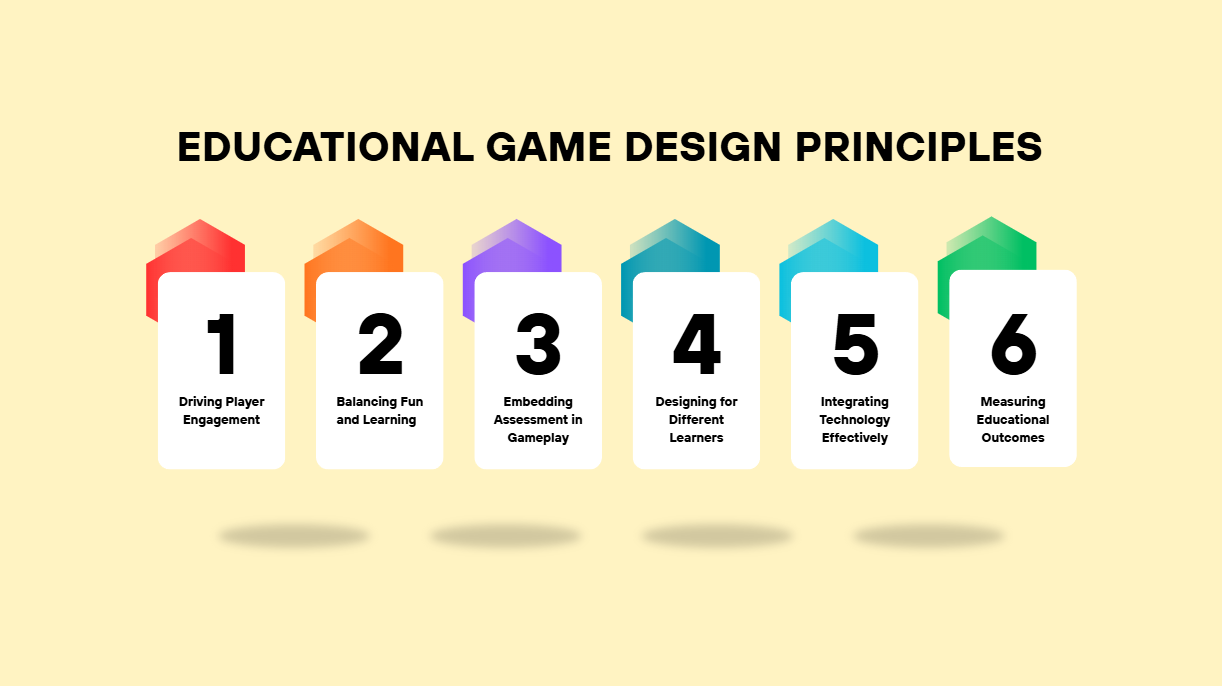
It’s important to understand that educational game design principles are not fixed rules. They should be viewed as guides or design anchors that ensure learning and gameplay strengthen each other.
Here are the common key principles that shape most educational games:
Driving Player Engagement
Engagement is the engine of any educational game. The truth is, learning cannot happen meaningfully without sustained attention. Studies back this up, stating that learners’ attention spans have been decreasing, and that employing methods to improve engagement is key.
Modern educational games achieve engagement through layered systems:
- Short-term rewards (points or unlocks) and long-term progression (levels)
- Narrative context (story-driven motivation)
- Social interaction (leaderboards or multiplayer features)
- Challenge curves (increasing game difficulty)
- Player Agency (allowing learners to be in control of the journey)
One strong example is Kerbal Space Program. Traditional physics lessons would be through lectures and tests. In this game, students learn orbital physics through experimentation. By challenging players to launch and manage spacecraft, they become motivated to understand physics concepts.
Balancing Fun and Learning
One of the most vital educational game design principles is balancing entertainment with instructional value. Without balance, a game can be rigid, like a digital worksheet, or too focused on fun, leaving learning almost nonexistent. The best educational games ensure that playing well and learning well are the same action.
Effective design solves this by:
- Merging both elements into the same mechanics (math problems become part of a puzzle system)
- Finding the middle ground where the game is neither too easy nor too hard
- Offering analytical thinking and decision-making choices that shape learning objectives
The Oregon Trail is one reference that shows learning is not separate. Here, players make survival decisions that require an understanding of historical constraints such as resources, travel conditions, and weather.
Embedding Assessment in Gameplay
Traditional education separates learning and testing. Meanwhile, educational games integrate assessment directly and seamlessly into gameplay. Simply put, a well-designed system shows learners their improvement through how well they play the game.
This principle makes assessment a continuous feedback, where players are evaluated through:
- In-game performance metrics
- Behavioral tracking (accuracy, choices, timing)
- Milestone-based achievements
For example, a language app like Duolingo uses adaptive learning. It constantly adjusts difficulty based on user performance, automatically reinforcing weak areas.
Designing for Different Learners
A robust framework of educational game design principles accounts for learner diversity. Players differ in age, cognitive ability, prior knowledge, and learning style. So, it’s a must that games accommodate all levels of learners, including those who require additional support.
To address this, designers use:
- Various modalities (sharing information through auditory, kinesthetic, or visual channels)
- Optional hint structures
- Accessibility features (customizable text size, language localization, and controls)
Prodigy Math Game does this efficiently by teaching standards-aligned skills in Math through a fantasy game and adapts math problems based on a student’s skill level.
Integrating Technology Effectively
Technology is not just the foundation of educational game design. Actually, it’s the enabler. Modern educational game design principles use technology to enhance interactivity and scalability, not just for novelty.
Key technological integrations include:
- Artificial Intelligence for adaptive learning paths
- Augmented and virtual reality for immersive environments
- Cloud-based systems for multiplayer learning
This can be seen in Kahoot! It transforms traditional quizzes into fast-paced, competitive learning sessions. By leveraging modern technology, moderators can see responses, adjust instruction, and support concepts through gamified processes.
Measuring Educational Outcomes
Closing the list of educational game design principles is evaluating whether learning actually happened. These types of games should be able to determine whether players really improved in a particular subject.
Checking the effectiveness of the games calls for measurement techniques, such as:
- Pre and post-game assessments
- Retention testing over time
- Classroom performance comparison
Games like DragonBox allow players to successfully transfer in-game skills to formal math tasks. It shows that the game enables real learning outcomes.
Final Thoughts: Gaming and Learning as One
Educational game design offers a modern approach to creating new learning experiences for students in today’s digital world. With new technology and emerging trends in game design, game-based learning will also continue to evolve. In fact, the educational games market size is expected to jump to over $50 billion by 2033. But despite the evolution, the foundation will remain consistent: educational game design principles focus on integrating learning seamlessly into interactive systems.
However, success ultimately depends on how these principles are applied. Not getting caught up in the game aspects is crucial. Learning outcomes must also remain in focus. Otherwise, the game would fail to deliver the true purpose of educational game design, which is to make learning possible through the game itself.

