From our previous comprehensive guides that delved into card game design, board game design, mobile game design, educational game design, and retro video game design, you probably think we have covered everything. But no. There’s actually a lot more to explore in this area of game creation. One of the most technically demanding genres remains unexplored in our series: fighting game design.
There’s a reason why fighting games like Street Fighter and Mortal Kombat have big-budget movie adaptations. It’s because producers and filmmakers know they have a huge following and are easily bankable. And that says a lot about how successful the video game versions are. From receiving compelling ratings on Metacritic to becoming household names in the gaming world, fighting games have come a long way since Sega’s Heavyweight Champ in 1976. In fact, records show that the market size of the global fighting games has already crossed the billion mark.
However, none of these would be possible without one of the most demanding disciplines in game development — fighting game design. A fighting game can look spectacular and still fail within weeks of release. Why? Because players may initially praise the visuals, character roster, or cinematic supers. However, they will immediately move on once they figure out that combat lacks depth or responsiveness.
And even with technological advancements, the foundation of successful fighting game design remains remarkably consistent. Therefore, if you’re planning to create your own video game under this genre, understanding those systems reveals why some fighting games remain influential for decades, and why others disappeared shortly after launch, or why they failed so hard that you didn’t even know about them.
This article introduces fighting game design and explores the principles that underpin a successful fighting game with dynamic combat systems.
Introduction to Fighting Game Design
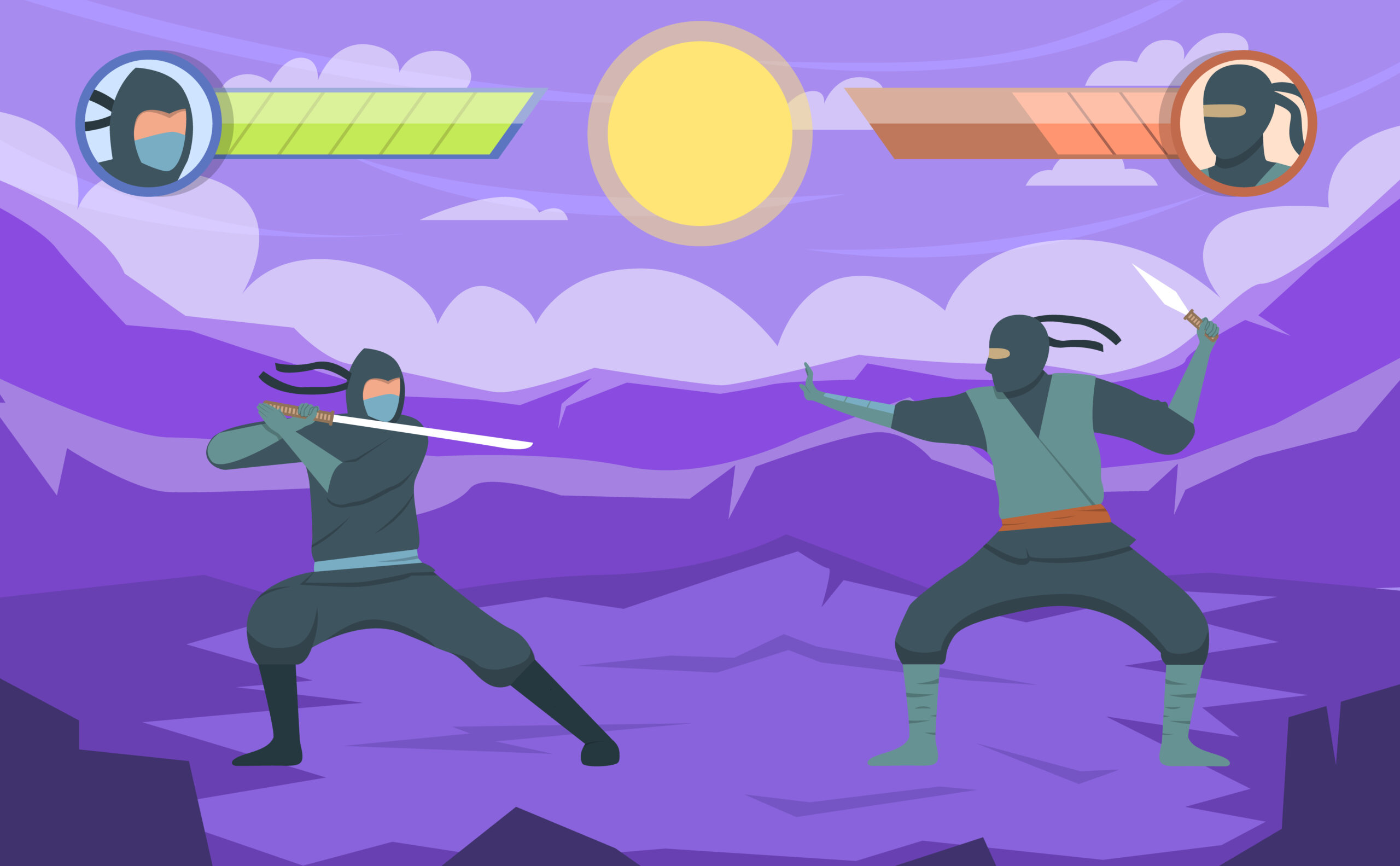
Fighting games really don’t need an introduction. But for the benefit of those unfamiliar, a fighting game is a type of video game in which players control a character and engage in close-range battles. Typically, the objective of the game is to win the most time-limited rounds by performing inputs that quickly diminish the opponent’s health.
Speaking of definition, fighting game design refers to the process of creating competitive systems that govern player-versus-player or player-versus-environment combat experiences.
In general, fighting games are popular for their diverse characters with unique abilities and striking visual spectacle. But the most memorable moments in fighting games rarely come from flashy cutscenes or scripted events. They come from split-second decisions. A perfectly timed parry in Street Fighter. A clutch rage drive in Tekken. Or a high-risk combo extension in Guilty Gear Strive. It’s the things that can show all-out dominance or turn a losing round into a comeback. And it’s important to know these moments are the outcome of deliberate fighting game design decisions that shape how players attack, defend, move, predict, and respond under pressure.
Particularly in the fighting games market, studios such as Namco, Capcom, Arc System Works, and many others have spent a long time refining the foundations of fighting game design. In detail, some use iconic characters to boost engagement, others emphasize technical and storytelling innovation, and others focus on intricate combat systems, authentic fighting experience, and quality competitive play. Because, unlike other game genres that can hide weak systems underneath the spectacle, fighting games expose every design flaw instantly. Issues like sluggish movements, inconsistent hitboxes, and the like can quickly disengage players. In other words, effective and efficient fighting game design is an absolute must, as every part shapes the player experience.
Key Principles of Fighting Game Design
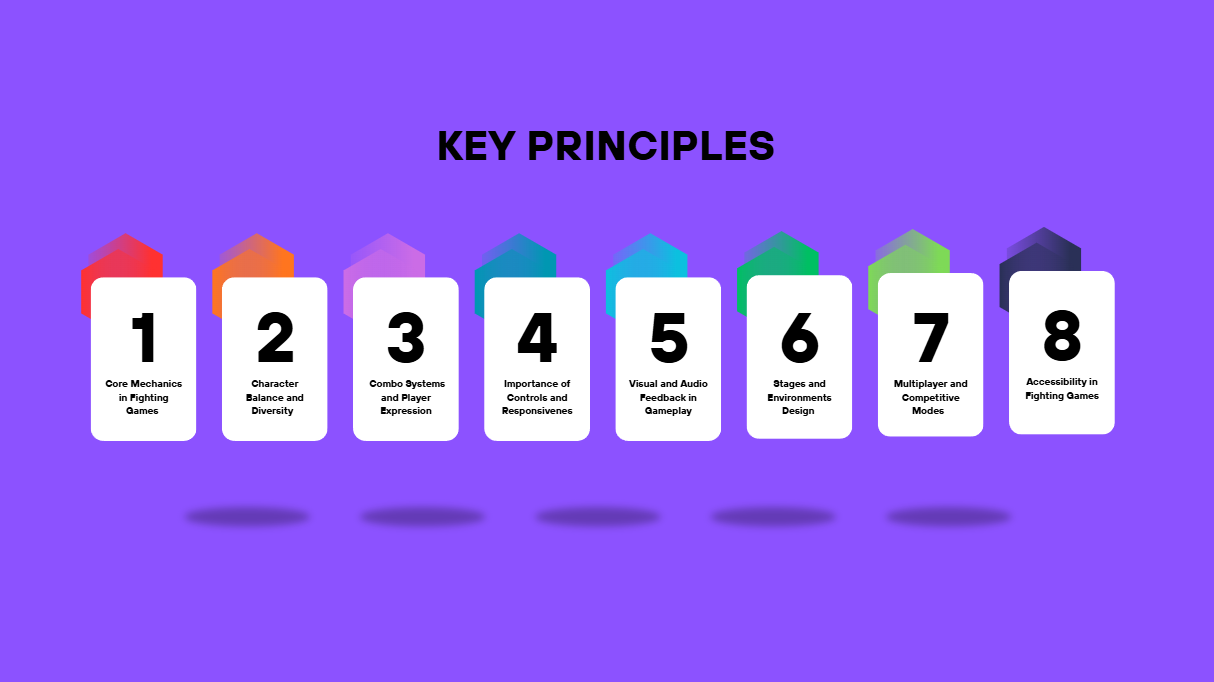
Ever wondered what made dynamic combat systems possible? You’ll be surprised that it takes more than adding punches, kicks, and special moves. It actually involves several principles that sustain long-term engagement. That said, here are the key principles that explain why certain titles continue to thrive years after their release.
Core Mechanics in Fighting Games
Every successful fighting game has core mechanics that are built around interconnected systems that define every interaction during a match. In particular, these systems determine player movement, offense, defense, timing, and resource management. So, if the mechanics lack clarity or consistency, even visually impressive games quickly become frustrating.
Usually, movement is the first system that players evaluate. In Tekken 8, sidestepping creates a three-dimensional layer of positioning that changes how attacks connect. Street Fighter 6, by contrast, allows walking, dashing, and jumping arcs to emphasize grounded footsies, spacing, and controlled movement. Both movement systems create a completely different competitive rhythm.
Offense and defense design are equally important. These are conceptually the primary ways to achieve victory. Good fighting games establish a clear distinction between fast attacks, heavy attacks, anti-air tools, grabs, and special moves. These options create a strategic loop where players constantly weigh risk against reward. For instance, players build percentage damage in Super Smash Bros. to increase knockback and secure ring outs. However, most attacks also entail costs and risks. This is where defending or blocking becomes crucial. Players can use this to lure opponents into conditions where counterattacks are possible. This allows players to punish unsafe moves or turn defense into offense with the right timing.
Resource systems add another strategic layer. Super meters, drive gauges, burst mechanics, and rage systems force players to make informed decisions under pressure. And this emphasizes strategy. Should a player use a special move for guaranteed damage now or save it for defensive escape options later? These instances make games more engaging by creating tension beyond simple health points.
More importantly, strong mechanics don’t necessarily have to be complex. Divekick showed this best. It didn’t go beyond two buttons, but it still demonstrated deep competitive play and appealed to many player types using a simplified but balanced control scheme. Depth comes from meaningful interaction, not mechanical overload.
Character Balance and Diversity
Another key principle of fighting game design, which defines the strengths of fighting games, is character variety. Oftentimes, players form a long-term emotional attachment to specific fighters. It’s why certain players always want to play as Ryu, Ken, or Guile. For that reason, it’s important for you to ensure there is a diverse character roster. Keep in mind that players must find characters that gel with them both aesthetically and functionally. A choice they can relate to.
In doing so, defining the character’s basic attributes helps. Is the character a human or not? Is it thin or muscular? Is it a woman or a man? And so on and so forth. From there, it’s important to give characters a personality or a gameplay style that matches their visuals. For example, if you’re making a professional boxer, the character needs moves that show training. Likewise, if you are designing a robot character, it’s expected to have more rigid but solid motions.
However, character diversity is rarely enough on its own. They must also feel unique and powerful without becoming unfair. Archetypes are common in fighting games because they help establish playstyle differences. Street Fighter’s grapplers like Zangief dominate at close range. Meanwhile, Skullgirls’ zoners such as Peacock control the pace. But the challenge lies in designing character archetypes that remain viable across competitive play. That’s why balance patches have become a major component of modern fighting game creation. Even major AAA games do this, as seen in the recent Street Fighter 6 patch notes, which included adjustments to the entire roster.
To achieve true character balance and diversity, ensure that strengths are offset by meaningful weaknesses. Like a high-damage fighter struggling with low health. Such asymmetry creates strategic diversity while preserving fairness.
Combo Systems and Player Expression
From Ryu’s shoryuken and Jin Kazama’s electric wind god fist to Sub-Zero’s ice clone freeze and Goku’s meteor combination, chances are, these are some of the factors that made fighting games memorable. It’s because these combo systems are one of the clearest forms of player expression. They transform successful hits into creative opportunities rather than isolated attacks.
In line with this, different combo philosophies dramatically affect gameplay pacing. Hype and skill execution are possible with long combos. But if defensive players take a long time to respond, this also risks reducing player interaction. On the other hand, shorter combos maintain faster match flow but somehow prevent players from being creative in combining attacks.
Hence, modern fighting game design often uses systems that balance freedom with structure. This technique allows designers to incorporate mechanics that preserve the thrill of offense while limiting frustration. You can do this by employing combo scaling to reduce damage during extended sequences. It prevents nonstop or unfair combos. In the same way, adding burst systems helps trapped players escape pressure, just as in Guilty Gear and BlazBlue.
In reality, many casual gamers activate these combo systems just by spamming buttons (it works, but it’s not ideal). Meanwhile, experienced players can string together basic movements and special attacks to pull off combos, including extended ones. And that entails ensuring that the best combo systems reward mastery without becoming repetitive. In the 2011 installment of Marvel vs. Capcom, long aerial combos and assist extensions create spectacular offensive sequences. In contrast, SNK’s Samurai Shodown puts emphasis on tension and high-damage strikes by adding intentional limits on combos.
Importance of Controls and Responsiveness
Almost every game genre requires responsiveness. But fighting games (arguably) need it the most. Why so? Well, a delay of even a few frames can disrupt timing, punish windows, and defensive strategies. It’s annoying and frustrating all at once, much like watching a movie that buffers every two seconds. That makes responsive controls the single most important technical element in fighting game design.
However, responsiveness is not just about low input lag. It encompasses so much more, including buffering, animation cancel windows, rollback netcode behavior, and how consistently the game translates the player’s intention into on-screen action. Put simply, responsiveness is the time it takes to show feedback after pressing a button.
While not traditionally classified as a fighting game, Bloodborne shares similar combat concepts that make it a good representation of responsive controls. To give an example, when pressing a button in the game, you’ll notice that the actual hit takes around a fraction of a second to take effect. However, it does not exactly constitute unresponsiveness, since the windup animation begins immediately after a button is pressed. That subtle body coil or step forward signals that a move is about to occur. This visualization of anticipation tells a player that there is feedback.
This example shows that playing a fighting game requires skill and knowledge of the game. That means inputs feel immediate, but execution requires intentional timing rather than button-smashing. And when players feel that every input is trusted by the game, they engage more deeply with its systems.
Visual and Audio Feedback in Gameplay
Combat readability is essential, especially in fast-paced fighting games. In here, players constantly process attacks, movements, resources, spacing, and timing under intense pressure. This condition makes visual and audio feedback crucial in communicating all information instantly. Without it, even well-balanced mechanics can feel disconnected.
A key design principle here is “readability before spectacle.” Although spectacular moments give player actions a sense of scale, making special moves feel more rewarding and, by extension, making the game cooler. However, effective fighting game design goes beyond impact effects. More than the cinematic looks, you must ensure that the effects never obscure hitboxes or character positioning. Poor readability can lead to misjudged spacing, missed punishes, and frustration in competitive play. Color contrast, motion-blur, and camera framing must all work together to ensure clarity.
Real Boxing 2 captured this. When a power punch is delivered during a bout, the game goes into slow motion, pulls the camera in tight, and slaps massive, stylized flash frames onto the screen. On the surface, this appears as a mere spectacle. But beneath, it serves a mechanical purpose. It gives the attacking players an enormous window of time to visually recognize the states and what follow-ups they can do, providing unmatched readability.
Sound design also carries mechanical weight. In games like Tekken 8, different types of attacks have distinct audio signatures. Light jabs, heavy strikes, and armor breaks all produce unique cues. It then allows players to subconsciously use these to react faster than visual recognition alone would allow.
Stages and Environments Design
For the most part, characters and mechanics carry fighting games. But in reality, stage and environment design can also influence pacing, strategy, and competitive balance, even though they are often underestimated. When creating this, ensure that they’re both visually appealing and mechanically functional.
In many ways, environmental design helps enhance overall gameplay. Audio environment design, such as crowd reactions, echo effects, and ambiance, helps reinforce match intensity without distracting from core gameplay. In the same way, a poorly lit stage can make animations, especially low attacks or fast overheads, seem unclear. One way to avoid such a problem is to test the stages extensively to remove any visual interference during high-speed exchanges. These pull players into the game world through proper lighting, atmosphere, and setting, thereby stimulating emotions and delivering an immersive experience.
At the same time, stage and environment design, along with game mechanics, shape how players fight, move, and strategize. Tekken 8 does this by integrating boundaries, wall breaks, and floor transitions that directly affect combo routes and positioning. As a result, an additional strategic layer appears that requires players to consider stage geometry when making decisions.
Just like in real-world boxing, the pressure of the corner exists in fighting games. Although players don’t have coaches yelling at them to get out of the corner or stay away from the ropes, wall mechanics also lead to dangerous situations. During these scenarios, players lose escape routes and are forced to take extended combo damage. Then, the corner advantage pops up, shifting the game from neutral play.
Multiplayer and Competitive Modes
One more vital principle of fighting game design is multiplayer and head-to-head versus modes. Why? This principle is the defining attribute of a fighting game’s identity and foundation. The genre was literally built around one-on-one human competition, dating back to the early arcade era.
However, technological advancements became a double-edged sword for modern fighting games. It allowed games to have polished combat systems, but with weak online functionality that can rapidly shrink a player base. As a result, many succeed or fail largely based on their multiplayer ecosystems.
By modern standards, delay-based netcode is no longer the superior method for improving online stability. Designers and developers have switched to rollback netcode. Games like Guilty Gear Strive demonstrated how effective rollback is. Instead of waiting for inputs to travel across the network, rollback systems predict actions and correct mismatches after the fact. However, this can also mean more work for creators. So, if you’re planning to adopt this, make sure to get it hooked up early to avoid tedious overhauls to get rollback working after the game is launched to the public.
Also, ranked systems play a major role in retention. Poor matchmaking leads to frustration for beginners and boredom for experienced players. A player with a high rank wants to test his skills against a player at the same level, and no beginner would willingly go against a much more skilled opponent. Therefore, a well-designed ranking system must reflect skill accurately while allowing progression to feel meaningful.
Ultimately, multiplayer design determines longevity. Remember that a fighting game is meant to sustain repeated interactions, not just support a one-time experience.
Accessibility in Fighting Games
For decades, fighting games struggled with accessibility problems. Intricate inputs, limited tutorials, and punishing skill gaps discouraged many new players. Unfortunately, the techniques used in classic titles like Super Mario Bros. are not exactly applicable to modern games, which now feature more complex gameplay. Nonetheless, you don’t have to deal with limited cartridge storage or other technical constraints.
That’s why modern game creators are increasingly addressing these issues through smarter onboarding systems and inclusive design philosophies.
The introduction of structured learning paths is a major shift in modern fighting game design. Nowadays, players don’t need to master the mechanics up front. In the latest edition of Street Fighter, concepts like spacing, punishing, and anti-airs are gradually introduced through guided tutorials and mission-based training.
Granblue Fantasy Versus: Rising also presented another innovation: simplified input systems. In the game, players can launch a special move just by using a single button. However, the game compensates for it by adjusting damage scaling or limiting certain options. For high-level players, this becomes a tactical choice. Ultimately, this ensures accessibility does not remove competitive depth.
If you want to further improve accessibility, allowing players to tune visuals would help. The game will become more inclusive while maintaining gameplay integrity through features such as colorblind modes, reduced screen shake options, and customizable HUD elements.
All in all, accessibility is about lowering entry barriers. The best-designed systems let beginners instantly be part of the experience but still offer deep mastery paths for advanced players.
Final Thoughts: The Arena Remembers the Best
Games that are globally recognized and that endure for decades rarely succeed just because of graphics or brand popularity. In fact, even big AAA games can fall apart without this. Such a tragedy happened with Marvel Vs. Capcom Infinite. Reports revealed that it fell short of its projected sales and received mixed reviews on gaming platforms like Steam.
That’s what makes fighting game design essential. With it, every movement, counterattack, combo, and defensive decision represents a form of communication shaped by design systems. The best fighting games employ effective fighting game design to build competitive ecosystems where precision, psychology, creativity, and balance coexist in real time. Street Fighter stood the test of time because its mechanics reward spacing and adaptation. In the same vein, Tekken thrives because it offers depth of movement and match-up complexity.
The core concept of fighting games is simple — be the first one to land enough hits to win the round. In the end, it all comes down to the meaningful decisions players can make in a matter of seconds and how satisfying those decisions feel when everything clicks.

