Home Blog Page 12

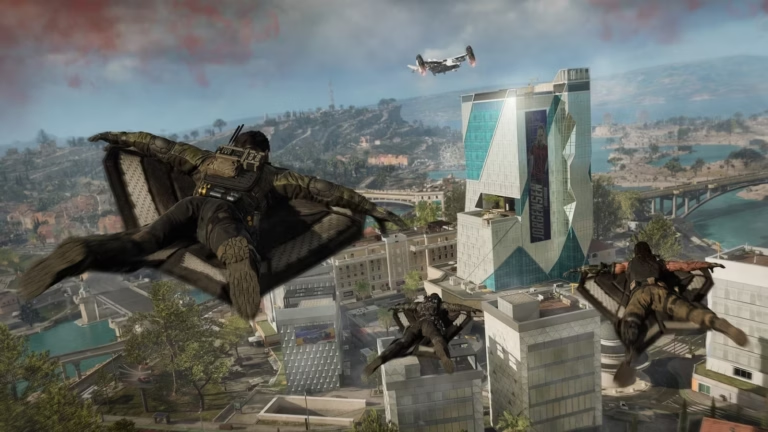
How to Get Better at CODM

0

For years, I’ve had that love-hate relationship with Call of Duty Mobile. It’s the kind of game that I play every single day, get bored with it, but still come back weeks or months after. If you’re a new player who’s struggling at getting more kills or winning more matches, or a veteran who’s been settling for 1/9/0 KDAs, I’ve been there too. But getting better at CODM isn’t just about having fast reflexes or fancy skins. You literally need to understand how the game works and learn how to play smarter. You can have the best gun in the game, but you can still lose if you don’t know how to use it to your advantage.

Now that I can confidently say I’m good at CODM, I wanted to share some tips that I wish I had known when I was still starting. And yes, it starts with having a fast wireless service at home because trust me, lag will frustrate you so much if you play with slow WiFi. Here’s what you need to know if you want to get better at CODM:

Learn to pre-aim corners before you see enemies,

I used to get eliminated first because I react too late. I’d run into a room, see someone, then panic and try to aim. What helped me improve was learning to pre-aim corners. Before I even turn, I already aim my crosshair where I expect someone to pop up. Now, this needs map awareness, so it will take some time to master, but once you do, everything will be easier.

Stop sprinting into every fight.

Back then, I treated CODM like a race. I’d sprint around the map nonstop because I wanted to get to the fight faster, and I’d end up dying faster, too. I won’t lie when I say that sometimes, it works. Sometimes. I’ve tried this play style via my cell phone service before, even when I know the signal is spotty. I’d rush into fights even when my teammates say hold, then my game would lag. By the time my screen caught up, I was already down.

Now, I’ve made it a habit to slow down before turning corners or entering tight spaces. I keep my gun up, ready to shoot, just in case there’s an enemy camping. And if I know that I’m lagging, I would hide first and try to fix my connection.

Use the training room as much as you need.

I used to think the training room was boring (well, it really is at times, not gonna lie), but over time, I started appreciating it because I needed to work on my aim and reaction time. Instead of just shooting targets, I started practicing my slides, jumps, and strafes while shooting. You can try doing that if you need to improve your CODM skills in general, as the training room is there for a reason.

Customize your HUD.

This is a common mistake newbies make. Although the default HUD works, it’s still better to customize your HUD because we all have different comfort levels and play styles. When I was new to CODM, I didn’t bother touching the settings. But when I saw one streamer having a different HUD, I got inspired, and when I tried, it was a trial-and-error, but it was one of the best things I did for myself.

Once I finally took the time to move a few buttons around, the difference was night and day. That, combined with a fast internet connection from a reliable internet provider, is just heaven. It might take some time at first, but it’s so worth it.

Stop chasing kills and start focusing on the game’s objective.

In CODM, there are different game modes. In every game mode, there’s a different objective. I understand that at first, you have this urge to kill more instead of focusing on the game’s objective because it boosts your confidence, but it’s not always about the kills. I used to be that player, but now that I focus on objectives, I notice that my points were so much better, and I’m also helping my team win.

Improve Your CODM Gameplay with These Tips

Being better at CODM does not happen overnight. It will require time and patience, and most importantly, hard work. If you keep getting eliminated early in the game, practice until you can keep up with other players. Also, when you play ranked and start from the lowest tier, you’ll likely be matched with bots to improve your gameplay. Good luck, and I hope we meet in-game in the future!

How Much Does It Cost to Make a Video Game? Full Breakdown

0

Video game development has grown into a multi-billion-dollar industry, with statistics showing a video game market industry value of $292.4 billion in 2025. It continues to attract and inspire players, investors, and aspiring developers alike. However, regardless of what segment they come from, one question consistently arises: How much does it cost to make a video game? The answer is far from simple, as the budget needed to make one varies dramatically, from small indie titles like Hollow Knight or Undertale to blockbuster AAA franchises such as Grand Theft Auto V or Destiny.

Since costs can range from a few thousand dollars to hundreds of millions, understanding game development budgets is crucial for developers. Whether they are planning projects or just curious about why games cost what they do, learning about the reasons is helpful. This article breaks down the main cost drivers, highlights examples and case studies of game budgets, and provides insights into funding and cost-reduction strategies.

Why Are Video Games So Expensive to Make?

Over the past decade, the cost of game development has skyrocketed. In 2009, Call of Duty: Modern Warfare 2 made headlines for having a $50 million development budget with an additional $200 million for marketing. It placed the first-person shooter video game as the highest-budget game in the world at that time.

Today, modern AAA games spend more. For instance, Rockstar Games’ “Grand Theft Auto V” exceeded $265 million. The figure is rooted in production costs and vast marketing campaigns. Similarly, Bungie and Activision’s Destiny had an estimated budget of roughly $500 million, covering development and marketing.

In particular, costs increase because games now demand the following:

  • Advanced software and AI tools for realistic graphics and immersive gameplay
  • Cross-platform game development for PC, consoles, and mobile
  • Procedural-level design and complex game mechanics
  • Rigorous testing using testing automation

Key Factors Influencing Game Development Costs

Image designed by Freepik

The astronomical figures showcase the massive development budgets required for AAA titles. It turns out that creating a game—whether a simple mobile app or a sprawling open-world adventure—can be a costly endeavor.. That is because games require dedicated teams of professionals and involve critical processes that incur additional expenses to accomplish.

Game Type and Scope

The type of game is a primary factor. Indie games like Hades and Celeste are small in scope. Most of the time, they are developed by solo developers or small teams. On the other hand, AA or mid-tier games have larger teams and modest budgets. Meanwhile, AAA games involve hundreds of employees and extensive resources.

Several key factors influence the total cost of game development:

Team Size and Talent Acquisition

Staff wages and talent acquisition costs are substantial. AAA studios hire hundreds of professionals, including programmers, animators, game designers, narrative designers, game testers, game producers, and sound engineers, among others. In detail, the average annual salary of game developers in the United States is around $91,000. It is also the reason why many indie studios prefer outsourcing or using revenue-share models to reduce upfront salaries.

Art, Design, and Technology Requirements

High-quality art and animation, realistic physics, and sound design are major cost drivers. Advanced tools such as procedural level design and pipeline automation. Software also contributes significantly to budgets. Using off-the-shelf game engines like Unity or free options like Godot can save costs. However, AAA studios frequently require custom tools or advanced AI tools for content creation.

Testing and Quality Assurance

QA is essential to deliver a polished game. It is the reason why many studios rely on testing automation, beta programs, and community feedback. These are crucial stages where they can identify areas that need fixing and improvement. Poor QA can damage a game’s reputation.

Marketing and Distribution

As seen in earlier figures, promotional budgets often match development costs. Most games encompass public relations campaigns, trade shows, game trailers, digital storefront fees, packaging for physical copies, and more.

In fact, even indie developers spend on marketing, often using crowdfunding campaigns or grassroots social media strategies.

Legal, IP, and Administrative Costs

Costs include intellectual property rights, licensing, legal counsel, and administrative overhead. Failure to secure these can result in lawsuits or lost revenue sooner or later.

Platform Fees and Ongoing Support

Depending on the platform, fees typically range from 10% to 30% of a game’s total profit. This actually takes a huge chunk off the sales, adding to how much it costs to make a video game. Aside from profit sharing, Indie titles also account for registration fees when distributing on platforms like Apple Store, Google Play Store, and Steam.

At the same time, there are recurring expenses related to post-launch support. Resolving bugs, dropping DLCs, and improving gameplay through patches are essential for player retention.

Additional Costs

In addition to the primary expenses, some of the overlooked costs include:

  • Localization for international markets
  • Network infrastructure and API request charges
  • Insurance and workspace costs

The bottom-line is that it realistically will cost a game studio, even a small one, thousands of dollars to market a game.

Game Cost Calculator

The game cost calculator allows you to plug in some pertinent info regarding your game, development team, etc. You could specify that you’re merely updating a game or starting from scratch.

There are other aspects to choose from, like how long your project is estimated to take and what your team will excel in. It’s only five questions, and it can give you an imaginative picture of what game development might look like to you.

In the end, they send you a ballpark figure of what a game and all its nuances might cost.

Setting Up A Gaming Company: Cost

Unfortunately, it isn’t just declaring that you have a game company. Those who want to create their own game company need to consult lawyers, get trademarked and other applicable practices, hire people, and make sure you have great software.

This could cost the game studio a hefty sum from a conservative standpoint and show you just how much even a small game studio could cost you.

Final Thoughts and Advice for Video Game Developers

Making a game is both a creative and financial challenge. Understanding how much it costs to make a video game is as important as the game itself. Whether you are building an indie hit or an AAA blockbuster, careful budgeting, efficient use of modern tools and resources, and employment of cost reduction strategies can make the difference between success and financial strain.

Frequently Asked Questions

Q: What is the most expensive part of game development?

A: Salaries, marketing, and advanced technology requirements are typically the largest contributors to costs.

Q: How can indie developers reduce costs?

A: As proven by many creators before, using open-source software, outsourcing, crowdfunding, and small teams can help.

Q: Do platform fees significantly impact budgets?

A: Yes, such factors must be factored in.

Best RPG Games for Mac

0

Role-playing games (RPGs) have always been one of the most popular genres in the gaming space. Players love them for the deep stories, memorable characters, and choices that matter. Thankfully, Mac users are no longer strangers to such immersive gaming experiences. Many top developers now support macOS, giving players access to rich worlds without the need to switch to a Windows PC. In order to make sure that gamers in the Apple ecosystem find the best titles, this article runs down a few RPG Games for Mac.

Five Recommended RPG Games for Mac

Baldur’s Gate 3

Baldur’s Gate 3 is the third installment in the role-playing video game series.  It offers a large, story-driven world set in the Dungeons & Dragons universe. Players can choose to create an original character or use an origin hero. Additionally, they will make their own decisions that shape the entire journey.  

  • Initial Release Date: August 3, 2023
  • Developer: Larian Studios

Disco Elysium

Disco Elysium offers a groundbreaking RPG experience. Instead of the usual combat system, the game utilizes dialogue, choices, and player expression. As the detective in the game, players get to interrogate characters and solve murder cases in a struggling city. Eventually, choices will determine their character’s fate.

  • Initial Release Date: October 15, 2019
  • Developer: ZA/UM

Pillars of Eternity II: Deadfire

Pillars of Eternity II: Deadfire is a classic RPG and a sequel to the multi-awarded 2015 version. It features a deep story of sailing through the Deadfire Archipelago. The game requires players to manage a crew and explore islands filled with quests.  

  • Initial Release Date: May 8, 2018
  • Developers: Obsidian Entertainment and Red Cerberus

Wasteland 3

Wasteland 3 follows the highly praised Wasteland 2 of 2013. This version is the latest release in the series that introduced the post-apocalyptic genre. The story takes place in a post-nuclear world, where players lead a team of Desert Rangers in the battle to save a land from three bloodthirsty enemies.

  • Initial Release Date: August 27, 2020
  • Developer: inXile Entertainment

World of Warcraft

World of Warcraft is a massively multiplayer online RPG. While it is older than other titles on this list of RPG games for Mac, it remains an iconic one with many expansions, with The War Within being the most recent. Generally, it lets players choose from many classes and races, explore regions, work with guilds, and take part in raids and battlegrounds.

  • Initial Release Date: November 23, 2004
  • Developer: Blizzard Entertainment, Inc.

Leveling Up the Mac Gaming Experience

With Mac devices now being more compatible with video games, RPG fans can continue enjoying access to some of the most acclaimed titles in the genre. These five RPG games for Mac ensure that every playstyle finds a match.

EA FC 26 Best ST Wonderkids & Youth Players for Career Mode

0

When starting a virtual football journey in EA FC 26 Career Mode, having a top-tier young striker (ST) can completely shape a team’s attacking identity. It is the last piece after acquiring the best GK wonderkids, CB wonderkids, RB & LB wonderkids, RM/RW wonderkids, LM/LW wonderkids, and CDM/CM/CAM wonderkids.

Accordingly, ST wonderkids are not just cheap future options — they can become the heart of a squad. These young players can score goals, hold up plays, and grow into elite players over multiple seasons. In the same sense, ST wonderkids bring a mix of high potential, adaptability, and long-term value. Whether the goal is to manage a budget club and look for hidden gems or a powerhouse aiming to build a dynasty, signing young strikers is one of the most rewarding strategies in Career Mode.

To help select players, this article lists some of the top ST wonderkids that come with room to grow, unlike established stars.

Best ST Wonderkids in EA FC 26

Here is a more detailed look at five of the top ST wonderkids in Career Mode who can transform a team’s attack and become key goal scorers in the game:

Jhon Durán (Overall Rating: 79 | Potential Rating: 85)

Jhon Durán is a well-rounded striker considering his young age. He has notable acceleration and sprint speed, making him dangerous in behind or on the break. However, Jhon currently does not have alternate positions.

In-game, he excels with his precision header ability, which allows him to execute more powerful and more accurate headers. Elsewhere on the virtual field, he has 81 for pace, 81 for shooting, 63 for passing, 75 for dribbling, 32 for defending, and 82 for physicality. Teams in Career Mode can use him for scoring opportunities due to his composure, which enables him to handle pressure well.

  • Age: 21
  • Team: Fenerbahçe SK
  • League: Trendyol Süper Lig
  • Nation: Colombia
  • Rank: 920
  • Height: 187cm / 6’2″
  • Weight: 70kg / 154lb
  • Preferred Foot: Left
  • Wage: €38K
  • Value: €28.5M

Samuel Aghehowa or Samu (Overall Rating: 79 | Potential Rating: 86)

Samuel Aghehow, widely known as Samu in the sport, arrives as a real aerial threat. He brings a rare combination of height and athleticism. In line with this, he possesses a strong presence in the box. Unfortunately, Samuel is purely a striker. He cannot switch to other roles.

On the virtual pitch, he holds the enforcer and precision header abilities. The former helps him perform dribble shoulder challenges and shield effectively. On the other hand, the latter lets him do powerful and accurate headers. In different aspects of the video game, Samu has 79 for pace, 79 for shooting, 58 for passing, 68 for dribbling, 36 for defending, and 83 for physicality. His jumping ability is superb, and he can surprisingly make penetrating runs or beat defenders in duels.

  • Age: 21
  • Team: FC Porto
  • League: Liga Portugal
  • Nation: Spain
  • Rank: 940
  • Height: 193cm / 6’4″
  • Weight: 90kg / 198lb
  • Preferred Foot: Right
  • Wage: €14K
  • Value: €36M

Mathys Tel (Overall Rating: 77 | Potential Rating: 86)

Mathys Tel is a young French ST wonderkid with a body type that supports both speed and physical play. Additionally, his explosive pace becomes his biggest asset. Compared to Jhon and Samu, Mathys is much more versatile. Besides his main role as a striker, he can play as a left winger and a central attacking midfielder.

More specifically, Tel’s ability in EA FC 26 Career Mode is finesse shot. It allows him to achieve finesse shots that are quicker, more accurate, and have increased curve. Across the digital field, he has 86 for pace, 80 for shooting, 67 for passing, 78 for dribbling, 29 for defending, and 64 for physicality. If a team needs someone who can dribble through tight spaces or drop into pockets to link up play, he might be the right pick.

  • Age: 20
  • Team: Tottenham Hotspur
  • League: Premier League
  • Nation: France
  • Rank: 1497
  • Height: 183cm / 6’0″
  • Weight: 77kg / 170lb
  • Preferred Foot: Right
  • Wage: €68K
  • Value: €23.5M

Endrick Felipe or Endrick (Overall Rating: 77 | Potential Rating: 89)

Endrick Felipe, or more commonly known as simply Endrick, shines with his blistering pace. It means that the young footballer is one of the fastest ST wonderkids on the list or even in the game. At a very young age, he is built for speed, agility, and technical play. Felipe can even take on dual roles as a striker and a right winger.

His key attributes within the game are gamechangers, power shot, quick step, and rapid abilities. As for other aspects of Endrick, he has 87 for pace, 77 for shooting, 62 for passing, 78 for dribbling, 30 for defending, and 68 for physicality. All of these qualities help him make dynamic runs and take powerful shots.

  • Age: 19
  • Team: Real Madrid
  • League: La Liga EA SPORTS
  • Nation: Brazil
  • Rank: 1504
  • Height: 173cm / 5’8″
  • Weight: 66kg / 146lb
  • Preferred Foot: Left
  • Wage: €95K
  • Value: €24.5M

Santiago Castro (Overall Rating: 76 | Potential Rating: 84)

Santiago Castro is a young striker who has a balanced physical profile, which ensures his strength and agility. Moreover, he is technically sound. However, he has no alternate positions that he can play.

Unlike other players on the list, Castro does not offer any special ability in Career Mode. Nonetheless, he has 79 for pace, 75 for shooting, 62 for passing, 75 for dribbling, 40 for defending, and 68 for physicality. But more importantly, Santiago is reliable, as he is not afraid to take responsibility in front of the goal.

  • Age: 21
  • Team: Bologna
  • League: Serie A Enilive
  • Nation: Argentina
  • Rank: 1813
  • Height: 182cm / 6’0″
  • Weight: 76kg / 168lb
  • Preferred Foot: Right
  • Wage: €35K
  • Value: €16.5M

Final Kick Before the Full-time Whistle

Finding ST wonderkids in EA FC 26 Career Mode can set a team up for future and lasting success. Each player on this list has a distinct profile, ranging from aerial beasts to pacey finishers, making them ideal for different tactical styles and long-term plans.

To succeed, a team manager must understand that these are not just cheap projects. They need focused development to grow into superstars and reach their peak in order to contribute significantly to the team. Furthermore, investing in these ST wonderkids early means benefiting from their potential growth, either by building a title-winning squad or selling them for profit. Either way is a win.

Note: This article incorporates the latest available EA FC 26 and Sofifa data and information at the time of writing. Keep in mind that player rating and potential in the game can change over time due to updates and real-world performance. This list serves more as a guide rather than a definitive ranking of ST wonderkids.

Best Mac Games for Kids

0

Mac computers are often underestimated or overlooked when it comes to gaming. The truth is, they are not just for work and school; these devices can also be a gateway to fun, safe, and educational gaming for children. With the right choices, the young ones can explore creativity, problem-solving, and teamwork while having endless entertainment. To ensure the selection process is heading the correct way, check out some of the best Mac games for kids on this list.

Five Recommended Mac Games for Kids

Disney Dreamlight Valley

Disney Dreamlight Valley is a life simulation adventure game. This title allows players to explore a world filled with the magic of Disney, as they discover rich stories and build a perfect neighborhood alongside Disney and Pixar heroes and villains. They can do quests, decorate, and interact with popular characters.

  • Initial Release Date: September 6, 2022
  • Developer: Gameloft

LEGO Duplo World

LEGO Duplo World caters to younger children, helping them develop problem-solving and motor skills while having fun. It contains several activities and open-ended play experiences. This multi-awarded gaming app also features various themed play packs to cover the distinct interests of kids.

  • Initial Release Date: October 10, 2019
  • Developer: StoryToys Entertainment

Minecraft

Minecraft is perhaps the most popular and successful Mac games for kids. This title has an open-world sandbox gameplay that enables the youngsters to visit unique worlds, hone survival skills, and build structures with no limits. The game encourages collaboration with friends, which teaches planning, creativity, and teamwork.

  • Initial Release Date: May 17, 2009
  • Developer: Mojang Studios

Roblox

Roblox has been one of the fastest-emerging online game platforms and game creation systems. Specifically, it is more than just a single game. Roblox delivers thousands of games created by others to all its players. It is a virtual universe where kids can create and share experiences.

  • Initial Release Date: September 1, 2006
  • Developer: Roblox Corporation

Rocket League

Rocket League is a vehicular soccer video game, combining the sport and driving. This title features an arcade-style gameplay with the options to play solo or in teams. The main goal is for kids to control rocket-powered cars to score goals. It is very easy to understand, making it ideal for children to practice hand-eye coordination and strategic thinking.

  • Initial Release Date: July 7, 2015
  • Developer: Psyonix

Leveling Up the Mac Gaming Experience

These recommended Mac games for kids are more than just popular titles. They are age-appropriate and they help develop multiple skills. By setting clear rules and playing together, gaming can be both fun and full of learning for children.

EA FC 26 Best CDM/CM/CAM Wonderkids & Youth Players for Career Mode

0

Mastering the midfield in EA FC 26 Career Mode is as crucial as many other positions on the digital football field. A defensive central defensive midfielder (CDM) protects the backline. Central midfielders (CM) give balance, linking defense and attack by dictating plays. Meanwhile, central attacking midfielders unlock defenses with creativity and vision.

In line with this, CDM/CM/CAM wonderkids can become cornerstones of a football club and potentially turn into superstars. For that reason, signing and developing them early can give a team an edge in the long run.

To speed up the process of finding the right players, this article will provide lists of CDM/CM/CAM wonderkids that a team manager can acquire in the football simulation video game.

Best CDM/CM/CAM Wonderkids in EA FC 26

Here is a more detailed look at three of the top CDM wonderkids in Career Mode that form part of the success of a team in the game:

Carlos Baleba (Overall Rating: 81 | Potential Rating: 87)

Carlos Baleba has very good defensive and physical attributes. He can also play as a central midfielder.

As for his in-game strengths, he carries the aerial fortress, power shot, and technical abilities. Across the rest of the pitch, Carlos has 74 for pace, 70 for shooting, 75 for passing, 80 for dribbling, 79 for defending, and 79 for physicality.

  • Age: 21
  • Team: Brighton & Hove Albion
  • League: Premier League
  • Nation: Cameroon
  • Rank: 472
  • Height: 183cm / 6’0″
  • Weight: 77kg / 170lb
  • Preferred Foot: Left
  • Wage: €70K
  • Value: €38M

Aleksandar Pavlović (Overall Rating: 80 | Potential Rating: 87)

Aleksandar Pavlović is another excellent CDM wonderkid option. He also has CM as his secondary position, giving team managers flexibility in midfield.

In EA FC 26, he excels with his Tiki Taka ability. When it comes to other areas of the game, he has 62 for pace, 64 for shooting, 79 for passing, 78 for dribbling, 76 for defending, and 71 for physicality.

  • Age: 21
  • Team: FC Bayern München
  • League: Bundesliga
  • Nation: Germany
  • Rank: 849
  • Height: 188cm / 6’2″
  • Weight: 75kg / 165lb
  • Preferred Foot: Right
  • Wage: €45K
  • Value: €40M

Adam Wharton (Overall Rating: 80 | Potential Rating: 86)

Adam Wharton operates as a versatile youngster with a long development runway. Similarly, switching to the central midfield position is part of his wheelhouse.

His standout in-game abilities are first touch, press proven, and slide tackle. In different phases of play, Adam has 62 for pace, 62 for shooting, 81 for passing, 77 for dribbling, 75 for defending, and 69 for physicality.

  • Age: 21
  • Team: Crystal Palace
  • League: Premier League
  • Nation: England
  • Rank: 861
  • Height: 182cm / 6’0″
  • Weight: 70kg / 154lb
  • Preferred Foot: Left
  • Wage: €61K
  • Value: €31M

Here is a more detailed look at three of the top CM wonderkids in Career Mode that form part of the success of a team in the game:

João Neves (Overall Rating: 85 | Potential Rating: 90)

João Neves is a technically gifted CM wonderkid. His current overall and potential rating proves that he is one of the stronger midfielders in the game. Neves can also play as a central defensive midfielder.

Regarding his main gameplay specialties, he champions the press proven+, aerial fortress, long ball pass, relentless, and Tiki Taka abilities. Beyond these, he has 74 for pace, 69 for shooting, 80 for passing, 74 for dribbling, 82 for defending, and 83 for physicality.

  • Age: 21
  • Team: Paris SG
  • League: Ligue 1 McDonald’s
  • Nation: Portugal
  • Rank: 116
  • Height: 174cm / 5’9″
  • Weight: 66kg / 146lb
  • Preferred Foot: Right
  • Wage: €90K
  • Value: €79.5M

Gavi (Overall Rating: 83 | Potential Rating: 88)

Gavi continues to be a well-known young talent with promising potential. He is primarily listed as a CM, but can switch to the central attacking midfielder position.  

His game is built around the press proven, relentless, slide tackle, and Tiki Taka abilities. In wider virtual match situations, Gavi has 76 for pace, 66 for shooting, 78 for passing, 85 for dribbling, 68 for defending, and 70 for physicality.

  • Age: 21
  • Team: FC Barcelona
  • League: La Liga EA SPORTS
  • Nation: Spain
  • Rank: 279
  • Height: 173cm / 5’8″
  • Weight: 70kg / 154lb
  • Preferred Foot: Right
  • Wage: €85K
  • Value: €53.5M

Andrey Santos (Overall Rating: 80 | Potential Rating: 87)

Andrey Santos is an up-and-coming Brazilian midfielder in the game. He plays CM but can even drop into a central defensive midfielder role.

Specifically, he is effective in EA FC 26 due to his aerial fortress, precision header, slide tackle, and Tiki Taka abilities. As for Andrey’s other facets in the video game, he has 74 for pace, 69 for shooting, 74 for passing, 78 for dribbling, 77 for defending, and 80 for physicality.

  • Age: 21
  • Team: Chelsea
  • League: Premier League
  • Nation: Brazil
  • Rank: 604
  • Height: 180cm / 5’11”
  • Weight: 75kg / 165lb
  • Preferred Foot: Right
  • Wage: €86K
  • Value: €42.5M

Here is a more detailed look at three of the top CAM wonderkids in Career Mode that form part of the success of a team in the game:

Nico Paz (Overall Rating: 80 | Potential Rating: 89)

Nico Paz has a relatively good physical presence, creativity, and vision for his age. Plus, playing as a central midfielder is possible for him.

In the digital field, Paz is at his best when using his finesse shot, incisive pass, inventive, and technical abilities. Elsewhere on the field, he has 78 for pace, 71 for shooting, 77 for passing, 82 for dribbling, 51 for defending, and 64 for physicality.

  • Age: 21
  • Team: Como
  • League: Serie A Enilive
  • Nation: Argentina
  • Rank: 876
  • Height: 186cm / 6’1″
  • Weight: 81kg / 179lb
  • Preferred Foot: Left
  • Wage: €70K
  • Value: €46.5M

Kenan Yıldız (Overall Rating: 80 | Potential Rating: 89)

Kenan Yıldız is one of the most well-rounded young footballers in EA FC 26. In detail, he can switch to three other positions, including left midfielder, left wing, and central midfielder.

His most impactful attributes in the simulation game come from his gamechanger, incisive pass, technical, and whipped pass abilities. About his other offerings, Kenan has 84 for pace, 78 for shooting, 74 for passing, 83 for dribbling, 35 for defending, and 66 for physicality.

  • Age: 20
  • Team: Juventus
  • League: Serie A Enilive
  • Nation: Turkey
  • Rank: 889
  • Height: 185cm / 6’1″
  • Weight: 75kg / 165lb
  • Preferred Foot: Right
  • Wage: €84K
  • Value: €46.5M

Franco Mastantuono (Overall Rating: 77 | Potential Rating: 88)

Franco Mastantuono positions himself as one of the brightest CAM wonderkids in the video game with his current overall and potential ratings. Aside from playing his role, he can also perform as a right wing and a striker.

What truly defines him on the virtual pitch is his dead ball ability. In terms of other aspects in the virtual pitch, he has 74 for pace, 71 for shooting, 75 for passing, 80 for dribbling, 50 for defending, and 83 for physicality.

  • Age: 18
  • Team: Real Madrid
  • League: La Liga EA SPORTS
  • Nation: Argentina
  • Rank: 1456
  • Height: 177cm / 5’10”
  • Weight: 71kg / 157lb
  • Preferred Foot: Left
  • Wage: €69K
  • Value: €22M

Final Kick Before the Full-time Whistle

One of the smartest ways to build for the future in EA FC 26 is to integrate these CDM/CM/CAM wonderkids in a football team. With Carlos, Aleksandar, Adam, João, Gavi, Andrey, Kenan, Nico, and Franco, team managers have plenty of options to consider when searching for defensive stability, deep playmaking, balance, energy, and vision to open up defenses.

By leveraging the appropriate approach to their development, one can ensure that the process sets the path for long-term dominance.

Note: This article incorporates the latest available EA FC 26, Sofifa (a), Sofifa (b), and Sofifa (c) data and information at the time of writing. Keep in mind that player rating and potential in the game can change over time due to updates and real-world performance. This list serves more as a guide rather than a definitive ranking of CDM/CM/CAM wonderkids.

Women Shaping the Game Industry in 2025

0

Women influence not only the games being played but also how games are designed, developed, and marketed. Their preferences shape industry priorities and content. While men still dominate the space, females have already become part of the bigger picture. Plus, they will continue to transform the gaming landscape thanks to improved visibility, platforms, and support from international organizations.

This article explores the role of women in the gaming industry, highlighting how they influence the field and the impact they are making in 2025.

Growing Presence of Women in the Gaming Space

Women now make up nearly 45% of gamers worldwide. At the same time, the recent GDC State of the Industry Report indicated that females represent 25% of the global game development workforce in 2025. Over the last three years, there has also been a 20% rise in the proportion of women in the indie games sector. Similarly, roughly 10% females hold executive roles in the gaming space.

The Impact of Women

Generally, women are transforming the gaming sector by advancing technology, amplifying voices, establishing inclusive communities, innovating design, leading in development, pushing social impact, and more. Teams with higher female representation commonly make more inclusive and diverse game content. It includes broader character representation, narratives, and gameplay mechanics.

Likewise, their influence extends to economic power. Women contribute significantly to revenue through mobile gaming and in-game purchases, as they are more likely to purchase downloadable content, according to statistics. Similarly, they break esports barriers with 25% joining esports betting or tournaments.

Spotlight on Women Leaders

Here are five female leaders who continue to shape the gaming industry in 2025:

  • Amy Hood

Amy Hood is the Chief Financial Officer at Microsoft. Her work enabled the Windows-maker to acquire Activision Blizzard and pioneer AI-based advances. She also paved the way for Microsoft to make gaming services available across platforms.  

  • Brenda Laurel

Brenda Laurel works as a video game expert who championed story-driven, inclusive, and non-violent games, inspiring a new generation of female developers and designers.

  • Bonnie Ross

Bonnie Ross has been a pivotal leader at Xbox Game Studios and 343 Industries. She helped shape the direction of gaming innovation for years. Her vision for multiformat gaming laid the foundation for Xbox Game Pass and a more accessible gaming ecosystem.  

  • Keisha Howard

Keisha Howard is the founder of Sugar Gamers. She has transformed the gaming industry by creating an inclusive platform for female and marginalized gamers. Until now, Howard leverages AI and mixed reality. Likewise, she continues to merge technology with social change.  

  • Kim Swift

Kim Swift now serves as Xbox’s game design leader, focusing on cloud-native development. At the same time, she pushes the boundaries of gameplay by combining transformative design with future-focused technologies.

Final Thoughts

In 2025, women are shaping the gaming space both as players and as creators. The roles they place drive more inclusive content and propel the industry toward better workplace practices. Although they are still underrepresented, their impact shows that they are central to the current growth and future direction of the landscape.  

Note: This article gathers information and data from sources such as Gitnux, Global Leaders Insights, WifiTalents, and Women in Games to ensure accuracy and reliability.

Stake.us Promo Code “CSGOBETTINGS” to Unlock a 5% Rakeback No Deposit Bonus Today

0

Playing online casino games can be a hit or miss in the US, especially with the country’s very strict gambling regulations. Thankfully, Stake online casino has hurdled legal obstacles to make its presence felt in the U.S. of A. It’s like Stake in Canada and elsewhere (accessed as Stake.com), except it’s more specific to US players. 

More importantly, it’s a “social” casino that doesn’t require real-money wagers and where players can participate in sweepstakes legally.

With the Stake bonus codeCSGOBETTINGS”, US players (except in some states where prohibited) can enhance their casino game plays by receiving up to a 5% rakeback boost to complement weekly bonus drops. 

Bonus Code Bonus Type Details
CSGOBETTINGS Rakeback Unlock up to 5% rakeback on every bet


How to Use the Stake Promo Code 

Players in the US can use a Stake promo code to enjoy a higher percentage of house edge returns. It’s a straightforward registration, needing only a few steps.

Visit Stake.us.

Click Register.

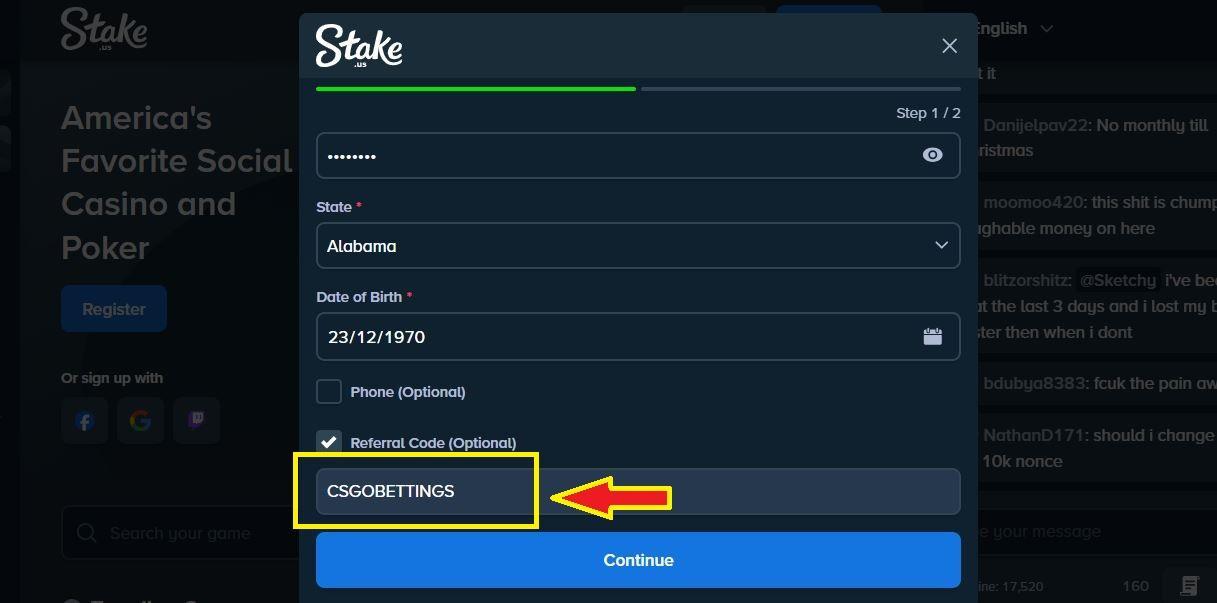
Enter “CSGOBETTINGS”.
Verify email.

Claim up to 5% rakeback.

While the steps are easy, US players must complete KYC verification (including submitting required documents and other processes). This step is vital to ensure compliance with US gambling regulations and discourage fraudulent activities from “unscrupulous” players.

Once completed, enjoying Stakes.us’s numerous offerings (including Originals and Sweepstakes games) should be a breeze. The 5% (maximum) return in your house edge contributions should make your gambling adventures more worthwhile.

Stake Promo Code Benefits 

The Stake Casino bonus code unlocks a few benefits for US players, including rakeback (Stake.us returns a portion of its house edge, which is 5%, to your balance regardless of whether you win or lose) and reload bonuses via the daily reload coins based on your activity.

In addition, this code helps members climb up the VIP levels faster because every gameplay and rakeback count toward the tiers. 

And what’s even more? Activating the code gives them access to occasional bonus drops via the site’s social and Discord giveaways.

These rewards empower US players to enjoy more games, maybe even try out a new betting strategy.

The Stake referral code “CSGOBETTINGS” unlocks these perks instantly after registration. So, you definitely don’t want to miss the long-term benefits you’ll get for redeeming it, too.

Welcome Rewards

Part of the Stake casino bonus for new members is the rakeback system, which returns 5% of the house edge to your account (and is valid on every bet). 

Its reload perk rewards players for topping up their accounts, giving them “redeemable” money to use in different games (including sports matches).

Of particular significance of joining the casino, not to forget, is Stake’s sweepstakes gameplay. Players can use Gold Coins or Stake Cash (also called Sweeps Coins or SC) to join, although most newbies prefer betting with GCs for fun (while seasoned gamblers often opt for SCs for redeemable prizes).

Rakeback & VIP Program Explained 

Stake’s rakeback system rewards US players (and global users on Stake.com) with up to a 5% increase in their house edge returns. When players bet, Stake.us deducts a “fee” (or house edge). It then returns a portion of that “share” to players with a rakeback bonus.

Beginner players often start with a 0.5% rakeback, which means 50 cents for every $100 they wager (win or lose). Climbing through Stake.us’s VIP ranks can boost the share to 5% (or $5 per $100 bet).

Hence, the only way players can maximize Stake.us’s rakeback reward system is by progressing through the platform’s 14-level VIP program.

In a comprehensive Stake Casino overview, this platform’s VIP program requires players to accumulate gaming spend to rise through the ranks. 

For instance, spending over $50K in accumulated bets is enough to move from Bronze to Silver (with Diamond VIPs needing at least $25M in game play amount). 

Here’s how Stake.us’s VIP structure looks like. It’s worth mentioning that higher-level VIPs enjoy more lucrative (or exclusive) bonuses.

  • Bronze – Bonuses for leveling up, periodic (monthly and weekly) perks, and rakeback boosts (starts at 0.5%) 
  • Silver – Same as Bronze + bonus growth
  • Gold – Like Silver
  • Platinum I-III – Same as Gold + daily bonuses and reload bonuses
  • Platinum IV-VI – Same as Platinum I-III + VIP host bonus (custom gifts), dedicated VIP host, and renewable reloads 
  • Diamond I-V – Same as Platinum IV-VI, but higher value perks

Games & Sweepstakes Overview 

Stake.us has hundreds of entertaining games to ensure US players have an awesome experience. Some of the platform’s most beloved games include:

Slots 

A quintessential favorite of casino players, where GCs and SCs can be used to spin virtual machines in varying themes.

Crash
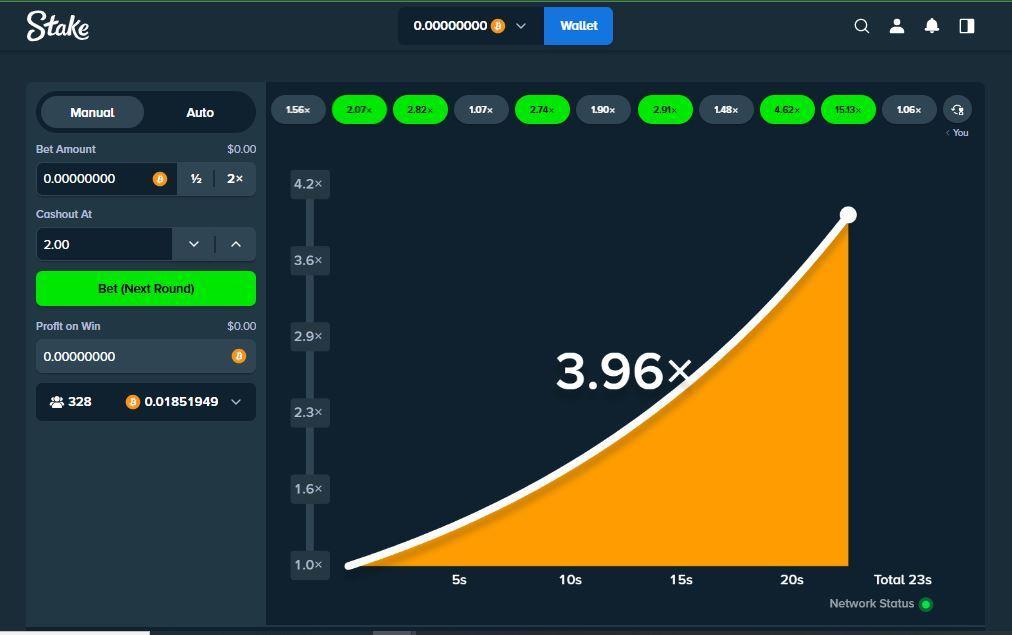
It’s a guessing game-meets-lightning reflexes type of game, where players must “payout” in a flash before the “count-up” crashes.

Plinko

A game of bouncing, dropping balls, cascading through virtual pegs, and hopefully landing on a high-value slot.

Dice

A game that’s as classic as any backstreet betting activity, except it’s all on a digital frame.

Blackjack

It’s an all-time favorite of casino players fond of table games.

How Gold Coins and Sweeps Coins Work

It’s worth reiterating that Stake.us isn’t a typical online casino. It’s a sweepstakes or “social” casino that doesn’t require any real-money or crypto deposits.

Instead, players earn Stake Cash (or Sweeps Coins) from challenges and promotional activities (like daily free coins). Players can bet SCs on their favorite games and accumulate prizes, which they can redeem in the future. They can also “withdraw” such prizes.

On the other hand, Gold Coins are strictly for “fun” and entertainment, where players don’t get redeemable prizes. They can also earn these through promos (like daily coin drops) and are often the perfect wagers for trying out Stake.us’s many game offerings.

New players don’t have to worry about activating such features because the Stake Casino bonus code “CSGOBETTINGS” automatically does it upon signup.

Mobile & Desktop Experience 

Navigating Stake.us is a breeze, with well-placed web elements and a clutter-free interface. While it doesn’t have a mobile app, accessing Stake.us on any device is easy. It’s nearly identical to its desktop version, only smaller and with a more thoughtful layout to accommodate the limited screen space.

Speed is hardware-dependent, although it works even on budget-friendly Chromebooks and legacy computers. Its crypto-style visuals work best on mobile devices. However, computers with at least mid-level graphics should display web elements splendidly (and play games more immersively).

Security & Fair Play 

Over 11,000 users have voiced their complete trust in Stake.us, earning the platform a stellar 4.5 stars on Trustpilot-5-point scale. It’s also recognized for its enhanced 256-bit encryption, ensuring user information remains secure.

As for its fair play, Stake.us (like Stake.com) offers a user-verifiable method to ensure game outcome objectivity. Each sweepstakes (or casino) game has a Provably Fair button to help players feel confident about the fairness of their favorite games.

Stake.us also performs periodic audits, including ongoing assessment of its RNGs (to ensure everything works to create a credible gaming platform).

More importantly, Stake’s reputation is revered globally, a feat it achieved since 2017. That’s more than enough to cement Stake.us’s credibility as a sweepstakes casino. It’s also legal in the USA.

Deposits, Payments & Withdrawals
One thing that separates Stakes.us from Stakes.com (and other online casinos) is its “sweepstakes” or “social” nature. 

The latter requires players to fund their accounts with crypto or even real money. 

On the other hand, Stake.us (as a social casino) doesn’t require players to deposit anything. Instead, US players can earn Stake Cash (SC) from promotions, like welcome bonuses and even daily or weekly challenges. Some bonus codes might offer free Gold Coins (GCs).

GCs vary from SCs in their redeemability. Most players use GCs for fun or to try out betting tactics (even to explore Stake’s games). Meanwhile, SCs allow players to accumulate redeemable prize balance.

US players can rely on efficient and secure redemption after redemption.

Final Thoughts 

Stake.us is like a “softened” or “more social” version of the Stake Casino we’ve learned to love since 2017. While it’s not a “hardcore” gambling website, it remains a favorite of US players who want a more fun and entertaining way to enjoy casino games. It’s also perfect for those who want better rewards (redeemable prizes) without shelling out real cash or even crypto.

The Stake Casino promo code “CSGOBETTINGS” offers a great way to enjoy Stake’s social nature. You’ll get up to 5% in the house edge return, plus chances for daily coin drops and other freebies. So, redeem this code today!

FAQs 

What is the Stake.us promo code? 

The Stake.us promo code is “CSGOBETTINGS”.

How does rakeback work?

Unlike cashback that hinges on a player’s losses, rakeback works on a user’s overall wagers (or bets), regardless of outcome. So, betting $1,000 for a week (cumulative) can return up to $50 to the player.

Can I use Stake in the US? 

Yes, players in the US can use Stake.us (except in New York, Washington, Montana, New Jersey, Pennsylvania, and 13 other states).

Are Stake.us bonuses legit?

Yes, Stake.us bonuses are legitimate (with some giving away free Stake and Gold coins).
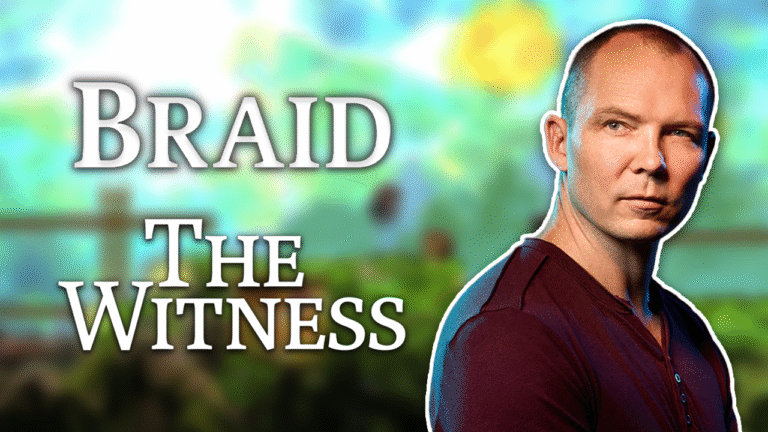
Jonathan Blow: The Mind Behind ‘Braid’ and ‘The Witness’

0

Indie games have grown beyond the notion that they are anything less than blockbuster titles. Today, these projects continue to make players think deeply, solve problems creatively, and experience stories in new ways. They have been important in pushing the boundaries of game design. Some titles that embody such qualities are ConcernedApe’s Stardew Valley and Toby Fox’s Undertale.

Puzzle games are also a perfect example of this trend in the indie segment. Particular examples are Braid and The Witness. These games are works of one of the most influential figures in this space — Jonathan Blow.

This article talks about Jonathan Blow, two of his games, and how his work inspired a new generation of game creators.

The Genius and His Equally Brilliant Games

Jonathan Blow is an American independent game developer, designer, and programmer. He is also the founder and president of Thekla Incorporated, which is a small independent game studio. Blow and his team are committed to making games that blend artistry, intelligence, and technical excellence. They are best known for creating Braid and The Witness.

In particular, Braid is a puzzle-platformer that follows a character looking for a Princess through a series of interconnected worlds where time works differently. This video game allows players to manipulate the flow of time in solving platform puzzles.

On the other hand, The Witness is set in an open world that has puzzles across dozens of locations. It is a game that lets players explore a strange island in hopes of regaining memories and finding a way home.

The Stories Behind Braid and The Witness

In early 2005, Jonathan Blows spent a few weeks making a prototype of a game. To give himself the sense of urgency to finish it, he immediately presented the basic version at the GDC around March of the same year. People showed positive interest, and he ended up spending more than three years refining and completing the game. After funding its $200,000 development himself, Braid was released in 2008 and became Blow’s breakout game.

Following the success of Braid, Jonathan and his team at Thekla Incorporated decided to make another game. He wanted to make a bigger project that takes the ideas in Braid and explores them deeper. It is a more mature game, to say the least. As an indie developer, the team had six people for most of the process. However, they needed to get extra help from architects and sound designers from time to time. But generally, they had lenient working hours, avoiding crunch culture. Given the nature and objectives of the project, all the earnings of Braid were spent. After seven years of development, The Witness launched in 2016.

Impact of Jonathan Blow on the Gaming Space

Aside from receiving critical acclaim and solid commercial success, Jonathan Blow has had a lasting impact on the video game industry. Braid and The Witness are milestones in game design. They made indie games a form of art and storytelling. Blow’s works inspired many other creators to take creative risks. Most importantly, he continues to demonstrate that games can be meaningful and thought-provoking, without losing their entertainment value. 

Note: This article uses information and insights from Game Developer (a), Game Developer (b), Notion, and The Guardian, to ensure depth and reliability.

Toby Fox and the Making of ‘Undertale’

0

Indie games have the power to tell stories in ways that many big-budget titles from massive studios fail to capture. Fortunately, projects of this kind have emerged, like ConcernedApe’s Stardew Valley and many more.

Likewise, one game that stands out for its creativity and emotional depth is Undertale. Created by Toby Fox, this indie game attracted players globally with its unique characters, memorable music, and the ability to make choices that truly matter.

This article highlights Toby Fox and dives into the story of how Undertale came to be, which is just as interesting as the game itself. At the same time, it will talk about the project’s success.

The Mind and The Game

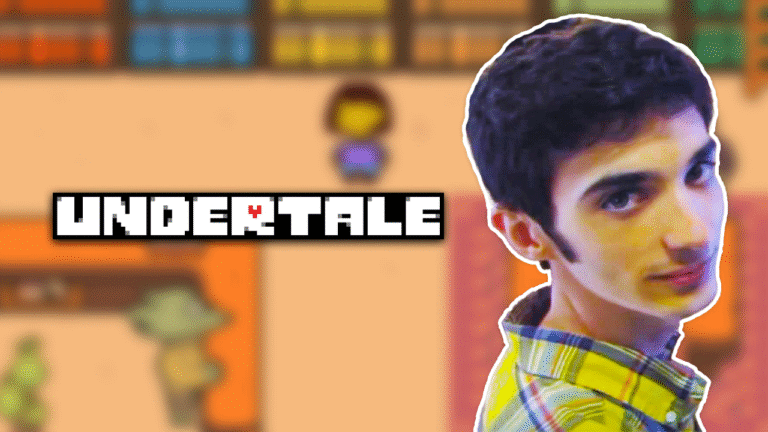
Toby Fox is an American video game developer. He has gained recognition for his work on the critically acclaimed indie title Undertale.

Specifically, this project is a retro-style RPG inspired by Earthbound  (1994) and Shin Megami Tensei (1992). It focuses on the journey of a child who falls into the Underground, where monsters live after battling humans. The protagonist must then find a way out or stay trapped beneath the Earth.

In terms of gameplay, Undertale allows players to choose between killing all enemies or sparing them.

The Creation of Undertale

As a kid, Toby Fox started making RPGs with his brothers using the RPG Maker 2000. It continued during his high school days, where he ventured into making a few ROM Hacks of Earthbound. His interest in developing games remained until he made a battle system after randomly reading about programming a text system using arrays. In turn, this discovery and his long-time interest in making an RPG where one can befriend bosses pushed him to make a demo.

To fund further development of the game, Toby started a Kickstarter campaign in 2013. While he only intended to reach $5,000, the initiative raised him over $50,000 from nearly 2,400 backers.

After the successful campaign, Fox resumed developing the game. He handled almost every aspect of Undertale himself. Toby wrote the story, designed the characters, and composed the music. Although it was a largely independent project, he eventually hired artists to draw some of the art.

The biggest challenge for Fox was finishing the game on time. He exceeded his deadline due to unforeseen issues and underestimating how long some things would take to make. That is why his original summer 2014 release got delayed, and the game officially came out in September 2015.

Reception and Recognition of Undertale

Upon launch, players praised Undertale for its humor, characters, story, and innovative battle system. The game’s 96% positive reviews on Steam highlight how word-of-mouth drove its immediate success. It even recorded an all-time peak of 10,462 concurrent players, with an average playtime of 13 hours.

Moreover, Undertale won several awards and earned multiple nominations alongside blockbuster games. As of writing, the game has already sold over six million Steam units, gaining roughly $30 million in gross revenue, proving its powerhouse status.

Legacy of Toby Fox and Undertale

The work of Toby Fox is now considered one of the most influential indie titles. His game shows an inspiring story of creativity, dedication, and willingness to do something special.

Note: To ensure accuracy and reliability, this article draws on sources such as Levvvel, Medium, Melos Han-Tani, and PC Gamer.

Spinch AU: sharp, quick, and ready

0

Spinch Casino keeps things simple for Aussie players. Sign up, claim a matched first deposit with a handful of free spins, and give it a whirl today — easy as.

First take: games that click

Spinch packs over 5,000 titles, so you won’t be twiddling your thumbs hunting for a pokie or a live table. Think Starburst, Elvis Frog in Vegas, Book of Dead, along with live blackjack and roulette from studios like Evolution. The layout is clean, the search works, and the lobby doesn’t bury you in nonsense. Spinch also supports crash and jackpot games for a quick hit when you’re short on time.

Bonuses with straight talk

This is a Spinch Casino review, so let’s get to the meat: promos. Spinch rotates welcome packages and seasonal deals, and it keeps regulars in the loop with cashback and weekly extras. Numbers change with campaigns, but the structure stays familiar: clear codes, fair timeframes, and wagering that’s spelled out in the terms. If you’re chasing the phrase “Spinch Casino no deposit bonus,” note that these appear during short promo bursts; when they do, they’re usually small, tied to free spins, and capped at a modest cashout.

Here’s a quick snapshot of typical offers you’ll see on Spinch, plus why they’re worth a look:

  • Welcome bonus: a matched first deposit plus free spins; usually 40× wagering on bonus funds, and around 30× on spins; minimum deposit commonly AUD 30; codes posted on the promos page;
  • High-roller boost: a bigger percentage on larger deposits; higher max bet during wagering;
  • Daily cashback: often 10–20 percent credited the next day with low rollover;
  • Spinch Wheel Wednesday: deposit, spin the wheel, pick up bonus funds or free spins;
  • VIP tiers: better cashback, bespoke reloads, and a manager who answers fast.

A gentle reminder that you can only claim each bonus once. If Spinch finds bonus abuse (it checks this with details like your IP address), your bonus winnings can be removed. Read the T&Cs, set a budget, then have a crack when you’re comfortable.

Banking in AUD that feels familiar

Spinch sticks with payment options Aussies actually use. You’ll see cards, Neosurf, popular e-wallets, bank transfer, and crypto. Deposits land quickly, and cashouts via e-wallets or crypto are typically swift once you’ve verified your account. Below is a handy overview to set expectations before your first deposit.

Method Type Deposit time Withdrawal time Typical minimum (AUD)
Visa / Mastercard Card Instant 2–5 business days 30
Neosurf Prepaid Instant N/A (deposit only) 30
Skrill / Neteller E-wallet Instant Few hours 30
Payz (ecoPayz) E-wallet Instant Few hours 30
MiFinity E-wallet Instant Few hours 30
Bank Transfer Bank 1–3 hours 2–5 business days 30
Bitcoin / Ethereum / Litecoin Crypto Network-dependent Minutes to a few hours 30

Spinch sets sensible limits in AUD, with daily, weekly, and monthly caps that fit regular play. Verification is part of the process for withdrawals — standard ID, proof of address, and sometimes a payment method snapshot. No dramas if you have it handy.

Licence and player protections

Spinch operates under the Curaçao Gaming Control Board with license OGL/2024/1178/0479, granted 22 July 2024 to Bets Entertainment N.V. (No. 155648). That’s the current regime and certificate, and it covers the brand’s domains while keeping compliance tight. Spinch also offers deposit limits, time-outs, and self-exclusion right in your account settings, backed by age checks and anti-money-laundering controls. Support runs 24/7 via chat and email.

Tournaments, missions, and the cheeky wheel

Spinch leans into light gamification without turning the site into a circus. Slot races and missions pop up regularly with leaderboard pools, while Spinch Wheel Wednesday adds a bit of luck tax to mid-week deposits. High-volume players get invited to VIP, which means better cashback bands, personalised reloads, and faster withdrawals once you’re known to the team. Spinch keeps these events rolling so there’s usually something to chase beyond a casual session.

FAQ

Is Spinch legit for Australian players?

Yes. Spinch is operated by Bets Entertainment N.V. under Curaçao GCB license OGL/2024/1178/0479, active since 22 July 2024. KYC, RG tools, and clear T&Cs are in place.

How do Spinch bonuses actually work?

Promos come with a stated percentage match, a wagering figure, a maximum bet during playthrough, and a validity window. Cashback is typically low-rollover and credited daily. Codes and exact figures sit on the promos page.

Does Spinch have a no deposit offer?

Sometimes. Spinch Casino no deposit bonus campaigns show up during short runs, usually tied to free spins with about 30× wagering and a small max cashout. Keep an eye on announcements.

What games can you play at Spinch?

Pokies from big studios, blackjack, roulette, game shows, jackpots, crash titles, plus video poker and keno. Live tables are handled by specialist providers, and the lobby filters make it easy to jump straight to favourites.

All Spins Win Casino: straight talk for Aussie players

0

Ready to play with clear promos and quick banking? Head to All Spins Win Сasino to claim a matched first deposit with a set of free spins to start. All Spins Win Casino keeps mobile play smooth and the lobby responsive, so you can get underway without delay.

Games that get chatter, not yawns

All Spins Win puts pokie fans front and centre. You’ll see BGaming regulars like Elvis Frog and Aztec Magic Bonanza — bright, punchy, and with bonus rounds that hit often enough to keep you on the hook. All Spins Win also carries Black Wolf from 3 Oaks for players who like stacked wilds and a hold-and-win chase. If you prefer feature hunts, TNT Bonanza (Booming Games) brings multipliers that spike without warning. All Spins Win Casino doesn’t forget table lovers either: Evolution’s live rooms cover blackjack and roulette with Aussie-friendly hours, clean streams, and dealers who don’t drone on.

That mix is what makes AllSpins Win Casino easy to recommend: a few crowd-pleasers, a few sleepers, and live tables when you want a change of pace. All Spins Win isn’t trying to be everything to everyone — and that’s a compliment.

The welcome deal and weekly value — plain English

The headline offer at All Spins Win is a 100% match up to AU$7,500 + 100 Free Spins. Use code DZ100 on a min deposit of AU$30; wagering is 40× on bonus funds and, where shown, on spins too. All Spins Win then keeps the tap flowing with Wednesday Free Spins tiers — DAZWED20, DAZWED30, DAZWED50 — and a Friday Reload of 50% up to AU$450 with code 50FRIDAY. Loyalty matters at All Spins Win: DAZ Points accrue at 1 point per AU$16.50 wagered, feeding VIP levels that throw out perks and occasional gifts. A gentle reminder: you can only claim each bonus once. If All Spins Win detects bonus abuse — it checks things like your IP address — your bonus winnings may be voided.

Want to lock it in without mucking about? Here’s the quick version at All Spins Win:

  • Open an account and verify your email;
  • Deposit AU$30 or more and enter DZ100;
  • Open the eligible pokie, spin the freebies, then meet 40× before cashing out.

Keep in mind that All Spins Win bonuses change from time to time, so read the promo card — not just the banner — before you punt again. The value stacks up if you pace yourself.

Banking built for Australia

All Spins Win supports local-friendly ways to load your balance and get paid, and it lists limits in AUD so you don’t need a calculator. Deposits at All Spins Win are instant on cards, e-wallets, and crypto; bank transfer is slower but still popular for larger amounts. Here’s the neat summary:

Before the table, a quick tip: use the same method for deposit and withdrawal at All Spins Win. It shortens verification, which helps payouts land faster.

Method Deposits (Min / Speed) Withdrawals (ETA)
Visa / Mastercard AU$20 / Instant 1–3 business days
Bank Transfer AU$30 / 1–3 business days 1–5 business days
Flexepin AU$10–AU$20 / Instant N/A (deposit only)
Skrill / Neteller AU$20 / Instant Often same day
Cryptocurrency Varies / Instant Often same day

After the table, one more thing: All Spins Win may ask for ID on your first withdrawal — standard stuff. Have a photo ID and a recent utility bill ready and you’ll be right.

Mobile and support that don’t faff about

All Spins Win runs in your browser on Android or iPhone. No app, no storage headaches, and the lobby scales cleanly down to a 6-inch screen. If you need help, All Spins Win has 24/7 live chat plus email, so you can sort hiccups while waiting for your coffee. Response times are snappy, and the chat agents keep it short and useful.

Play with a plan

All Spins Win includes deposit limits, session reminders, and self-exclusion tools. Use them. It’s easy to get stuck chasing a feature drop that refuses to land. When you’re hitting promos at All Spins Win, cap your stake per spin and stick to it — the bonuses stretch further, and cashouts come sooner.

FAQ

How do All Spins Win bonuses work?

You start at All Spins Win with DZ100 — a 100% match up to AU$7,500 plus 100 Free Spins on a AU$30+ deposit, with 40× wagering. Weekly, All Spins Win runs Wednesday Free Spins codes (DAZWED20/30/50) and a Friday Reload at 50% up to AU$450 with 50FRIDAY. Read each promo’s game list and bet cap, then clear the playthrough before withdrawing.

Which games at All Spins Win are worth a spin?

Pokie-wise, All Spins Win highlights Elvis Frog and Aztec Magic Bonanza for upbeat features and quick-hit bonuses; Black Wolf is the pick for hold-and-win chases; TNT Bonanza can spike with multipliers; and The Quest of Azteca suits slower, story-led spins. For something different, All Spins Win also streams Evolution live blackjack and roulette.

How fast are withdrawals at All Spins Win?

All Spins Win pays out e-wallets and crypto often the same day, cards in 1–3 business days, and bank transfer in 1–5 business days. Verification can add time the first go. After that, All Spins Win withdrawals tend to move quicker — no dramas if your details match your account.

The Scene Stealer: Using AI Backgrounds to Transport Your Content Anywhere

0
Imagine if your living room could be a Parisian café, a Tokyo glass-walled studio, or a neon-lit alley from a sci-fi blockbuster—without ever setting foot outside your home. That’s what today’s creatives are making possible with the use of tools such as the AI background generator within Pippit. Rather than being constrained by the walls that surround you, your content can be anywhere, in any atmosphere, with the sheen of a pro shoot.
For individual creators, budget brands, and small businesses, this isn’t just entertaining—it’s a timesaver for top-tier looks. And when you combine backgrounds with other Pippit features, such as an image enhancer, you’re not simply replacing a wall, you’re creating scroll-stopping masterpieces. Let’s explore how and why backgrounds are so much more than decorations.

Why backgrounds are more than decoration

Consider your background as the set in a theater. You would not stage a performance without one, since the setting determines the way the story tastes. A backdrop can change:
  • A product picture to a luxury catalog photo.
  • A snap to a movie poster.
  • A promo clip to a branded mini-movie.
The magic is in the emotional shift. A candle on a messy desk can be unremarkable, but on a rich black background surrounded by golden warmth and suddenly it’s sensual, decadent, and gift-worthy.

Fantasy and premium worlds at your fingertips

Creators are free from reality. AI environments can transport your audience to magical woods, Renaissance palaces, or super-minimal lofts—all in an instant. Need to hint at a holiday campaign? Create snowed-in cabins. Having a summer drop? Put your product on tropical beaches.
This power to leap between worlds isn’t entertainment alone—it’s strategy. You can produce seasonal campaigns, brand narratives, and mood-based content without reserving rooms or carrying gear. The only constraint is how far you’re willing to let your imagination fly.

The emotional science of background-driven storytelling

People are hard-wired to react to context. That same smile smiling in a pastel bakery tastes sweet and friendly, but the same smile flashing under neon lights can taste edgy and bold. This is why background imagery has so much in it of persuasive force.
Brands that employ created worlds on a consistent basis end up with better stories. Each setting is a narrative prompt, helping the viewer understand what they’re looking at. And when you put this story advantage together with features like an image sharpener, every detail shines through—textures, hues, and emotions get enhanced so the mood is undeniable.

Cinematic opportunities beyond filters

Overused filters deaden creativity and make everything look the same. Generated backdrops, however, usher in the possibilities of cinema. Picture taking a product demo in your kitchen, then being able to change the background instantly to resemble a shiny tech convention.
Or, if you’re feeling adventurous, you might pair your run-of-the-mill sentence with a reverse video effect, setting your product within a dreamlike environment where time reverses itself. This combination of background design and editing panache can get your content to look trendy, edgy, and memorable.

Where brands succeed with created worlds

Various industries can leverage backdrop magic in various ways:
  • Fashion brands can present one garment in ten specially crafted settings within one campaign.
  • Food companies can photograph their products against sophisticated kitchens, bright patios, or old-fashioned farm tables.
  • Influencers can produce themed collections—such as fantasy lands or dystopian cities—without ever renting a studio.
  • E-commerce merchants can present their items in aspirational settings, instantly upgrading perceived value.
It’s not about looks; it’s about converting. The nicer your content appears, the more seriously people take your brand.

How to make your dream backdrops happen with Pippit

World-building just got quicker and more enjoyable with Pippit. Using its AI-driven tools, you can build cohesive brand worlds that seem like they are from a full-scale production studio. Let’s go through the process.

Step 1: Add images from links or devices

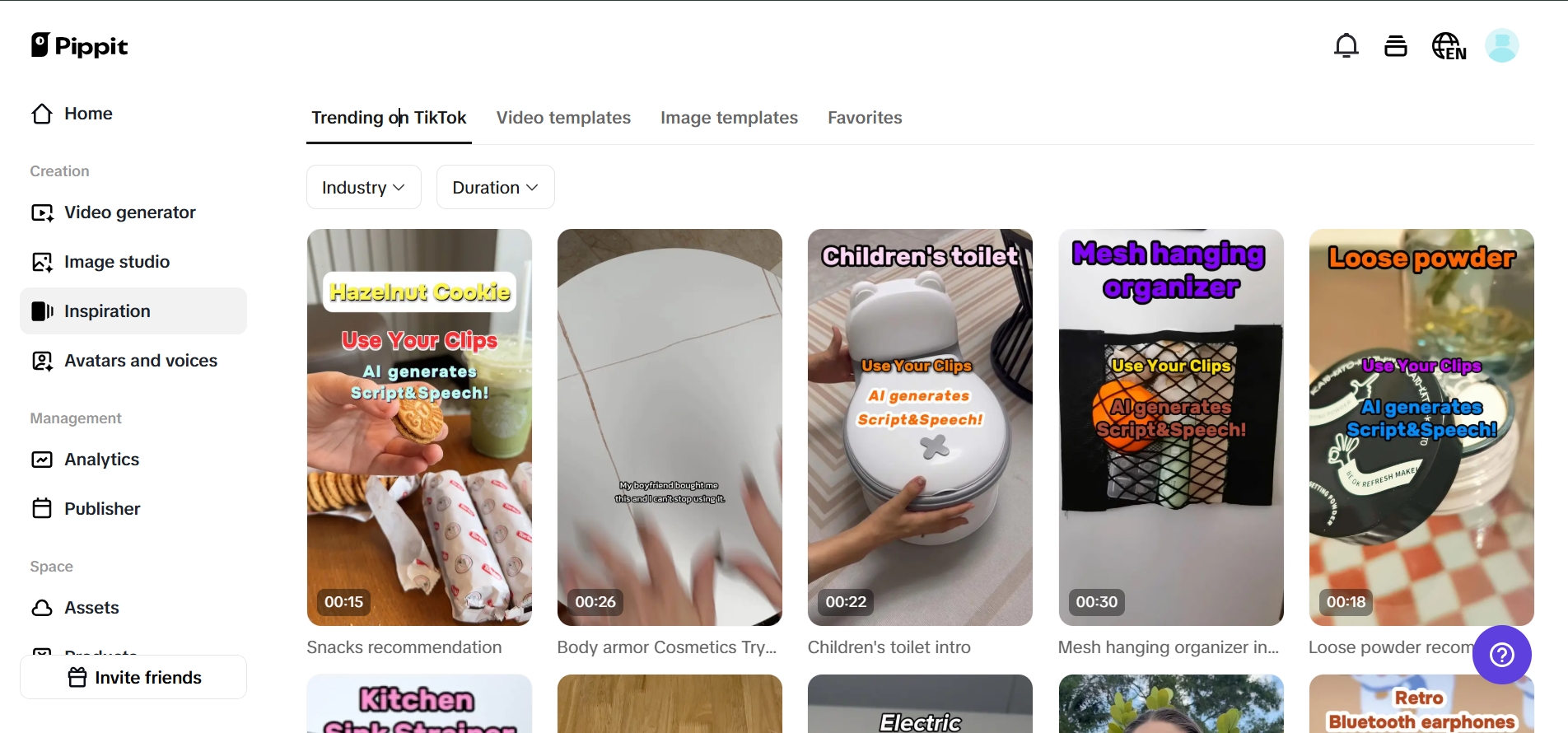
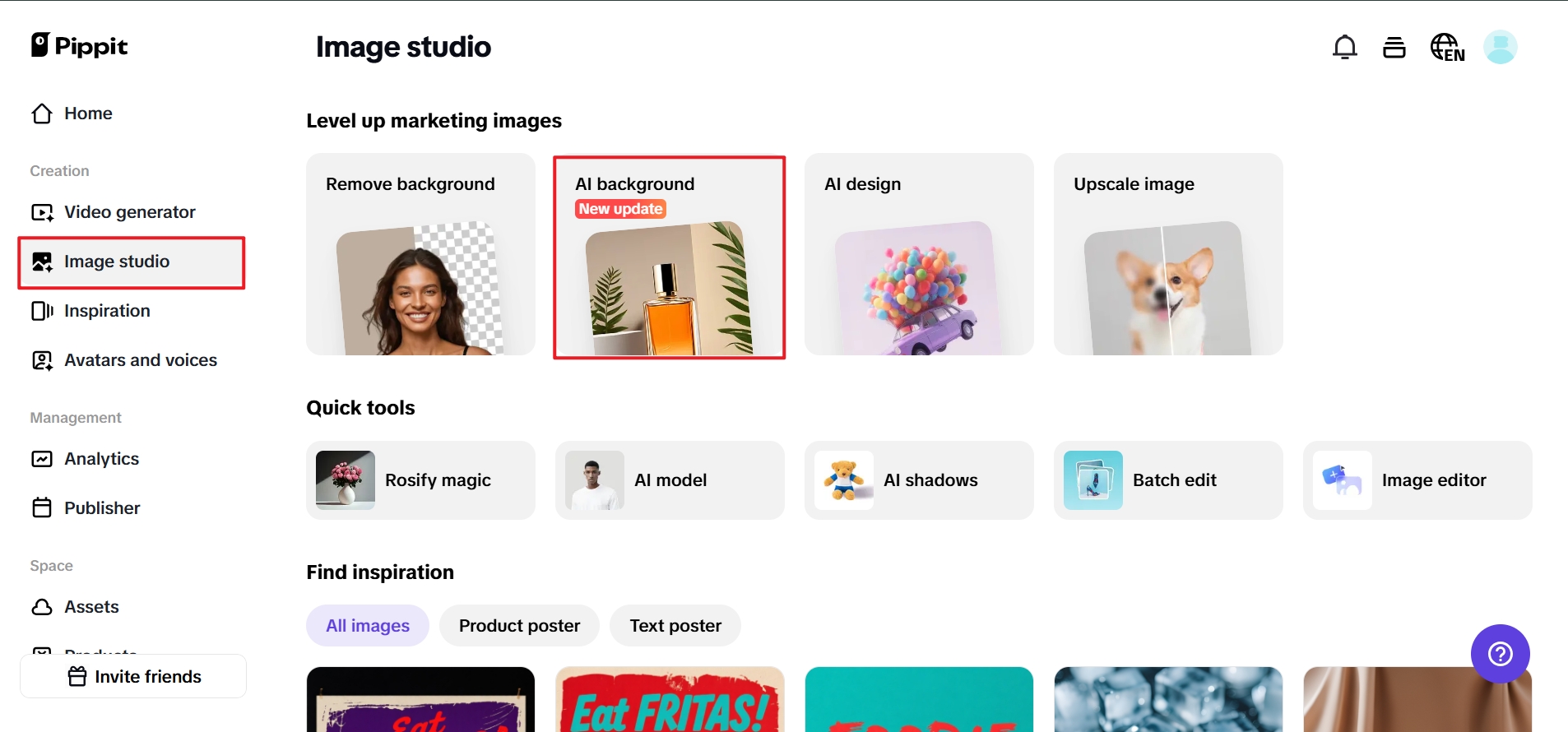
In the first step, sign up for Pippit AI generator background and click Image Studio on the left sidebar. Select AI Background under Quick Tools, drag and drop your product pictures, or click Device to import them from your PC.

Step 2: Edit image background and content

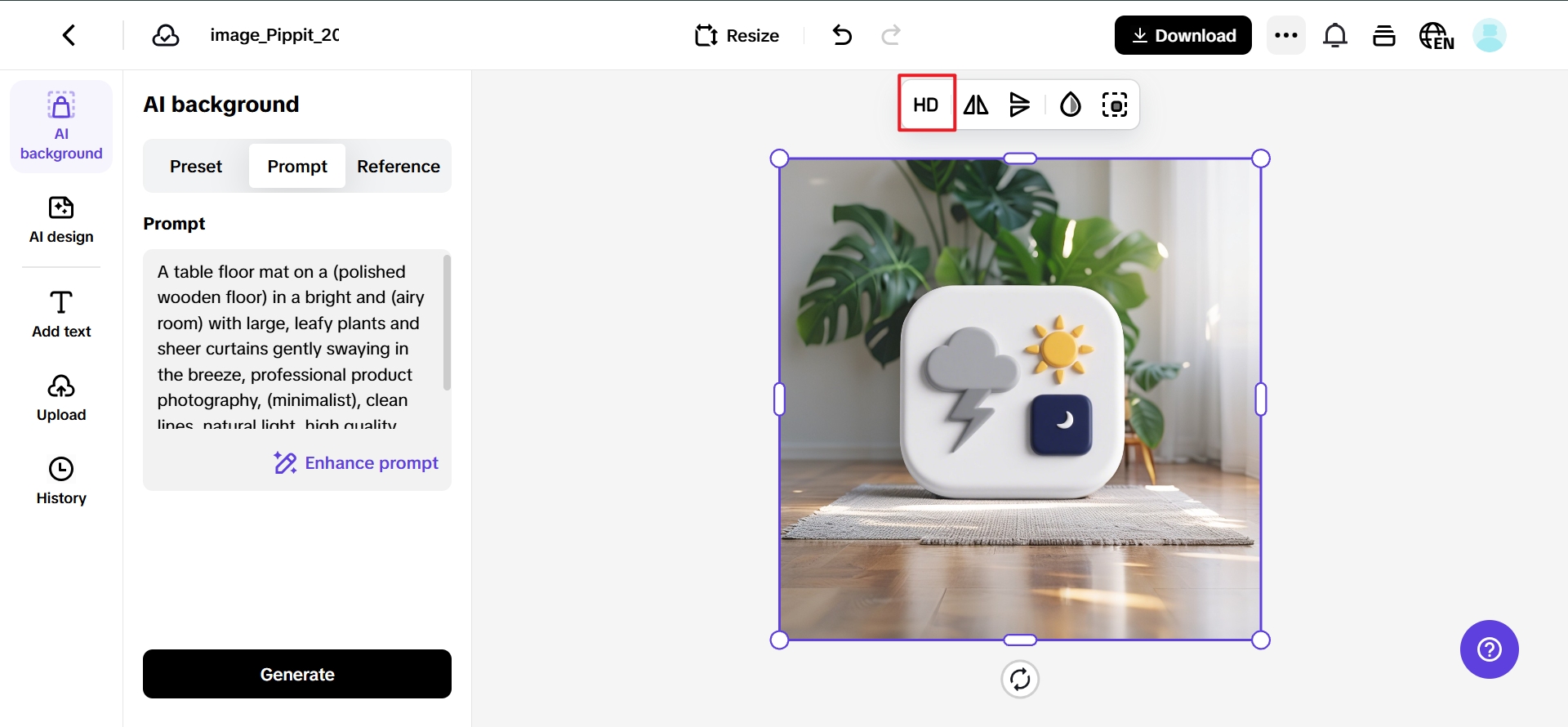
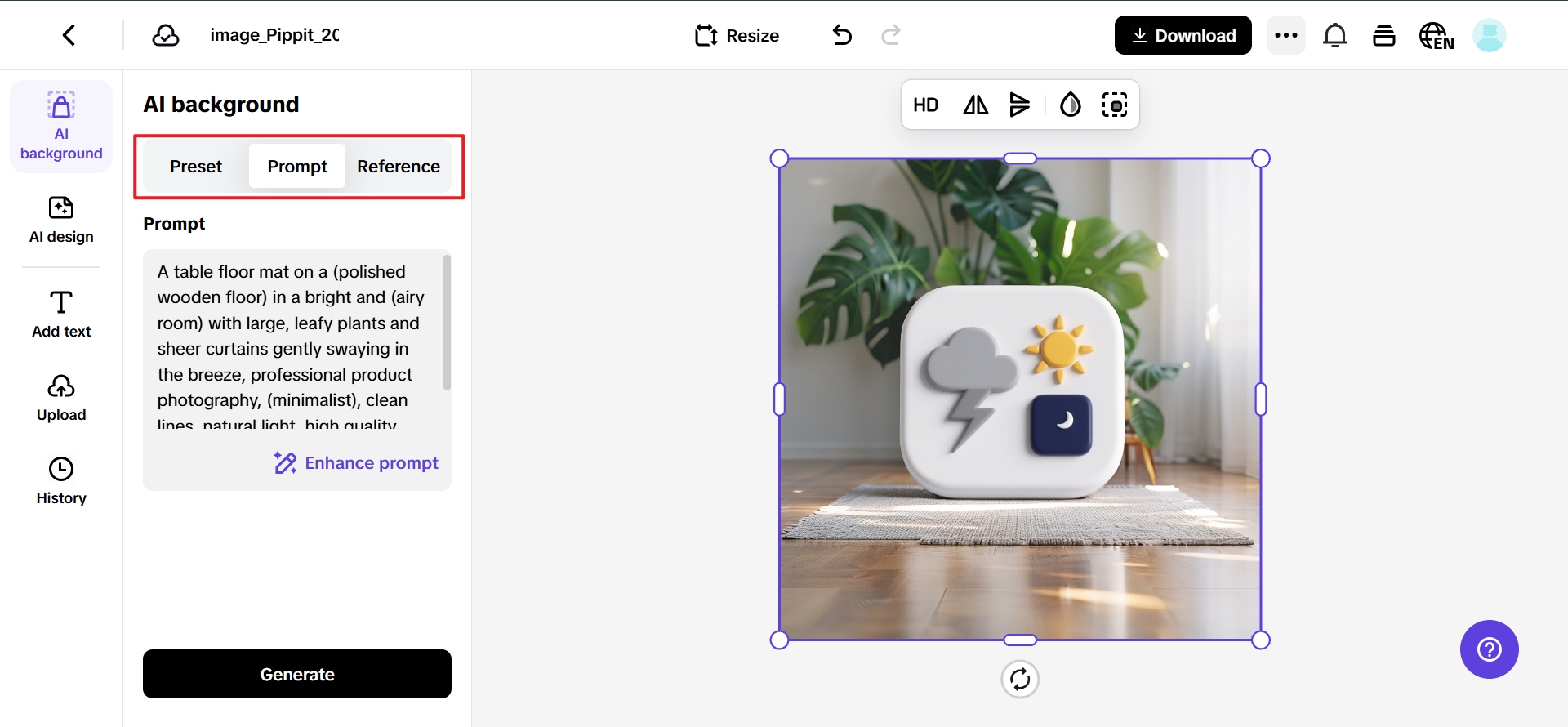
AI Background tool will automatically remove the background. Go to Preset now and choose a background, click Reference to add your own, or choose Prompt to create one with AI. You can similarly use the Sales Poster to create promotional material or Add Text to add captions onto your photos.

Step 3: Save your images

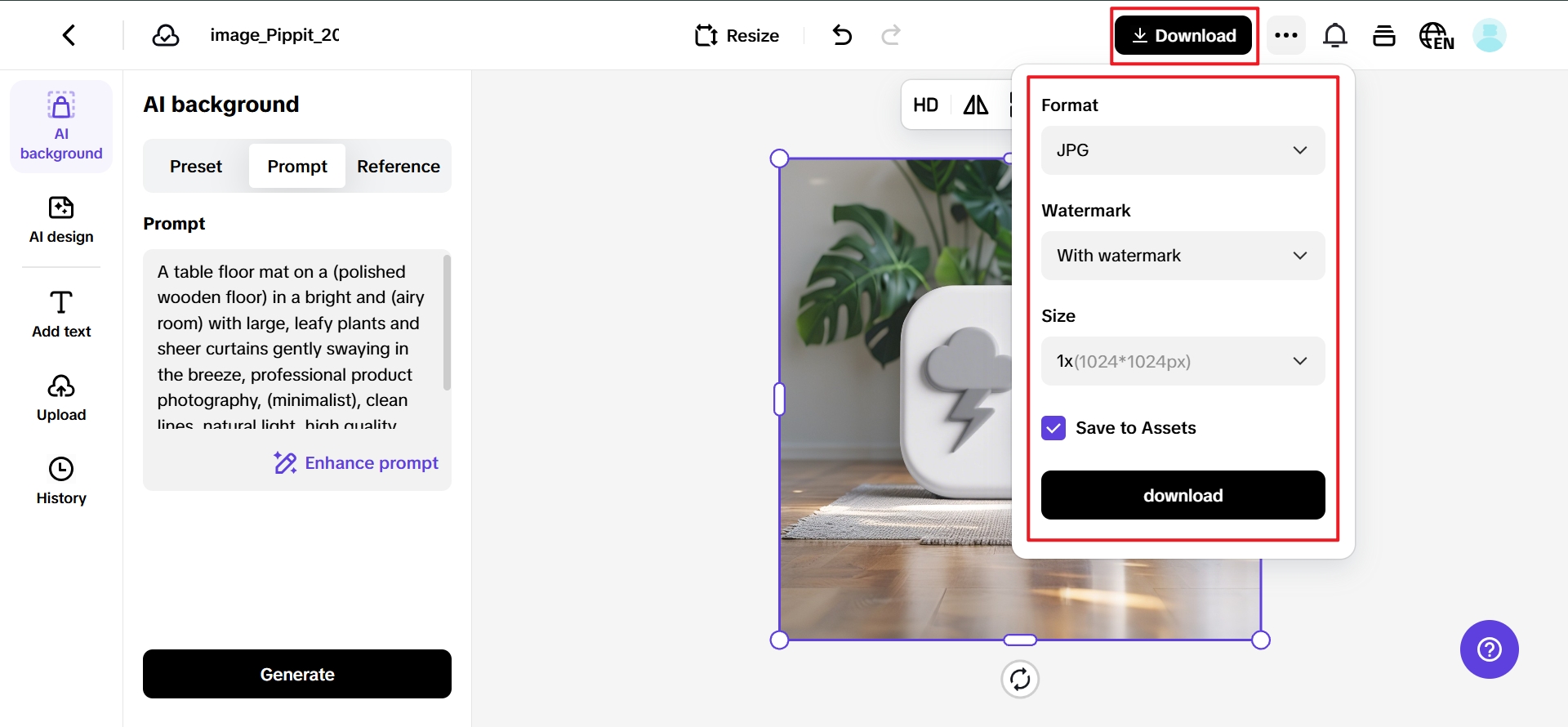
Finally, click Download at the top right-hand corner of the editor, choose the file size and format, and then click Download to save the product picture on your device. You may also choose to save the image with or without a watermark before exporting.

Turning ordinary shoots into extraordinary experiences

The wonder of background generation is that it makes creativity democratic. You don’t require costly lighting rigs, dressed sets, or massive studios. A blank wall, a good camera, and Pippit are all you require to make your content look larger than life.
This allows creators to push storytelling, brands to keep their message consistent campaign over campaign, and businesses to scale their imagery at lightning speed. And here’s the best part: each photo or video can be like a new adventure for your audience.

Conclusion: let Pippit steal the scene for you

When you leave your empty walls to technology, they become stages, worlds, and feelings that arrest attention the moment they are seen. From fantasy getaways to luxury simulations, your content should live in spaces as unapologetic as your imagination.
With Pippit’s AI-driven background creator, combined with sharpening, captions, and video effects tools, you’re not merely creating—you’re transporting. Ready to make your content the undisputed scene stealer? Visit Pippit today and construct worlds that your viewers will never forget.

EA FC 26 Best LM/LW Wonderkids & Youth Players for Career Mode

0

A club in EA FC 26 Career Mode is an aggregate of players that play equally important roles. Some take care of the offense, a few focus on defense, and others balance both. Likewise, the size of a football pitch calls for players assigned to specific zones. Just like the right side and other areas, the left side of the formation also plays a massive role. It opens up defenses, stretches the pitch, and creates goal-scoring chances. In line with this, a left midfielder (LM) and a left winger (LW) can turn a stagnant attack into a creative force.

Accordingly, this is where LM/LW wonderkids shine. They bring energy, pace, and room to grow. Plus, Career Mode managers can sign them early before their value skyrockets. Whether one prefers traditional wide players who deliver precise crosses or modern inside forwards who cut in and score, establishing a young core for a team is one of the smartest investments possible.

To help in discovering the top LM/LW wonderkids in EA FC 26, this article will list young footballers who bring unique qualities that can give a team a real edge for years to come.

Best LM/LW Wonderkids in EA FC 26

Here is a more detailed look at three of the top LM wonderkids in Career Mode that elevate the performance of your team to win more matches:

Jamie Gittens (Overall Rating: 78 | Potential Rating: 85)

Jamie Gittens is one of England’s brightest young wide players. Still in his early twenties, he already shows composure, pace, and confidence on the ball. Jamie can also switch to the left winger position, which increases his usefulness.

His in-game specialties include faster acceleration in explosive sprints and stronger ball control at higher speeds, which reduces errors on knock-ons. When considering different parts of gameplay, he has 92 for pace, 73 for shooting, 66 for passing, 84 for dribbling, 27 for defending, and 59 for physicality. Overall, Jamie is indeed a nightmare for defenders due to his acceleration and close dribbling.

  • Age: 21
  • Team: Chelsea
  • League: Premier League
  • Nation: England
  • Rank: 1230
  • Height: 179cm / 5’10”
  • Weight: 77kg / 170lb
  • Preferred Foot: Right
  • Wage: €73K
  • Value: €28M

Malick Fofana (Overall Rating: 78 | Potential Rating: 86)

Malick Fofana has quickly built a reputation as one of Belgium’s most promising attacking left midfielders. He is known for his work rate and direct playing style. At the same time, Malick is the type of player who can change the tempo of a match instantly. He can also play as a left winger, proving his versatility.

In EA FC 26, his strengths lie in accurate fancy and trivela shots and quicker sprints with excellent control. Fofana can also dribble while making wide turns precisely. Looking beyond his main offerings, he has 86 for pace, 69 for shooting, 70 for passing, 82 for dribbling, 40 for defending, and 48 for physicality. This young footballer has adequate stamina and energy to fit into high-pressure systems and fast counter-attacks.

  • Age: 20
  • Team: Olympique Lyonnais
  • League: Ligue 1 McDonald’s
  • Nation: Belgium
  • Rank: 1241
  • Height: 170cm / 5’7″
  • Weight: 60kg / 132lb
  • Preferred Foot: Right
  • Wage: €17K
  • Value: €31M

Diego Moreira (Overall Rating: 77 | Potential Rating: 83)

Diego Moreira is a standout wonderkid for his technical skill and composure on the ball. In matches, he brings creativity and confidence to the left side. Diego can also slot in at left back.

In gameplay terms, Moreira excels at recovering faster from halftime fatigue. Similarly, he possesses the game-changer and rapid abilities, producing more advantages for teams. From a broader gameplay standpoint, he has 90 for pace, 67 for shooting, 69 for passing, 79 for dribbling, 64 for defending, and 68 for physicality. Teams that bank on possession-based systems will find Diego a nice addition.

  • Age: 21
  • Team: RC Strasbourg Alsace
  • League: Ligue 1 McDonald’s
  • Nation: Belgium
  • Rank: 1308
  • Height: 179cm / 5’10”
  • Weight: 73kg / 161lb
  • Preferred Foot: Left
  • Wage: €36K
  • Value: €16.5M

Here is a more detailed look at three of the top LW wonderkids in Career Mode that elevate the performance of your team to win more matches:

Mohamed-Ali Cho (Overall Rating: 76 | Potential Rating: 83)

Mohamed-Ali Cho blends pace, power, and technical precision. It may seem normal for a professional footballer, but this is rare for someone of his age. He is also basically a well-rounded player, as he can transition to multiple positions, including striker, right winger, and left midfielder.

On the virtual pitch, he shines in dribbling while sprinting faster with fewer mistakes on knock-ons. Exploring other elements of the game, Cho has 80 for pace, 70 for shooting, 69 for passing, 78 for dribbling, 26 for defending, and 59 for physicality. Opposing teams will also see him as a real goal threat because of his finishing prowess.

  • Age: 21
  • Team: OGC Nice
  • League: Ligue 1 McDonald’s
  • Nation: France
  • Rank: 1878
  • Height: 181cm / 5’11”
  • Weight: 66kg / 146lb
  • Preferred Foot: Left
  • Wage: €21K
  • Value: €15M

Wilson Odobert (Overall Rating: 75 | Potential Rating: 83)

Wilson Odobert is one of the most exciting young LW wonderkids from France. He is confident and creative. Additionally, he can take on defenders and turn moments up. His alternate positions are right winger and left midfielder.

Inside EA FC 26, gamers will notice Wilson can perform faster, controlled sprints. Doing precise wide turns while on the ball is also easy for him. As for other facets of his game, he has 86 for pace, 70 for shooting, 68 for passing, 78 for dribbling, 30 for defending, and 49 for physicality. Odobert’s agility and quick feet make him one of the most unpredictable wingers in the game, considering his age.

  • Age: 20
  • Team: Tottenham Hotspur
  • League: Premier League
  • Nation: France
  • Rank: 2313
  • Height: 182cm / 6’0″
  • Weight: 75kg / 165lb
  • Preferred Foot: Right
  • Wage: €59K
  • Value: €12.5M

Andreas Schjelderup (Overall Rating: 75 | Potential Rating: 83)

Andreas Schjelderup is one of the young stars in the left-winger position who has been making waves in the sport. This player offers an ideal mix of technique, composure, and intelligence. He is very versatile for he can switch to three more positions: central attacking midfielder, left midfielder, and right winger. 

Specifically, Andreas’s in-game key abilities are finesse shot and technical. In other areas in the video game, he has 80 for pace, 68 for shooting, 68 for passing, 80 for dribbling, 35 for defending, and 57 for physicality. Team managers who seek players to contribute in buildup plays will see him as a natural fit for his decision-making and creativity.

  • Age: 21
  • Team: SL Benfica
  • League: Liga Portugal
  • Nation: Norway
  • Rank: 2796
  • Height: 176cm / 5’9″
  • Weight: 69kg / 152lb
  • Preferred Foot: Right
  • Wage: €14K
  • Value: €12.5M

Final Kick Before the Full-time Whistle

LM/LW wonderkids are not just supporting players. They are potential match-winners. All the listed players offer balance, control, and that explosive spark every team needs. With their blend of pace, creativity, and growth potential, these six young talents can positively change a team’s future.

To build an unstoppable left side, these LM/LW wonderkids will need minutes, individual training, mentorship, and lots of patience. Skip no step, and they will reward a team with goals, assists, and match-winning moments.

Note: This article incorporates the latest available EA FC 26, Sofifa (a), and Sofifa (b) data and information at the time of writing. Keep in mind that player rating and potential in the game can change over time due to updates and real-world performance. This list serves more as a guide rather than a definitive ranking of LM/LW wonderkids.

ConcernedApe: The Solo Developer Who Created ‘Stardew Valley’

0

Indie games are video games created by small teams or even a single person. While most indies focus on creativity, unique gameplay, and personal vision, they often lack the support and financial backing of large studios. That is why it is difficult for such projects to gain traction and achieve triumph, given the competition in the gaming space.

However, there is one indie title that conquered all odds — Stardew Valley. It is a low-budget video game created by Eric Barone (a.k.a. ConcernedApe) that captured the hearts of millions of players.

This article explores the journey of Eric Barone and how he created the indie sensation, Stardew Valley. It will also break down the game’s impact on players and indie developers.

The Creator and The Creation

Eric Barone is an American solo video game developer who studied computer science at the University of Washington, Tacoma. Professionally known as ConcernedApe, he is best known for creating the 2016 indie title Stardew Valley.

In particular, this is a farming and country life RPG. Its narrative follows a character who inherits a farm from his grandfather. After deciding to leave the corporate city job, he moved out and started a new life in the countryside.

The game lets players create the farm of their dreams, learn to live off the land, take part in a community, start a family, and much more.

The Making of Stardew Valley

Eric Barone started developing the game around 2011 after graduating from college. However, it was not because of the desire to enter the gaming industry. It was supposed to be only for practice to improve his skill set and build a portfolio to get a better shot at applying for jobs, which he previously struggled with.

His idea for the game came from his love of the Japanese farming simulation series Harvest Moon as a kid. Barone said this game sparked his imagination and made him fond of exploring a different world. Later on, he noticed that the game had lost its way. Plus, Eric saw that there was no other game that had the same offering. So, he used this opportunity to make one of his own that shares the same feeling but expands it in his own way. However, Barone did not want any help. He preferred working alone so he could stay in full control and follow his own vision.

Eric began with the most basic aspect, such as creating a single avatar. He had no deliberate plan whatsoever. But he ended up working on it for an average of 12 hours a day. Barone did his own tedious research, trained himself, learned pixel art, and studied the tools to find the necessary solutions to move forward. He used Visual Studio 2010, Propellerhead Reason, Paint.NET, and xTile. Eric moved from one area to another, building slices of the game. After more than four years of countless errors, adjustments, and testing, the game finally came out.

Success and Impact of Stardew Valley

The indie game from ConcernedApe quickly became a hit after its release. Players from around the world loved it, resulting in 500,000 copies sold in only two weeks. Based on recent data, it has now sold around 35 million copies. Aside from the excellent market performance, it holds the highest rating on Steam.

Eric’s work continues to inspire aspiring developers. It made an impact by showing that it is about making something that matters and feels real. The game showed the importance of prioritizing heart over hype.  

A Continuing Journey

Over eight years since its launch, ConcernedApe continues to update Stardew Valley and has plans to do so as long as he feels like it is the right thing to do. He remains active and is looking forward to future projects.

The story of the solo developer who created Stardew Valley proves that one dedicated person can make an impact in the gaming world.

Note: This article gathers information and insights from sources, including BAC Education, Game Developer, GQ, and NPR, to ensure accuracy and depth.

A Beginner’s Guide to Black Ops 7 – Everything You Should Know

0

Call of Duty: Black Ops 7 brings tactical espionage back in addition to grounded gunplay and high-pressure combat scenarios. With realistic movement and better AI, the game requires strategy from the first moment new players join. Although the classic chaos of Call of Duty is still present, Black Ops 7 promotes strategy by positioning players, loadout choices, and utilizing cognitive environmental awareness.

As the game slowly rolls out levels, attachments, and operator abilities, the early hours can feel overwhelming. This is the rationale behind some players getting a Black Ops 7 boost. However, the right knowledge and approach permit natural progression while improving a player’s competitive edge.

Learn the Basics of Gameplay

Black Ops 7 uniquely combines stealth strategy, rapid gunplay, and heightened situational awareness. This is true across all game modes, whether campaign, multiplayer, or zombies. There is no substitute for mastering the fundamentals of the game to optimize overall performance.

As the game is designed, one achieves the overall objectives through consistency rather than aggression and awareness, rather than raw reflexes. Over time, players develop the discipline of controlling their recoil, sensing the map flow, and intercepting a moving enemy. Even in the absence of a Black Ops 7 boost, beginners can level up rapidly. 

With the right mindset and approach, the strategies I provided will permit a natural flow of progression. This will maintain their competitive edge as the game is designed to allow it.

Beginner’s Guide – Campaign

This is a step-by-step walkthrough prepared to help those new to the game get a more seamless experience when starting the campaign. While the walkthrough does not reveal major story elements, it does highlight important elements to help you progress.

1: Orientation – Learning the Basics

The first mission introduces movement, stealth, and gun mechanics.

What to do:

  • Follow the on-screen tutorials for crouching, sprinting, and aiming.
  • When encountering your first group of enemies, avoid rushing; use cover on the left and take out enemies one by one.
  • After the breach section, pick up the suppressed weapon — the game is teaching you stealth fundamentals.

Beginner Tip:

Use aim-down-sights whenever possible. Hip fire only works at extremely close range.

Perimeter Sweep – Using Tactical Tools

This mission teaches gadgets and environmental awareness.

Steps:

  1. Equip the sensor tool to highlight hidden enemies.
  2. Stay on the right side of the perimeter, it provides more cover.
  3. Use your first grenades sparingly; throw one only when an enemy group is.

Beginner Tip:

Practice leaning from behind objects. Black Ops 7 heavily rewards players who minimize exposure.

3: Proxy Silence – Stealth Introduction

This mission emphasizes quiet movement, takedowns, and path selection.

Walkthrough:

  • Stick to shadows.
  • Watch patrolling guards and move only when they turn away.
  • If spotted, retreat and reposition rather than pushing aggressively.
  • Hack the door terminal, then move through the service corridor to avoid a direct gunfight.

4: Pressure Point – First Open Combat Arena

This is your first major firefight.

How to approach it:

  1. Start on high ground; it provides a better shooting angle.
  2. Pick off ranged enemies first (rooftops and towers).
  3. Push into the midzone only once the sniper threat is cleared.
  4. Switch to your secondary weapon when reloading to avoid downtime.

Beginner Tip: 

Use frag grenades against clustered enemies near vehicles and crates.

5: Echo Collapse – Advanced Mechanics

Introduces:

  • Armor plates
  • Equipment rotations
  • Operator abilities

Walkthrough Steps:

  • Plate up before entering the second battle zone.
  • Use your ability (scan pulse or defensive shield, depending on your loadout).
  • Stick with your squad — spreading out too far will get you isolated.
  • Maintain mid-range distance and avoid pushing heavy machine gunners alone.

Completing these early missions gives beginners all the core gameplay skills needed for multiplayer and zombies.

Multiplayer Foundations for New Players

Choosing Starter Weapons

Stick with low-recoil weapons like:

  • Balanced assault rifles
  • Lightweight SMGs
  • Tactical rifles for safe mid-range engagements

Beginner Attachment Priorities

  1. Recoil control
  2. Better sight/optics
  3. Extended magazines
  4. Movement enhancers

Even advanced players using a Black Ops 7 boost rely on optimized attachments for peak performance.

Movement, Positioning & Combat Strategy

Avoid Rushing Head-On

Black Ops 7’s AI and player reactions punish reckless movement. Move methodically and avoid sprinting around blind corners.

Maintain Cover

Staying near solid objects reduces incoming damage and makes engagements predictable.

Use the Mini-Map

The mini-map reveals footsteps, suppressed shots, and UAV pings. Beginners often ignore it and pay the price.

Loadout Guide

Category Recommended Option Reason
Primary Weapon Assault Rifle Stable, forgiving, easy to control
Secondary Fast-reload pistol Quick backup for close encounters
Perks Ghost, Tactical Mask, Scavenger Stealth + resilience + ammo
Lethal Frag Grenade Simple and reliable
Tactical Stun Grenade Helps win 1v1 encounters
Killstreaks UAV, CUAV, Sentry Gun Easy to earn; high team value

Leveling Up Quickly

Complete Daily & Weekly Challenges

These give large XP bonuses and help unlock attachments faster.

Play Objective Modes

Domination, Hardpoint, and Control provide:

  • XP for capturing
  • XP for defending
  • XP for eliminating enemies near zones

Focus on One Weapon at a Time

This accelerates camo progress and speeds up leveling.

Improving Aim

  • Lower your sensitivity to improve accuracy.
  • Practice 10 minutes per session in the training range.
  • Use aim assist if available on your platform.
  • Track targets smoothly rather than flicking wildly.

Common Mistakes Beginners Make

  • Sprinting too much and exposing themselves.
  • Reloading during fights instead of switching weapons.
  • Ignoring audio cues (footsteps, reload sounds, tactical equipment).
  • Not using the equipment frequently enough.

Final Thoughts

Black Ops 7 is great because it combines tactical depth and quick gun action, which is great for beginners. New players can fast-track their learning by following the fundamental techniques to combat positioning, movement, and loadout strategy. The game does not punish players for smart game strategies, adaptability, and consistent improvement, whether you progress organically or use Black Ops 7 boosts to unlock goals quickly.

FAQs

  1. Is Black Ops 7 beginner-friendly?

Yes. With its improved tutorials, simplified movement, and balanced weapons, Black Ops 7 is one of the most accessible entries for new players.

  1. What’s the best mode for beginners?

Team Deathmatch or Domination. Both help improve map knowledge, movement, and aim.

  1. How do I level up faster?

Complete challenges, use double XP tokens, and participate in objective modes. Many players also use a Black Ops 7 boost for faster progression.

  1. Which weapons should new players use?

Assault rifles and low-recoil SMGs are the best starting points.

  1. How can I improve my aim?

Lower your sensitivity, practice regularly in the training range, and use ADS (aim down sights) consistently.

Game Industry Unions: What Developers Should Know in 2025

0

Over the years, the gaming industry has introduced hit franchises, cutting-edge innovation, and unmatched gaming experiences. We can safely say that the sector is booming rapidly. However, beneath the surface of this success are unpleasant situations for the workers who make the games. Many developers continue to face crunch culture, burnout, layoffs, and other unfavorable working conditions. While the problems still lurk, steps and initiatives have been taken to address them. Specifically, game industry unions are now emerging.

Earlier this year, the Communication Workers of America announced at GDC 2025 the creation of an industry-wide union. Known as the United Video Game Workers, it seeks to empower employees in the industry. Such an initiative solidifies the fact that the issues are rampant and destructive. That is why every worker, including developers, must become knowledgeable about game industry unions.

This article explores game industry unions and why they matter. It also discusses what developers should know to put themselves in a favorable position amidst the ongoing problems.

What are Game Industry Unions?

Game industry unions are organizations formed by workers in the video game sector. Their purpose is to raise awareness about the challenges faced by game developers. At the same time, they push for industry-wide benefits, protections, improved working conditions, standardized wages, and a stronger voice in workplaces.

What Developers Should Know About Game Industry Unions

To paint the situation, Microsoft slashed roughly 9,000 jobs a few months ago, contributing to more than 25,000 employees being laid off in the gaming industry over the last two years. In the same sense, there are workers from different studios who spoke up about abuse, discrimination, harassment, and misconduct.

While it may all seem discouraging, developers should know they can get tangible benefits from union representation.

  • Collective Bargaining

Deals can set standards for overtime, pay grades, severance, and job-cut protections.

  • Stronger Job Protections

Agreements can help push for right-of-notice, transparency, and better support for workers.

  • Voice and Representation

Unified workers have greater influence than individuals negotiating alone.

However, developers should understand that there are still realistic limitations. First of all, market risks that impact studios heavily remain, which may force them to take necessary actions. Aside from this, employment models, agreements, and state laws vary and are complex, which can affect how union protections apply. On top of that, a studio or company must formally recognize a union for protections to come into effect. While some do, others still resist or delay official acknowledgement.

Final Thoughts

As workplace issues remain in focus, game industry unions act as a solid step toward providing what the employees cry for. For developers, understanding what the organizations can offer, where their limits lie, and how they might apply them in their roles can help navigate the space in 2025. By staying informed, evaluating their positions, and being proactive, they can soon achieve an industry that values equality, dignity, fairness, stability, and a voice for the people who create the games that keep businesses running.

Note: This article integrates information from sources, including CNET, Dice, LinkedIn, Los Angeles Times, and Lords of Gaming, to ensure depth and reliability.

Work-Life Balance in Game Development: Crunch, Burnout, and Survival Tips

0

Game development is usually seen as a dream job, crafting immersive worlds that players love. However, it is not all about fun and games. Behind the scenes of video games, many developers face heavy demands, long hours, and intense pressure. Most of the time, the industry overlooks employees’ well-being due to its creative dynamism and fast-paced environment. These detrimental factors often hinder work-life balance. Such effects make this a critical issue that needs immediate attention and solution.

This article explains the concept of work-life balance, along with two key problems in game development — crunch and burnout. At the same time, it will provide survival tips for developers and teams.

Work-Life Balance in Game Development

Work-life balance means having time and energy for things other than the job itself. It cannot be denied that employees also need to focus on their families and hobbies. Most importantly, they need to rest.

It is understandable that most companies still struggle to find a balance since the gaming space naturally involves deadlines and high expectations that often tip the scale toward work. However, when work dominates, two issues arise: crunch and burnout.

Crunch time or crunch culture is characterized by excessive working hours to meet project deadlines. It is a typical result of unexpected delays, heavy workload, or demanding (borderline unrealistic) launch dates. Unfortunately, this has become a normal practice, with employees functioning more than 60 hours per week. In other words, it is nothing but glorified overwork.

With a sustained working setup like this, burnout emerges. It is like a virus that brings emotional exhaustion, impaired creativity, and loss of motivation. Worse, it damages physical and mental health. No amount of passion can prevent it. It happens even to the best.

Work-life balance is crucial. Without it, productivity slopes and pressure rises. Evidence even shows that crunching is not a definitive way to achieve a better quality of products.

Survival Tips for Protecting Well-Being

  • Set Clear Boundaries

Define reasonable work hours or adapt flexible working time.

  • Prioritize Rest and Recovery

Make sleep and break time non-negotiable.

  • Improve Planning and Scope Management

Reject crunch culture by setting realistic deadlines, transitioning to agile development methodologies, and prioritizing project management.

  • Promote Supportive Culture

Advocate for open communication to create a harmonious work environment, where employees and the company are proactive.

  • Monitor Workload and Resources

Employ regular feedback loops and check-ins to enable effective resource management and leverage technology to optimize workflow.

Final Thoughts

While maintaining work-life balance in game development is not easy, recognizing the risks of crunch and burnout is a good start toward finding solutions. Doing so creates an improved work environment and a supportive atmosphere that leads to better results. In fact, Gallup research reveals that highly engaged employees open up a 21% increase in profit. Likewise, workers who feel their companies value well-being are 69% less likely to leave. In short, healthy and engaged employees are more creative and productive. Ultimately, developers and studios can create more humane and sustainable careers. This approach fosters an industry that builds better games without breaking workers in the process.

Note: To ensure accuracy and reliability, this article uses data and information from sources such as 8Bit, CacheFly, Dice, Medium, Wayline, and Runn.

EA FC 26 Best RM/RW Wonderkids & Youth Players for Career Mode

0

In EA FC 26 Career Mode, having the right players on the flanks can completely change how your team attacks. Specifically, a team manager must acquire the best right midfielders (RM) and right wingers (RW), as they are not just speedsters but also game-changers.

For EA FC fans who love building a club from the ground up, investing in the top RM/RW Wonderkids is key. As young bloods, they offer raw skill and incredible potential that can help rebuild or strengthen a team more. Plus, through time and experience, these rising stars can develop into top-tier players. Eventually, they will be capable footballers who can stretch defenses, deliver precise crosses, and create opportunities that can decide matches.

To assist in the search for possible RM/RW Wonderkids prospects, this article will list the best names in each position and detail what they can offer in the context of the popular football video game from Electronic Arts.

Best RM/RW Wonderkids in EA FC 26

Here is a more detailed look at three of the top RM wonderkids in Career Mode that can take your team to the next level:

Lamine Yamal (Overall Rating: 89 | Potential Rating: 95)

Lamine Yamal is at the top of the list of young right midfielders in EA FC 26. At his age, he already shows incredible pace, dribbling, and attacking awareness. More importantly, he has a very high overall rating and potential as a wonderkid. He can even play as a right winger.

As for his top abilities in the video game, Yamal can perform a high-speed controlled sprint with precise, wide turns while dribbling. He does finesse, fancy, and trivela shots faster and more accurately. Executing multiple passes is also part of his wheelhouse. Similarly, his speed shows in dribbling transitions and explosive sprints. On another part of the virtual pitch, he has 85 for pace, 81 for shooting, 86 for passing, 90 for dribbling, 23 for defending, and 53 for physicality. Teams can use him to stretch defenses and exploit gaps easily.

  • Age: 18
  • Team: FC Barcelona
  • League: La Liga EA SPORTS
  • Nation: Spain
  • Rank: 14
  • Height: 180cm / 5’11”
  • Weight: 72kg / 159lb
  • Preferred Foot: Left
  • Wage: €100K
  • Value: €147M

Arda Güler (Overall Rating: 82 | Potential Rating: 89)

Arda Güler offers creativity at the core of his game. He combines excellent dribbling and passing with a strong attacking instinct. Arda can also switch to the central attacking midfielder and right winger positions.

With regard to his best features in EA FC 26, Güler has finesse shots and technical ability. At the same time, he can pass the ball faster, with more curve, and higher accuracy. Moving to another spot on the digital arena, he has 70 for pace, 77 for shooting, 83 for passing, 83 for dribbling, 52 for defending, and 50 for physicality. Arda is ideal for high-stakes matches, as he can maintain possession under pressure.

  • Age: 20
  • Team: Real Madrid
  • League: La Liga EA SPORTS
  • Nation: Turkey
  • Rank: 560
  • Height: 175cm / 5’9″
  • Weight: 70kg / 154lb
  • Preferred Foot: Left
  • Wage: €135K
  • Value: €60.5M

Yankuba Minteh (Overall Rating: 79 | Potential Rating: 86)

Yankuba Minteh is a dynamic and explosive right midfielder. He has a natural attacking flair, excellent pace, and solid dribbling skills. Yankuba can double down as a right winger, too.

In the simulation game, his main strengths lie in explosive sprints with faster acceleration and fewer mistakes on knock-ons. Meanwhile, in other areas of Career Mode, he has 94 for pace, 67 for shooting, 66 for passing, 81 for dribbling, 55 for defending, and 57 for physicality. Team managers who like having ace players in one-on-one situations would love to sign him.

  • Age: 21
  • Team: Brighton & Hove Albion 
  • League: Premier League
  • Nation: Gambia
  • Rank: 1421
  • Height: 180cm / 5’11”
  • Weight: 65kg / 143lb
  • Preferred Foot: Left
  • Wage: €66K
  • Value: €35M

Here is a more detailed look at three of the top RW wonderkids in Career Mode that can take your team to the next level:

Désiré Doué (Overall Rating: 85 | Potential Rating: 91)

Désiré Doué delivers speed and technical prowess in matches. Versatility is also part of his game, as he can play alternate positions: left winger, center midfielder, and right midfielder.

His unique abilities in the video game include trickster, first touch, gamechanger, inventive, press proven, and quick step. Across the digital field, he has 83 for pace, 80 for shooting, 77 for passing, 90 for dribbling, 55 for defending, and 74 for physicality. Désiré can contribute more in longer matches since he has the stamina to run up and down the flank consistently.

  • Age: 20
  • Team: Paris SG
  • League: Ligue 1 McDonald’s
  • Nation: France
  • Rank: 123
  • Height: 181cm / 5’11”
  • Weight: 79kg / 174lb
  • Preferred Foot: Right
  • Wage: €100K
  • Value: €83.5M

Savinho (Overall Rating: 82 | Potential Rating: 87)

Savinho is an exciting Brazilian talent who provides flair and creativity. Beyond his natural position, he can contribute as a left winger and a right midfielder.

In EA FC 26, Savinho is known for his first touch and technical abilities. Plus, he can perform various passes with more curve, quicker, and more accurately. Looking at other in-game aspects, the Brazilian wonderkid has 87 for pace, 71 for shooting, 78 for passing, 86 for dribbling, 30 for defending, and 53 for physicality. More than his individual capabilities, teams will benefit from his ability to create chances for teammates.

  • Age: 21
  • Team: Manchester City
  • League: Premier League
  • Nation: Brazil
  • Rank: 441
  • Height: 176cm / 5’9″
  • Weight: 71kg / 157lb
  • Preferred Foot: Left
  • Wage: €110K
  • Value: €47M

Rayan Cherki (Overall Rating: 81 | Potential Rating: 88)

Rayan Cherki emerges as one of the skilled RW wonderkids in the game. At a young age, he demonstrates dribbling and attacking intelligence. Cherki’s versatility also allows him to play as a central attacking midfielder and a right midfielder.

His trickster, technical, and first touch abilities are some of his standout qualities in the video game. On top of that, he excels in chip and low-driven shots. Passing with more accuracy, speed, and curve is also his strength. In other facets of the virtual pitch, he has 75 for pace, 75 for shooting, 80 for passing, 88 for dribbling, 21 for defending, and 65 for physicality. He can affect matches by scoring and providing assists.

  • Age: 22
  • Team: Manchester City
  • League: Premier League
  • Nation: France
  • Rank: 569
  • Height: 177cm / 5’10”
  • Weight: 71kg / 157lb
  • Preferred Foot: Left
  • Wage: €100K
  • Value: €52.5M

Final Kick Before the Full-time Whistle

Right-sided players are more than just supporting roles; they can be the difference between a good team and a great one. Signing RM/RW wonderkids in the video game, gives a team access to creativity, flair, tactical intelligence, speed, and goal-scoring potential.

With a structured approach in the development process, your club’s future will be on the roll to glory in EA FC 26 in just a few seasons. It is more than building a team — it is about creating a dynasty on the pitch with these RM/RW wonderkids.

Note: This article incorporates the latest available EA FC 26Sofifa (a), and Sofifa (b) data and information at the time of writing. Keep in mind that player rating and potential in the game can change over time due to updates and real-world performance. This list serves more as a guide rather than a definitive ranking of RM/RW wonderkids.

Leveling Up: How to Move from Junior to Senior Game Designer

0

Game development is made possible by skilled and talented professionals. It is a team effort that includes game animators, narrative designers, game testers, game producers, and more. In the same sense, another member who plays a crucial role in shaping how a game feels and plays is a game designer.

Each role offers growth opportunities, and leveling up is an important career milestone. However, it requires improving skills, gaining experience, and developing leadership capabilities.

This article focuses on the role of a game designer and how one can move from a junior to a senior position.

Understanding the Role of a Game Designer

In the creation of video games, a game designer generally acts as a design engineer specializing in recreational software. They are responsible for shaping the game mechanics while ensuring a seamless user experience. Specifically, a game designer does this by working on the game’s function, gameplay, rules, and system. The entire process aims at delivering a game that is engaging, entertaining, and playable.

As a game designer gains experience and grows skills, responsibilities and roles can evolve. In the junior position, they focus on learning the basics and handling minor tasks, providing support to the team. In contrast, a senior game designer shifts from hands-on work to people-oriented soft skills. They lead projects, present ideas, structure information, think strategically, and leverage extensive game expertise.

Tips for Moving from Junior to Senior Game Designer

  1. Master technical and soft skills.

Honing technical skills is a foundation for advancement. Having sufficient expertise in game engines, scripting languages, game physics, and the like sets you apart and keeps you highly sought after. Likewise, deepening soft skills is essential, as companies value those who can improve team performance.

  1. Gain experience through projects.

Experience is key, so it is recommended to work on small and large projects to help understand the full development cycle.

  1. Build a diverse portfolio.

Showcase various projects where your contributions made an impact. Companies will see this as growth potential, hinting at your capability to take on bigger responsibilities.

  1. Seek feedback and mentorship.

Ask peers and head for comments to refine your skills. In the same way, networking widely can help in gaining mentorship from other seniors, which can boost your growth.

  1. Find leadership opportunities.

Take on more responsibilities, such as leading small projects or components of large ones. Doing so strengthens your position in landing a senior role.

Key Takeaways

There is growth in game development, especially for a game designer. By combining practical and technical experience, developing soft skills and industry knowledge, seeking mentorship, and pushing boundaries, one can successfully level up. Most importantly, moving from a junior to a senior position requires a solid foundation to ensure a well-rounded career.

Note: This article incorporates information and insights from reliable sources, such as CG Spectrum, devtodev, and LinkedIn, to ensure accuracy and profundity.

Freelance Game Development: How to Build a Remote Career

0

Game development can be a rewarding career path. However, it often causes burnout due to fixed long hours of duties and toxic work environments. At the same time, modern technology and the emergence of digital nomads changed how many perceive work. As a result, many people now desire flexibility, independence, and a change of pace. In line with this, a recent study discovered that there has been a rise in the number of remote workers in the US, suggesting an ongoing global trend. Accordingly, many talents are eager to do remote freelance game development. Luckily, it is very much possible to do this if one focuses on the right things.

Stay until the end of the article if you have plans of entering the field. This guide provides a detailed breakdown of the role and how to build a remote career.

Learning Remote Freelance Game Development

Instead of jumping right into it, it is best to learn a bit about game development, freelancing, and remote work.  

Game development pertains to the process of making a video game. It is the transformation of a concept into a playable reality. On the other hand, freelancing means working independently and mostly for multiple clients. Someone who is a freelancer is not typically tied to a single company. Meanwhile, remote work refers to a job that is performed outside the traditional office. Remote workers can work from home or any other place.

With that said, remote freelance game development is the practice of building games independently for clients or studios while working from any location using online collaboration tools.

Tips for Building a Remote Career in Freelance Game Development

  1. Develop In-Demand Skills

Identify your game development niche and find high-demand skills to focus on. Keeping skills up to date increases the chances of landing more projects.

  1. Establish a Capable and Efficient Workplace

While not as strict as on-site work, clients would still prefer that you have an ideal workspace with the right equipment to get the job done. Secure the devices you need and keep the area organized and clean.

  1. Build a Strong Portfolio and Remote-Ready Resume

Compile projects that showcase your abilities and craft a resume that proves you are fit, qualified, and ready for remote work.

  1. Find Clients and Network

Utilize various employment platforms and online job boards, and attend online events related to the field.

  1. Manage Remote Work and Keep Learning

Working remotely does not mean lying on the bed beside a laptop. Establish a personalized but productive routine and always find ways to expand your skills.

Key Takeaways

Working remotely in freelance game development is not a walk in the park. It is a decision, and a tough one at that. Specifically, not being employed by a company brings uncertainty regarding the stability of work. However, it comes with irresistible trade-offs. Remote freelance game development offers freedom, opportunities, and a space that empowers talents without the pressure found in traditional offices. Although it can be hard to maintain, taking care of the important matters allows people to succeed in this fast-growing industry.

Note: To ensure depth and reliability, this article integrates insights and information from sources such as Code Academy, Game Developer, JobScan, and Medium.

The Role of a Game Producer (And Why Studios Can’t Function Without One)

0

Creating a video game is more than just game development, narrative design, and game testing. Also called a production, it is a complex project that has many moving parts. From planning the story to programming gameplay mechanics and everything in between, the entire process involves multiple disciplines working toward the same goals.

For this reason, a game producer is necessary, especially for growing teams. The role acts as a guiding force and a force multiplier of game development.

This article discusses the role and why it is integral to every studio.  

Knowing the Role of a Game Producer

Before getting into it, it is first important to clarify what they are not. In particular, game producers are neither game developers nor simply grand team leaders or project managers. While their job does involve leading teams and managing projects, it goes far beyond those tasks.

A game producer is the individual responsible for overseeing the entire process of creating a video game. They ensure everything comes together smoothly and the game gets completed regardless of any challenges.

Generally, the role includes leading the team effectively, managing and structuring workflows, and maintaining high standards throughout the project.

Due to the responsibilities, they work closely with artists, build engineers, marketing departments, publishers, and many other teams in the game production.

The Impact of a Game Producer

In today’s competitive gaming industry, a gaming producer’s impact on the production is undeniable, which is why studios cannot function without one.

A game producer is the backbone of a game studio. They enable other members to focus on their specific responsibilities while the overall process remains organized and manageable. One handles a wide range of tasks, including scouting talent, securing rights, solving problems, managing budgets, negotiating development deals, and coordinating time and resources. In fact, this is just the tip of the iceberg.

Without one, the project can become disorganized with deadlines not met, poor quality, and out-of-control expenses. Worse, there is no central point of accountability. It means that studios value game producers because they often prevent delays or failed completion.

Key Takeaways

A game producer does not make the game — they make the game possible. While the key responsibilities may vary depending on the studio, the overall work remains the driving force behind a game’s success, unlocking a team’s best work. The role is not just helpful but also essential. Without a game producer, the whole thing can go all over the place. 

Note: This article incorporates information from ELVTR, Game Developer, Pauline Gepilano, ScreenSkills, and Tono Game Consultants, to ensure depth and reliability.

Why User Experience Is Key For Conversion On Online Gaming Platforms

0

If you like something, it’s more likely you’ll be using/buying it. Plain and simple, but in today’s hectic development, such core principles are easily forgotten. A frustrating UI can lead to a bad user experience, regardless of how good the rest of the product is. Once people start playing, they want a smooth and pleasurable experience. And it’s up to devs to deliver!

UX and Conversion in iGaming

In the iGaming domain (online casinos, betting, digital lottery), UX becomes even more critical because the stakes and regulatory pressures are higher. The user often arrives with the intent to register, deposit, play, or withdraw. Any friction anywhere can kill conversion.

Data shows that in iGaming, 83 % of players prefer platforms with personalised experiences. And around 78 % of customers consider customer service an important factor when choosing a platform.  Withdrawal speed, trust signals, and mobile optimisation — all influence conversion and retention. One study noted that adopting a mobile-first design among operators increased customer acquisition significantly. Top sites in the industry all employ these principles, and when you’re at the top, competition is fierce. The slightest of details can prevail when players choose their next place for a gaming session, and if they can’t play or are not satisfied, there are always similar sites to Bovada and others that can provide a fresh experience.

Because iGaming often involves transaction flows (payments, identity verification, regulatory compliance), the UX must integrate those without making them feel like obstacles. The check-in process must feel smooth. The deposit interface must be intuitive. Withdrawal must be credible and prompt. Each of these touchpoints affects conversion. Another nuance: for iGaming, the regulatory and responsible-gaming dimension adds extra layers. UX must reassure users about safety, fairness, and control. Failure here can drive users away, hurting conversion and long-term loyalty.

How UX Shapes Conversion In Online Gaming

In the realm of general online gaming, UX touches a wide array of elements: loading performance, intuitive interfaces, meaningful feedback loops, and emotional engagement. One of the first touchpoints for players is how quickly a game or platform responds. When load times lag, abandonment becomes more likely.

A clear navigation and interface design also matters. When players feel lost — maybe unsure where to click, which game to select, or how to make a purchase — they simply leave. In practical terms, this means designers must map out straightforward journeys from landing to action. The psychology is simple: reduce friction, increase completion, and design websites with user experience in mind. This extended time can correlate with higher chances of conversion — whether that means a purchase, subscription, or in-game transaction.

From a monetisation viewpoint, conversion can take many forms: a player upgrading from free to paid model, making an in-game purchase, or subscribing to additional content. Data from UX studies suggest that well-designed experiences can lift conversion by substantial margins — up to 200-400 % in some contexts. Lastly, device matters. Mobile gaming dominates many markets now — any platform that lags on mobile responsiveness or performance loses conversions.

UX Principles Specific To Conversion

Let’s break down some concrete UX principles that can make a significant difference:

  • Performance and speed. The faster the initial load and the smoother the interaction, the less likely users are to bounce. Some data indicate that each second of delay on mobile can reduce conversion by around 17 %.
  • Clarity of purpose. Buttons, prompts, and calls to action must be obvious. If users hesitate or need to think “what do I do next”, there’s a risk of drop-off.
  • Personalisation and relevance. Offering content or options matched to user behaviour raises engagement and conversion. While this is more common in iGaming, it applies equally in gaming platforms: custom offers, progress-based unlocks, and tailored recommendations.
  • Trust and friction‐reduction. For any purchase or upgrade, users need trust in the platform. That means secure payment processes, visible feedback, and transparent terms. Any signs of uncertainty reduce conversions.
  • Segmentation and flow. Different user types require different onboarding. A new user benefits from a simple walk-through; a veteran wants quick access and advanced features. If the UX treats everyone the same rigidly, conversion suffers.
  • Retention orientation. Instead of just converting once, the UX should nudge toward repeat interactions. Because conversion isn’t just a first purchase; it’s a process of ongoing value.

Visuals matter, yes—but if the path to conversion is obscured, you lose more than you gain. So there’s a balance.

Shared Challenges And Overlooked Areas

Whether gaming or iGaming, some UX issues commonly undermine conversion and sometimes are simply forgotten. One such area is onboarding. Many platforms present too much information, too many steps, too many forms. The result: the user abandons midway. Simplifying onboarding by even one step can boost conversion noticeably.

Another challenge: consistency across devices. If a user starts on mobile, then moves to desktop, and the experience is disjointed, trust and comfort drop. Users often shift between devices and expect coherence. Samsung’s One UI achieved a uniform design, which set homework for other devs and showed that this principle is possible. Feedback and responsiveness matter. If a user completes an action but doesn’t receive a clear confirmation (e.g., “Deposit successful”), the uncertainty can undermine confidence, reducing the conversion of subsequent actions.

And a subtle but real factor: design fatigue. When many platforms look and feel alike, users form expectations quickly. If you fail to meet those expectations or surprise users with poor flows, you risk engaging, but not converting. Designing for expectations, not just novelty, is a skill I’ve adapted over the years. Finally, analytics and iteration: For UX to drive conversion, you need to track, test, and tweak. A/B tests, funnel tracking, and heat maps all play a role. Without that feedback loop, you’re drifting. Some data suggest that most companies that optimise UX see measurable improvements.

Measuring Impact And Making UX Count

It’s one thing to talk about UX and conversion, but another to measure and act. Platforms should monitor conversion metrics across the funnel: visitor → registration → first deposit/purchase → repeat action. Then overlay UX-related metrics: load times, drop-off points, device type, and onboarding completion rates.

If registration drop-off is high on mobile devices, that points to mobile UX problems. If withdrawal requests lag or get confused, that’s a credibility/flow issue. Another metric: session length and return frequency as a proxy for engagement. Since higher engagement often precedes conversion in both gaming and iGaming, seeing increases here is a good sign. Engagement data for gaming platforms shows average session length rose from 35 minutes to 42 minutes in one study, reflecting improved UX and thus a better conversion foundation.

Breaking Into QA: How to Start a Career in Game Testing

0

The video game industry continues to expand, with several titles being developed each year across devices and platforms. That is why people who love games should not limit themselves to merely playing. Nowadays, there are tons of opportunities to be part of the development process. Some can work in game animation, in narrative design, or in other areas. In line with this, the volume of games has created steady demand for quality assurance, which makes developers in need of people for game testing. It may not be as technical as other roles in the space, but it is vital to ensure games are fun, stable, and bug-free before launch.

If you want to blend your love for gaming with a legit career, read on! This article explains what game testing is, its significance, and all the necessary things one should know to take the first step into the world of game development.

Understanding Game Testing

Game testing pertains to the process of playing early builds of a video game to identify bugs, crashes, and other errors. However, this job is not just casual gaming. It is extensive and repetitive. Game testers must test all possible scenarios in the game and record every issue. Most video game testers have specific aspects to focus on. They work closely with programmers and the like and operate on tight deadlines before launch. The entire rigorous process enables seamless experiences for players.

Tips for Securing a Job in Game Testing

  1. Know the Basic Skills.

Learn the necessary soft and hard skills through formal education or a comprehensive quality assurance course.

  1. Get Experience and Master Tools.

Gain experience by joining public beta tests, volunteering in community projects, or freelancing. At the same time, familiarize yourself with the necessary tools, such as PCs, consoles, scripting languages, and software for managing projects or tracking bugs.

  1. Build Connections and Apply for Game Testing Roles.

After establishing the foundation, it is now time to look for and apply for jobs to gain real-world experience. It will also be the perfect way to continue improving.

Key Takeaway

Starting a career in game testing is a practical way to enter the gaming industry. With the right skills and experience, beginners can land entry-level positions, such as a beta tester, functional tester, QA tester, usability tester, and more. Aside from getting exclusive seats to play unreleased games, it is a rewarding career that gives growth opportunities. Plus, people in game testing can earn $47,000 all the way up to around $116,000. What a gaming bonus!

Note: This article draws on sources including Careerist, CG Spectrum, ELVTR, and Indeed to ensure depth, quality, and accuracy.

EA FC 26 Best RB & LB Wonderkids & Youth Players for Career Mode

0

Once a team manager signs the best GK wonderkids and CB wonderkids, the next goal should be getting the top RB & LB wonderkids. Young right-backs and left-backs deliver top-tier performance at a lower price with more room for growth. When building a Career Mode team in EA FC 26, having such full-backs can make a huge difference. They not only defend but also support attacks, overlap wingers, and provide width in high-stakes situations. Luckily, there are several RB & LB wonderkids in this year’s game.

To make scouting easier for team managers, this article provides a streamlined list of RB & LB wonderkids in the thrilling association football simulation video game.

Best RB & LB Wonderkids in EA FC 26

Here are three of the top RB wonderkids in Career Mode:

Rico Lewis (Overall Rating: 77 | Potential Rating: 84)

Rico Lewis has quickly become one of the most promising RB wonderkids in the sport. He is known for his intelligence and composure. Plus, he can play multiple roles, including left-back and central midfielder.

Rico’s best trait is blocking thanks to his increased reach. In terms of overall play in the video game, he has 76 for pace, 54 for shooting, 74 for passing, 79 for dribbling, 73 for defending, and 58 for physicality. Teams would love him for his sharp interceptions and discipline.

  • Age: 20
  • Team: Manchester City
  • League: Premier League
  • Nation: England
  • Rank: 1449
  • Height: 170cm / 5’7″
  • Weight: 64kg / 141lb
  • Preferred Foot: Right
  • Wage: €65K
  • Value: €20M

Givairo Read (Overall Rating: 75 | Potential Rating: 88)

Givairo Read might be one of the lesser-known RB wonderkids in EA FC 26, but he is not one to overlook. This young right-back has all the characteristics to become a standout defender with time and patience.

Specifically, fast acceleration in explosive sprints and better whipped passes are his areas of excellence. Beyond that, he has 81 for pace, 54 for shooting, 69 for passing, 71 for dribbling, 69 for defending, and 76 for physicality in FC 26. Read’s offensive awareness and overlapping runs make him a good addition to teams that rely on wing play.

  • Age: 19
  • Team: Feyenoord
  • League: Eredivisie
  • Nation: Holland
  • Rank: 2033
  • Height: 175cm / 5’9″
  • Weight: 70kg / 154lb
  • Preferred Foot: Right
  • Wage: €10K
  • Value: €13M

Michael Kayode (Overall Rating: 73 | Potential Rating: 83)

Michael Kayode is among the talented rising right-backs in the game of football. Likewise, he combines excellent pace with impressive defensive instincts.

Koyode’s core skills include powerful throw-ins for greater distance. He nails that long ball. Elsewhere on the virtual pitch, he has 74 for pace, 41 for shooting, 63 for passing, 72 for dribbling, 72 for defending, and 70 for physicality. Modern systems would benefit from him as he is not afraid to take on defenders and hold off opponents. He can be a key piece for winning duels in crucial moments.

  • Age: 21
  • Team: Brentford
  • League: Premier League
  • Nation: Italy
  • Rank: 3348
  • Height: 179cm / 5’10”
  • Weight: 70kg / 154lb
  • Preferred Foot: Right
  • Wage: €45K
  • Value: €15.5M

Here are three of the top LB wonderkids in Career Mode:

Milos Kerkez (Overall Rating: 82 | Potential Rating: 86)

Milos Kerkez offers a mix of pace, aggression, and creativity. His relatively high overall rating and potential for his age make him one of the best long-term investments in the game.

Moreover, he specializes in sprinting while dribbling, slide tackles, and faster curved crosses. In the simulation departments, he has 87 for pace, 59 for shooting, 75 for passing, 78 for dribbling, 77 for defending, and 80 for physicality. Milos would be an ideal player for teams that need power in one-on-one situations.

  • Age: 21
  • Team: Liverpool
  • League: Premier League
  • Nation: Hungary
  • Rank: 348
  • Height: 180cm / 5’11”
  • Weight: 71kg / 157lb
  • Preferred Foot: Left
  • Wage: €81K
  • Value: €41.5M

Lewis Hall (Overall Rating: 80 | Potential Rating: 86)

Lewis Hall is another full-back with huge potential. In the game, he is well-regarded for his energy and technical skill. With his current overall and potential rating, he might be the next big thing.

Hall’s strengths are whipped passes, blocking, and effective ball protection. When it comes to other areas, he has 77 for pace, 62 for shooting, 78 for passing, 79 for dribbling, 77 for defending, and 64 for physicality. Yes, he might not be the most physical defender, but his intelligence and positioning make up for it.

  • Age: 21
  • Team: Newcastle Utd
  • League: Premier League
  • Nation: England
  • Rank: 644
  • Height: 179cm / 5’10”
  • Weight: 71kg / 157lb
  • Preferred Foot: Left
  • Wage: €81K
  • Value: €30.5M

Myles Lewis-Skelly (Overall Rating: 78 | Potential Rating: 87)

Myles Lewis-Skelly closes this list of the rising LB wonderkids in EA FC 26. He seamlessly performs the role of a left-back due to his pace, energy, and work rate. At the same time, he can also play an alternate position, such as a central midfielder. Talk about versatility. His current rating might not be that appealing right now, but he will be better with proper development.

In addition, the main quality of Myles as a footballer is the exceptional ability to maintain possession and shield the ball even when moving quickly. When it comes to other aspects of his game in EA FC, he has 76 for pace, 60 for shooting, 74 for passing, 77 for dribbling, 75 for defending, and 78 for physicality. Accordingly, he will be able to handle the demands of a modern full-back since he can manage constant movement and high intensity.

  • Age: 19
  • Team: Arsenal
  • League: Premier League
  • Nation: England
  • Rank: 1016
  • Height: 178cm / 5’10”
  • Weight: 72kg / 159lb
  • Preferred Foot: Left
  • Wage: €64K
  • Value: €28M

Final Kick Before the Full-time Whistle

Full-backs play a vital role in modern football. A club needs players who can turn defense into offense in a heartbeat. That is the reason why the suggested RB & LB wonderkids on the list are sure wins. From power to intelligence to flair to drive to composure to versatility, all these footballers have the qualities to dominate both ends of the pitch with a bit of time and proper training. That means that your job as a team manager is to invest in their development, give them enough minutes, and fine-tune their training plans.

Note: This article incorporates the latest available EA FC 26, Sofifa (a), and Sofifa (b) data and information at the time of writing. Keep in mind that player rating and potential in the game can change over time due to updates and real-world performance. This list serves more as a guide rather than a definitive ranking of RB & LB wonderkids.