Home Blog Page 11

10 Best Animators in History: Legends Who Shaped Animation

0

Animators are the minds behind every iconic character and unforgettable story that made our childhood unforgettable and our adulthood relatable. They are also the reason why animation has captivated audiences globally for more than a century. The all-time worldwide animated box office proves this as the segment has earned billions, with Ne Zha 2 (2025) at the top, grossing $2,001,155,094 worldwide.

In this article, we are going to look at ten of the greatest animators in history and explore what makes them great as well as their impacts on the industry.

The Evolution and Impact of Animation

Animation went through a massive transformation, from silent-era shorts to streaming-era series. Today, the art reaches all ages and cultures thanks to early animators who pioneered tools and storytelling techniques and modern animators who push the boundaries.

What Makes a Great Animator?

Though every animated film relies on a team of talented artists and technicians, few people have as much influence over the final project as a film’s director. Most animation directors begin as animators themselves, but eventually, take on a larger role in overseeing every part of the project.

The job of an animation director is multifaceted, and their influence is felt in every aspect of their films. For this reason, directors end up being the most famous and influential animators of them all.

Before we can decide who makes the list of the top animators of all time, we need to clear up just what makes someone the best in their field.

The ranking of animators on this list is determined by the following factors:

  • Each animator has multiple completed works over their career.
  • Their works are not only commercially successful but also have received appreciation from both critics and fans.
  • New techniques and styles were introduced by the animators.
  • These animators have all had a significant impact on animation and culture as a whole.

Best Animators of All Time

Here are some of the top animators in history who have left a significant footprint in the field:

1. Walt Disney

Famous animator - Walt Disney

Any list of the most famous animators would be incomplete without mention of the greatest name in animation: Walt Disney. While you could argue for many other names to be put on this list, Disney is perhaps the only one that unquestionably must appear, and for that reason alone, his placement is justified.

Walt Disney got his start in animation in the 1920s at just 18. After recognizing the potential of the new cel animation technique, he and his brother Roy formed what would become the Walt Disney Company to work on producing animated shorts starring their signature character, Mickey Mouse.

Disney’s films continued to grow in popularity and became increasingly complex in their techniques. In 1935, Walt Disney released the first-ever feature-length animated film, Snow White and the Seven Dwarfs.

For the next three decades, Walt Disney and his company produced dozens of the most successful animated films of all time.

Over the course of his career, Walt Disney was nominated for 59 Academy Awards, 22 of which he won, giving him the record for most Academy Awards (and nominations) of anyone in history.

Disney also oversaw his company’s expansion beyond animation and into television, live-action film, and their famous amusement parks.

Walt Disney passed away in 1966, but his legacy was far from over. Despite a few years of declining profits, the company turned its fate in the 1980s and would go on to become a media empire that today is the largest media corporation in the world.

The company is now more successful than ever and is still producing projects based on the original creations of its founder, almost a hundred years later.

Notable Works: Fantasia, Mickey Mouse series, Snow White and the Seven Dwarves

Key Contribution: Raised the bar for animation aspects, such as character development, innovation, and storytelling.

2. Hayao Miyazaki

Famous animator - Hayao Miyazaki

In the world of animation, two countries have made a larger impact than any: the U.S. and Japan. While most of the names on this list are American, there are just as many amazingly talented animation directors overseas, though their Western fame may not be quite the same.

Hayao Miyazaki, however, is one of the only Japanese animators to break through and become a household name worldwide, and for good reason.

Miyazaki began his career during the 1960s at Toei Animation Studios. While he honed his skill at animation and worked up to bigger and bigger roles, Miyazaki was also crafting his own worlds in the manga he was drawing.

After the success of films such as The Castle of Cagliostro and an adaptation of his manga Nausicaa, Miyazaki and his colleagues founded Studio Ghibli in 1985.

After growing its reputation in Japan, the studio gained worldwide exposure with a string of critically acclaimed films directed by Miyazaki: Princess Mononoke, Spirited Away, and Howl’s Moving Castle. Spirited Away went on to win an Academy Award for Best Animated Feature and became the highest-grossing film in Japan for 20 years.

Miyazaki has succeeded in creating films in a more traditional hand-drawn style, even as other features moved towards 3d animation. His movies are famous for their colorful and intricate animation, and his fantastical worlds are full of wondrous elements.

In 2013, Miyazaki announced his retirement from feature film production, but he has since returned to work on new projects. Studio Ghibli continues to produce films with a range of directors, including Miyazaki’s own son, Goro, who has followed in his father’s footsteps and directed animated films of his own.

Notable Works: Howl’s Moving Castle, My Neighbor Totoro, Princess Mononoke, Spirited Away

Key Contribution: Transformed anime into an international art form by combining fantasy with environmental and social commentary.

3. Tex Avery

Famous animator - Tex Avery

Tex Avery was another of the greats of the golden age of animation who helped to create some of the most famous animated characters in history.

Among the characters helped to create are famous icons like Bugs Bunny, Daffy Duck, Porky Pig, and others from the Looney Tunes series.

Avery began his career in the early days of animation when short films were the primary style being produced. After falsely claiming to be an experienced director, Avery managed to land a job at Warner Bros., where he went on to work on the early Looney Tunes shorts.

Avery’s personal style of direction made Looney Tunes famous for its fast-paced action and over-the-top gags. Under his leadership, Warner Bros grew to rival industry leader Walt Disney as a top short film producer.

Thousands of Looney Tunes short films, feature movies, and other spin-offs have been made over the years, and the series’s popularity endures even today.

The films also served as a major inspiration for a whole generation of animated projects like Ren and Stimpy, Who Framed Roger Rabbit, and The Animaniacs. Avery passed away in 1980 at 72 years old.

Notable Works: Droopy, Looney Tunes, Red Hot Riding Hood

Key Contribution: Mastered and popularized comedic timing and exaggerated animation.

4. John Lasseter

Famous animator - John Lasseter

John Lasseter is probably one of the most influential animators in modern times, particularly in the world of 3D animation.

Through his executive roles at Pixar and Walt Disney Animation Studios, Lasseter had a role in the production of many of the most successful animated films in the last 30 years, including the groundbreaking Toy Story series.

Lasseter began as an animator at Disney but quickly ran afoul of his superiors by promoting new computer-generated animation techniques. After his firing from Disney, Lasseter worked to perfect computerized animation and became a founding employee of Pixar.

In a turn of fate, Pixar would go on to partner with Disney to release Toy Story, the first full 3D film ever made. Its huge success catapulted Pixar and its technology onto the world stage, with Lasseter to thank.

Lasseter worked on all 4 Toy Story movies as well as A Bug’s Life, Cars, and numerous shorts as either director or writer.

Almost 20 years after being fired, Lasseter returned to Disney, now as the chief creative officer of Walt Disney Animation Studios. In this role, Lasseter served as executive producer of over 30 films, including massively successful projects like Frozen, Zootopia, and Moana.

Unfortunately, Lasseter left Disney after allegations of sexual misconduct arose in 2017, adding a level of infamy to his fame. Though he left the industry on bad terms, his influence and legacy are undeniable.

Notable Works: A Bug’s Life, Cars, Toy Story series

Key Contribution: Introduced CGI to the mainstream and revolutionized animated storytelling.

5. Don Bluth

Famous animator - Don Bluth

Don Bluth is an American animator famous for his animated feature films and video games from the 80s and 90s. In his early years, Bluth worked at Disney on the animation teams for projects like Snow White, Robin Hood, The Rescuers, and The Fox and the Hound.

Later, he left Disney to found his own studio. Once independent, Bluth began directing his own feature films, which found great success with moviegoers. His works in this era include The Secret of NIMH, The Land Before Time, and All Dogs Go to Heaven.

Bluth was also an early innovator in video games, directing Dragon’s Lair and Space Ace, two games that combined traditional animation with choose-your-own-adventure style gameplay.

Though his output has naturally slowed in his later years, Bluth recently announced his plans to create a new animation studio in an attempt to revive the traditional animation styles that made him famous.

Notable Works: An American Tail, The Land Before Time, The Secret of NIMH

Key Contribution: Championed hand-drawn animation when GCI rose in animation.

6. Ralph Bakshi

Famous animator - Ralph Bakshi

Ralph Bakshi is best known as an animator and director who went against the grain of most animated films of his day. Animation today is as much for adults as it is for kids, with productions like South Park, Family Guy, and King of the Hill ushering in an age of adult animation in the early 2000s.

Despite the seemingly recent origins of the genre, Bakshi made a name for himself by creating more mature and adult-oriented animated features all the way back in the 1970s.

His first film, Fritz the Cat, based on the comic strip by R. Crumb, was the first-ever X-rated animated film to be released. The film received major criticism upon its first release, but it helped Bakshi find success.

Over the next 20 years, he directed numerous more films in his gritty style, such as Heavy Traffic, Cool World, Wizards, and an animated adaptation of The Lord of the Rings.

In his later years, Bakshi has semi-retired from animation but has continued to be involved in smaller projects, taken positions teaching animation and art, and explored his passion for painting.

Notable Works: Cool World, Fritz the Cat, Heavy Traffic, The Lord of the Rings, Wizards

Key Contribution: Redefined animation for adult audiences, breaking taboos with mature themes and inspiring new animators to take on bold storytelling.

7. William Hanna and Joseph Barbera

Famous animator - William Hanna and Joseph Barbera

It may seem unfair to include two people in one entry, but these two animators and their careers are so intrinsically linked as to justify their joint inclusion. William Hanna and Joseph Barbera are best known as the founders and leaders of the incredibly prolific Hanna-Barbera animation studios.

From the 1950s until the early 2000s, these animators produced hundreds of television series and films, and at one time were the largest TV animation studio in the industry. The studio once produced almost two-thirds of all animated series on the air and went on to define the look of animated television for years.

Notable creations of Hanna-Barbera include Tom and Jerry, The Flintstones, The Jetsons, Yogi Bear, Scooby-Doo, and more. Of the many series created by the studio, some are still being made today in modern incarnations, not to mention the many films, video games, and toys released through the years.

In 2001, after the death of William Hanna, the studio was dissolved into Warner Bros studios, which maintains its IPs to this day.

Notable Works: Scooby-Doo, The Flintstones, The Jetsons, Tom and Jerry

Key Contribution: Enabled animation to be a TV staple and made lasting franchises.

8. Brad Bird

Famous animator - Brad Bird

Brad Bird is one of the most influential figures at Pixar Animation Studios and is responsible for directing some of their most beloved films.

Before joining Pixar, Bird spent his early years as an animator at Disney, working on films like The Fox and the Hound and The Black Cauldron. After his success in his early years, he went on to direct The Iron Giant as his directorial debut.

Later, Bird joined Pixar, where he went on to write and direct The Incredibles and its sequel, as well as Ratatouille (this author’s all-time favorite film!). Besides these features, Bird has worked on several shorts at Pixar and has had a less direct role in almost all of their movies as part of the senior creative team.

These days, Bird has branched out into live-action films, but still, his legacy persists through his help in building one of animation’s most legendary studios.

Notable Works: Ratatouille, The Incredibles, The Iron Giant,

Key Contribution: Used complex themes and cinematic style to advance animated filmmaking.

9. Matt Groening

Famous animator - Matt-Groening

Animation is known not just for feature films, but also for its place on television, and Matt Groening is surely one of the greats of animated television.

After all, Groening’s The Simpsons is not only the longest-running animated television series of all time but also the longest-running American sitcom.

With its satirical take on everyday American life, the series has become a beloved show for multiple generations of Americans and continues to be produced to this day.

In addition to The Simpsons, Groening is also known for Futurama, a show that has gained less of a widespread audience than The Simpsons, yet still has a committed following. So beloved is Futurama that the show has been revived from cancellation twice! Next year, a new season is set to premiere more than 20 years after the show first began.

Along with The Simpsons and Futurama, Groening has recently created a new show, Disenchantment, meaning he currently has no less than three animated series under his directorship.

Notable Works: Disenchantment, Futurama, The Simpsons

Key Contribution: Influenced shows around the world with animated TV for adults.

10. Max Fleischer

Famous animator - Max Fleischer

Max Fleischer was an animator and director who played an innovative role in the U.S. animation industry in the early 1900s. His work in the field helped not only to develop animation from an artistic perspective but also to develop new animation methods.

Fleisher was most prominent in the years from about 1918 to 1960 and produced many films that are now considered classic animated works. Fleischer began making his first films during the silent film era with characters such as Koko the Clown, Betty Boop, and the animated incarnation of Popeye the Sailor.

Max Fleischer often used a unique animated style that came from his patented rotoscope technique. While many early animated works moved in halting and unnatural ways, the rotoscope allowed for smooth and lifelike movement.

The rotoscope allowed an animator to project film onto a drawing board to be traced, allowing live-action film to be converted to animation. Though the classic rotoscope rig may have fallen out of use, to this day, rotoscope-style animation still appears in movies, television, and music videos.

Notable Works: Betty Boop, Popeye the Sailor, Superman

Key Contribution: Pushed for technical innovation and pioneered pop culture icons.

Notable Mentions

Besides the top ten animators in the list, who have left a lasting impact on animation, there are also many more names that represent some of the greatest talents in the industry. These animators are as follows:

  • Akira Toriyama
  • Glen Keane
  • Rebecca Sugar
  • Stephen Hillenburg
  • Tim Burton

The Timeless Influence of Animation

Animation will continue to improve as new technologies are now combined with timeless storytelling. Motion capture and AI in animation is now a thing. In fact, the first AI-generated animated feature film was released in 2024, titled “DreadClub.” Accordingly, this evolution presents the enduring power of animation. At the same time, it also proves how the animators on this list — and many more — will continue to shape how people see the world. Their contribution is a true embodiment of the belief that imagination sets no boundaries. With that, it is safe to say that we will see more of animation, as it remains a powerful tool for creativity, emotional connection, and innovation.

Which Video Games Will Make You Smarter? Top 15 Picks

0

With the world and society we live in today, most people feel like they always have to improve themselves to be better and smarter. Accordingly, many people go to gyms, join writing workshops, engage in sports, participate in book clubs, or take up new hobbies to sharpen their minds. However, a question remains: where do you get a hold of something that will enhance your IQ, memory, and coordination?

Most individuals usually overlook an avenue for boosting their brainpower: video games. In contrast to the old stereotype, gaming is not just a mindless pastime. Actually, research shows that playing video games may improve cognitive performance. Choosing the right games can help you improve focus, memory, and hand-eye coordination, allowing for creativity and strategic thinking. It enables people to be smarter in more ways than one.

There are limitless possibilities regarding IQ games, and here — in no particular order —are 15 brain-training games to give your brain that extra edge.

How Video Games Make You Smarter

Image designed by Freepik

Games provide players with challenges, such as solving problems, thinking quickly, adapting strategies, and collaborating with other people. All of these skills help us in our everyday lives. In fact, they make us smarter in ways we do not usually notice.

However, not all games are created equal. You must understand that the type of game you play and the challenges that come with it will determine the benefits you can reap.

Best Games that Will Make You Smarter

Video Games Will Make You Smarter
Image designed by Freepik

Check out a few of the best brain-boosting games across different game genres to make you smarter:

Puzzle Games: Sharpening Logic and Problem-Solving

Lumosity by Lumos Labs, Inc. | 2007

I think this one’s reputation precedes itself. I’ve heard about Lumosity for years before actually trying it. It boasts over 60+ cognitive games for you to play. Lumosity helps you make IQ and cognitive exercises become a normal part of your everyday life.

Although I like the idea of improving my skills and always being challenged, I was hooked as soon as I was promised competition with my friends. Obviously not the app’s aim, but it does offer different incentives for more competitive people. Lumosity has an impressive scientific goal, one which I’ll gladly take part in. In short:

What Makes It Great

  • Holistic Communication Training: Elevate sharpens reading, listening, and grammar skills, enhancing overall communication.
  • Edutainment at Its Best: Elevate’s games are both fun and educational, offering captivating cognitive training sessions.

Gorogoa by Jason Roberts | 2017

Released on December 14th, 2017, on the Nintendo Switch, Gorogoa is a new, unique take on puzzle games to help get in touch with your brain as well as your creative side.

Gorogoa’s claim of a new kind of storytelling that emphasizes the use of critical thinking skills is extremely attractive to me. The vibe and feel of the game are very relaxed, and the puzzles seem more casual, but in a great way. I really enjoy this newer take on these types of games. I hope experiencing this mix of creativity and puzzles will make way for more indie developers and games of this type.

What Makes It Great

  • Intricately Crafted Visuals: Gorogoa is not just a game; it’s a work of art. Every scene is hand-drawn, showcasing a level of detail and creativity that is rarely seen in the gaming world. The game’s visuals are so captivating that they’ve been described as the “prettiest hand-drawn, hand-illustrated video game ever made.”
  • Deep and Thoughtful Gameplay: Beyond its stunning visuals, Gorogoa offers a gameplay experience that is both challenging and introspective. Players manipulate images in a two-by-two grid, diving deep into each image and even stacking them to solve puzzles.

2048 by Ketchapp | 2014

2048 is a skillful number game that can help you with your math skills. A few reviews on the Google Play store even said it helped them significantly with math. Your basic goal is kind of like blackjack: you need to slide number tiles to add up to the ultimate number, 2048.

One thing I like about this game is that the developer is actively listening to the reviewers and users to improve the game, something that I feel is unfortunately lost in today’s game market. Support your indie game developers, people!

What Makes It Great

  • Simplicity Meets Strategy: “2048” offers an intuitive yet challenging gameplay where players swipe to merge tiles with the same numbers. The goal is simple: reach the 2048 tile.
  • Endlessly Replayable & Engaging: The beauty of “2048” lies in its replayability. No two games are the same, and with each play, users can develop new strategies and approaches. The game’s design, inspired by Gabriele Cirulli’s original web version, ensures that players are consistently drawn back for just “one more try” to beat their high score.

Brain it On! by Orbital Nine Games Inc | 2018

This one is a doozy. Physics-based puzzles are the bread and butter of this game. You have to tap into your inner artist to pass these challenging games.

Level editor? Count me in. I’m a sucker for tinkering around with a game’s physics engine.

What Makes It Great

  • Innovative Physics Challenges: “Brain It On!” offers a unique blend of creativity and physics, challenging players to draw shapes that solve intricate puzzles. These puzzles are deceptively challenging, ensuring that players are constantly engaged and thinking outside the box.
  • Diverse Solutions: The game celebrates diversity in problem-solving, allowing for multiple solutions to each puzzle. Players can not only find their own unique approach but also compete with friends, sharing their solutions and vying for the “Brain It On!” crown, adding a competitive layer to the cognitive fun.

Strategy & Simulation Games: Planning, Decision-Making, and Resource Management

Chain Reaction by App Holdings | 2020

Chain Reaction is a multiplayer (2-8) game where you face off with your opponents on a dark grid. Orbs are placed in cells, and players attempt to stack up as many in a, yes, you guessed it, chain reaction to claim each cell for themselves.

I can see how this can help with your coordination, and also have a friendly, heated game with a super simple interface and some customization options.

What Makes It Great

  • Strategic Gameplay for All: “Chain Reaction” offers an engaging strategic experience, challenging players to take control of the board by eliminating opponents’ orbs. With the ability to cater to 2 to 8 players, it’s a versatile game that can be enjoyed in diverse settings, from solo play to large group gatherings.
  • Dynamic & Adaptable Challenges: The game’s core mechanics revolve around placing orbs in cells until they reach a critical mass, causing them to explode and claim surrounding cells. This dynamic ensures that each game is unique, with multiple ways to solve and win, fostering creativity and adaptability in every match.

Brain Training & Cognitive Apps: Focused Mental Workouts

Eidetic by Steven Waterfall | 2017

Eidetic states that it differentiates itself from other IQ apps “by using items that have meaning and context.”

The basic framework of Eidetic is very cool—it allows you to put pretty much anything you think is interesting or fun into the app. Did one of your friends say something hilarious? How about a quote from your favorite movie? These can all be stored in one place. It breaks up learning this info so you can better retain it in your brain.

What Makes It Great

  • Meaningful Memorization: Unlike typical brain training apps, Eidetic employs spaced repetition to help users memorize items that carry significance and context, from vital phone numbers to intriguing facts.
  • Adaptable Learning Intensity: Eidetic offers flexible intensity levels, allowing users to choose their learning pace. Whether you’re aiming for rapid recall in a day or a more gradual retention over a month, the app caters to diverse learning needs.

Peak by PopReach Incorporated | 2015

Peak offers you a state-of-the-art IQ and brain training regimen. When I think of Peak, I think of it like Lumosity’s cooler older brother.

I love the idea of an A.I. (Coach), guiding you through the best way to use the app, as well as scientists regularly looking for better ways to implement positive brain exercises in the game.

What Makes It Great

  • Comprehensive Cognitive Workouts: “Peak” offers a diverse range of stimulating games designed to challenge and enhance various cognitive skills. From improving focus and memory to honing problem-solving abilities and mental agility, the app ensures a holistic brain workout in short, intense sessions tailored to users’ lives.
  • Personalized Training with Coach: Beyond just games, “Peak” introduces ‘Coach’, a personal trainer for the brain. Coach provides tailored workouts, tracks user progress, and offers insights on areas of improvement.

CogniFit Brain Fitness by CogniFit | 2019

CogniFit promises scientific technology in the form of different brain exercises. You have memory, arithmetic, mental planning, and personalized brain training. It can also give you cognitive measurements based on these activities to ‘map’ out how well things like your visual perception and focus levels are.

What Makes It Great

  • Personalized Cognitive Enhancement: CogniFit stands out with its patented system that offers a tailored approach to brain training. By adapting to individual needs, the app ensures that users receive exercises that are most beneficial to them, enhancing cognitive functions like focus, memory, and problem-solving from virtually anywhere.
  • Real Results with Enjoyable Exercises: Beyond just numbers and charts, CogniFit delivers tangible cognitive improvements. Users can immerse themselves in a variety of interactive games and puzzles, all designed to sharpen essential cognitive skills.

Brain Fitness Pro by Mind Rvolve, LLC | 2011

One of my personal favorites is memory exercises, so this is what comes to me immediately. Brain Fitness Pro offers memory exercises and more. You train your brain to be sharper: recall details more quickly, retain important info, enhance your critical thinking skills, and hone your problem-solving abilities.

These only become more important as you age, as improved memory and cognitive skills will no doubt keep your brain at the forefront. It’s basically the equivalent of bench-pressing your noggin. Do you mind spotting me?

What Makes It Great

  • Adaptive & Personalized Approach: MindSparke’s Brain Fitness Pro stands out with its tailored training that adjusts according to an individual’s personality. Recognizing that brain training isn’t a one-size-fits-all solution, the program ensures that exercises are optimized for each user, leading to maximized cognitive gains.
  • Tangible Cognitive Enhancements: Beyond just charts and graphs, MindSparke delivers real-world results. Trainees have reported significant improvements in focus, memory, and problem-solving abilities, with many experiencing noticeable differences in their daily professional and personal lives within just a few weeks.

Cognito by Intuitive Learning | 2021

Cognito presents its puzzles and training games through the scope of a story about spies and secret agents. I was immediately drawn to a particular puzzle; it involved a jammed parking lot, and the user had to find out how to get their trapped car out of the lot.

I’m a sucker for these types of brain teasers that encourage the use of our problem-solving skills. It will be able to harness Apple Health for better personalized stats. It measures focus, memory, reasoning, adaptability, and speed. The app’s tie-in with Apple Health, along with measuring your own skills through the app, will definitely prove to be a key factor in the game’s survival.

What Makes It Great

  • Efficient Daily Learning: “Cognito Learning” offers a unique approach to continuous learning, delivering daily questions on selected topics that take less than 2 minutes to answer.
  • Competitive Knowledge Progression: As users answer questions, they not only enhance their understanding but also progress in their knowledge rank.

Adventure & Narrative Games: Creativity, Memory, and Emotional Intelligence

The Gardens Between by The Voxel Agents | 2018

Another release for the Nintendo Switch, The Gardens Between is a story-based puzzle game based on two friends questing together. The description:

A heartfelt narrative mixed with puzzles?

Sounds good to me. Along with Gorogao, the creativity that can be harnessed in brain games is a very real possibility.

If you’re seeking games that make you smarter, whether you want to train your brain to go through different narrative-rich puzzles for fun, or even just play quick Sudoku to pass the time, game stores, both in-person and digital, are swarming with them.

After engaging in these problem-solving games, you’ll emerge as a mental warrior.

What Makes It Great

  • Time-Twisting Gameplay: Dive into a unique puzzle experience where players control the flow of time, guiding two children, Arina and Frendt, through dreamlike islands that represent shared memories. The game challenges players to think in both directions—past and future—to solve intricate puzzles.
  • Artistic Mastery & Acclaim: With its breathtaking visuals inspired by Japanese dry gardens and a narrative that unfolds without words, “The Gardens Between” has garnered significant praise. It’s not just a game; it’s an art piece that has won the “Game of the Year” at the 2018 Australian Game Development Awards and the “Best Puzzle Game” at the 2019 Webby Awards, among other accolades.

Classic Brain Games: Timeless Cognitive Challenges

Brain Age: Train Your Brain in Minutes! by Nintendo | 2006

A classic, Brain Age, was released on the Nintendo DS in 2006. I’m including this just because it has earned veteran status in my mind. For being an older game, it still has an amazing number of critical thinking exercises.

From simple math to more complex problems, Brain Age is designed to be used a little bit each day.

I love how this game blazed a trail for IQ games in the mainstream gaming community, showing that brain games were for everyone, not just those who did crosswords or sudoku (but they’re included!). By 2015, 19 million copies had been sold, an impressive feat for a brain game.

What Makes It Great

  • Scientifically Inspired Gameplay: Developed with insights from neuroscience and inspired by the work of Tohoku University professor Ryuta Kawashima, “Brain Age” offers a unique blend of edutainment puzzles designed to stimulate various parts of the brain. From Stroop tests and mathematical challenges to Sudoku puzzles, the game aims to keep the brain active and engaged.
  • Widespread Recognition and Impact: Not only has “Brain Age” achieved commercial success with over 19 million copies sold worldwide, but it has also garnered critical acclaim for its innovative approach to brain training.

Brain Age 2: More Training in Minutes a Day! by Nintendo | 2007

You knew it was coming. The second iteration of the Brain Age franchise came in 2007 on the heels of its predecessor. The one thing that stands out to me, particularly with this game, is the inclusion of instrumental aspects.

I’m more musically minded, so I’m into practicing any instrument, and Brain Age makes that a reality. Brain Age 2 currently sits sandwiched between Pokémon HeartGold, SoulSilver, and Pokémon Black and White on the Nintendo DS bestseller list. Nintendo is one of the leading video game companies, a really pretty good company if you ask me.

What Makes It Great

  • Innovative Brain Training: “Brain Age 2” offers a diverse range of edutainment puzzles and minigames designed to stimulate the mind. With its unique Brain Age Check system, players can gauge their brain’s responsiveness, aiming for the agility of an average 20-year-old.
  • Global Acclaim and Sales Success: Critics lauded the improvements made over its predecessor, and the game’s appeal was evident in its sales figures. In its debut month in Japan, it was the best-selling game, and by March 31, 2013, the game’s worldwide sales reached an impressive 14.88 million.

Braingle by Braingle Inc | 1999

Braingle is an entire site of brain games. Braingle makes a very bold claim: that they have the world’s largest collection of brain teasers. Big talk, but it’s obvious from the website that they might be right. This site gives you different quizzes and exercises in the form of different categories: Puzzles, trivia, games, and ‘mentalrobics’.

The games section alone splinters off into classics like checkers, chess, and sudoku. Check out this site, it’s packed with games that make you smarter and content that’ll have you clicking for hours. In the middle of writing this, I got sidetracked by the ‘trivia’ section. That should be a recommendation in and of itself.

What Makes It Great

  • Diverse Brain Challenges: Braingle boasts an impressive collection of over 15,000 brain teasers, riddles, logic problems, and mind puzzles. From optical illusions and trivia quizzes to codes & ciphers and memory tests, the platform offers a vast array of cognitive challenges, ensuring users have a fresh and diverse set of puzzles to tackle every time they visit.
  • Personalized Experience: Not just a puzzle repository, Braingle fosters an active community where users can submit their own riddles, rate puzzles, and even engage in social games with friends. With features like private messaging, live chat, and public forums, users can interact, share, and challenge each other, making brain training a social and personalized experience.

Well-being & Mental Health Apps

ReliefLink by Emory University | 2013

Something I think is really important is your mental health. I know I suffer from anxiety now and then, and tracking those thoughts is helpful and constructive.

Enter ReliefLink: an app designed to help with suicide prevention, allows you to have better help coping mechanisms, helps you relax, experience mindfulness (basically being better at ‘living in the moment’), and countless other mental health tools and tips.

This app can even find a therapist for you!

What Makes It Great

  • Personalized Mental Health Support: ReliefLink offers a unique approach to mental well-being by allowing users to create a tailored profile with essential details, from contact information of mental health professionals to current medications. This ensures that the support provided is both relevant and meaningful.
  • Innovative Features for Crisis Management: Beyond daily mood and thought tracking, ReliefLink incorporates an emergency button, offering immediate options for assistance. Coupled with features like voice-recorded mindfulness exercises and a map locator for nearby mental health facilities, the app serves as a comprehensive tool for mental health crisis prevention and management.

Tips for Smarter Gaming

  • Pick mentally challenging games.
  • Add variety to the types of games you play.
  • Develop healthy playtime habits.
  • Take time to assess your progress regularly.

Final Thoughts: Level Up Your Brain

For students wanting to boost their memory, professionals looking to sharpen their minds, and casual gamers in need of a good challenge, the 15 video game titles on this list will definitely help you become smarter. Playing games like these is like hitting two birds with one stone — you get to have fun and learn.

Best Augmented Reality Games: Top 10 Picks for 2025

0

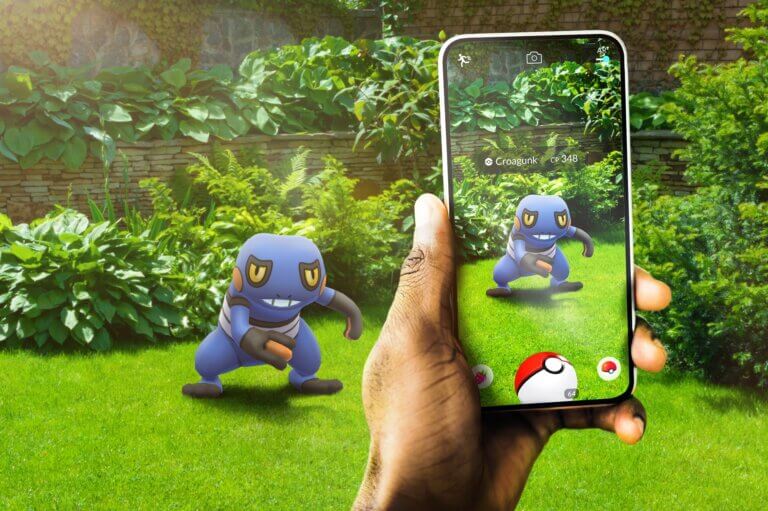
Way back in the summer of 2016, gamers of all ages were treated to the world-changing event that was the release of Niantic’s Pokémon GO. By harnessing augmented reality, they brought anyone with a smartphone to partake in the game. Overnight, people were everywhere looking for their favorite Pokémon —viewed not just on a screen, but seemingly right in front of them. Using augmented reality, or AR, Pokémon that we all know and love would be viewed through our phone’s camera.

If you’re curious about AR games, this article will guide you through what they are, the best titles available, and what makes them stand out.

What Is Augmented Reality?

Image designed by Freepik

Consider augmented reality, virtual reality’s little brother. It is a halfway point between the real world and virtual environments. In augmented reality simulations, the real world is infused with virtual objects (like Pokémon) and provides an interactive experience.

It can also be known as ‘mixed reality’, as it does just that; it mixes the computer-generated world with our reality.

The potential for augmented reality is easier than ever in this day and age. With merely smartphones or tablets within our reach, we can be intimately introduced to the concept of augmented reality.

In many augmented reality experiences, the user’s GPS is used to create a more realistic approach to gaming, allowing for the seamless transition between real-world environments and technological ones.

It is plain to see that augmented reality has brought us leaps and bounds technologically to places where we haven’t been before. That is fine, but what about the most important thing for us all? I am, of course, talking about GAMES, specifically, AR games.

How Does AR Gaming Work?

In AR gaming, specific hardware and software are necessary to open up a world of possibilities:

  • Camera and Sensors
  • Location-Based Gameplay
  • Real-Time Interaction

Types and Genres of AR Games

AR gaming covers a wide range of styles and audiences. These are some of the most popular game genres:

  • Adventure & Exploration
  • Competitive Multiplayer
  • Educational
  • Fitness & Health
  • Puzzle & Strategy
  • Horror & Thriller

The Best Augmented Reality Games

Pokémon GO was not the first, and definitely won’t be the last augmented reality game. Well, here is the list of the 10 best AR games:

Pokémon GO

Pokémon GO: Moving to a New Home with ScopelyNiantic, Inc. | 2016 | Free

This was the game that Pokémon fans worldwide were waiting for: a game to catch Pokémon and use them to battle at certain hotspots in the real world (usually landmarks or other places with heavy foot traffic), labeled as gyms, to exert dominance on other users.

The reason it is more relevant than ever is that Niantic keeps improving the game with more updates and lots of events.

It is clear that the popularity has not waned one bit for Pokémon GO, making it, I believe, one of the contenders for best AR games and, dare I say, all the time.

Difficulty

Its various features, such as Gym battles and Raid Bosses, can present challenges that require strategy and cooperation, especially for higher-tier encounters. The game balances casual gameplay with elements that can be complex for those seeking a more competitive experience.

In-Game Purchases

  • In-Game Currency Packs: Purchase packs of in-game currency at different price points for various in-game transactions and items.
  • Event Access: Obtain tickets or bonuses for access to special in-game events or content during limited-time promotions.

Zombies, Run!

Review: 'Zombies, Run!' Brings Dead Fun to Your Runs – GeekDadSix to Start | 2012 | Free

Zombies, Run! was released in 2012 by British game developers Six to Start. This augmented reality game is very story-driven, having the player listen to stories about a zombie outbreak, as well as having the players become proactive members.

Players will have to do what we now know is expected of us in a dreaded zombie outbreak: collecting valuable items for survival, helping others, and, of course, running from the zombies.

Along with all of this, the supplies the runner picks up during their exercise session will, in turn, benefit the town of Abel Township. The game then transitions to a city builder, like a strategy game, in which you can improve buildings and defenses.

And, as expected, the better the player does in terms of exercise, the more beneficial the town and its bonuses become, creating a nice cycle of positive health as well as addictive gameplay.

These aspects of positivity are just one positive aspect of augmented reality games and the bright future they have in our society.

Difficulty

The game is designed to be accessible to all fitness levels, with adjustable difficulty settings. It provides an engaging challenge by integrating zombie chases, requiring players to increase their pace to evade the undead.

In-Game Purchases

  • Premium Content Access: Unlock additional content, features, or benefits within the game with these in-game purchases.
  • VIP Membership: Subscribe to a VIP Membership for exclusive perks, content, or bonuses during your gameplay.

Harry Potter: Wizards Unite

Harry Potter Wizards UniteNiantic, Inc. | 2019 | Free

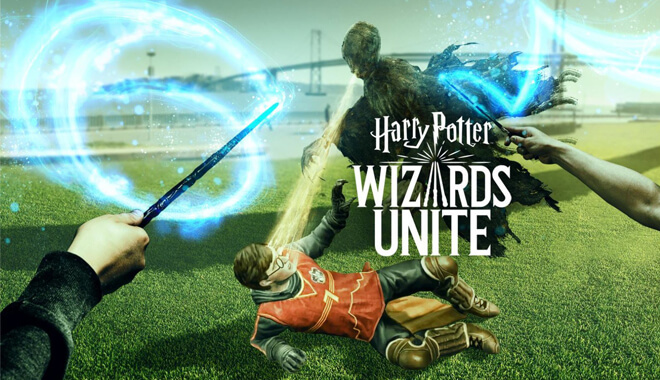
As you can surmise, J.K. Rowling’s beloved world of wizards and muggles comes to life in this augmented reality game. The premise is simple: the player takes on the role of a wizard who must battle beasts through the use of their GPS and cell phone.

In the game, the player chooses all their favorite aspects of the Harry Potter wizarding world, namely, choosing all of the customizable elements. Want a cool wand? Which house do you want to be part of? After you decide which specific wand and wizarding house to align with, and your specific class (in the guise of creative titles like Professor, Auror, or Magizoologist), you will travel around and battle mythological beasts like the basilisk and trolls from the Harry Potter books, films, and franchise.

And another surprise, Niantic published this title. They also worked alongside Warner Bros. Games to develop. It truly seems that Niantic is one of the pioneers in popular augmented reality games, and I am all for it.

Difficulty

“Harry Potter: Wizards Unite” offers a multi-layered gameplay experience that can be initially overwhelming for newcomers due to its array of features and mechanics.

Spirit Camera

Spirit Camera Augmented Reality GgameTecmo Koei | 2012 | Paid

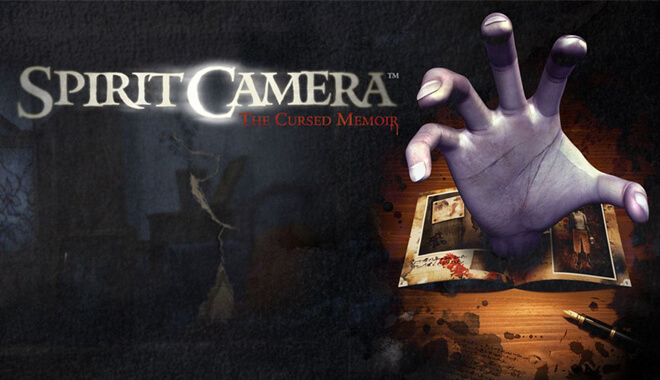
Make sure you are playing in broad daylight with this next title. Evoking imagery and fond memories of the terrifying Fatal Frame series of horror games, Spirit Camera has you thrust into the position of a character wielding a camera (the Camera Obscura) that defeats ghosts.

For the Nintendo 3DS, Spirit Camera is a handheld Fatal Frame title, released in 2012. The game is split into three different game modes: story, minigames, and challenges. The story mode is where most of the ‘meat’ of the gameplay lies, especially the augmented reality features of the game.

The game is split into three different game modes: story, minigames, and challenges. The story mode is where most of the ‘meat’ of the gameplay lies, especially the augmented reality features of the game.

Difficulty

The game’s reliance on specific AR and gyroscope conditions, such as needing well-lit areas and ample space, can make it inconvenient and challenging to play in various settings.

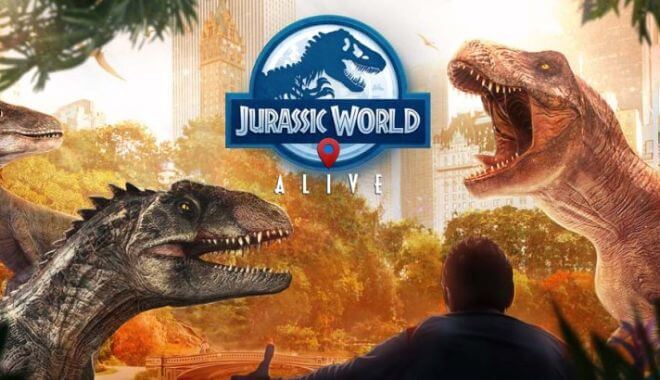
Jurassic World Alive

AR Game - Jurassic World AliveJam City, Inc. | 2018 | Free

“Jurassic World Alive” is an Augmented Reality (AR) mobile game that was released to coincide with the 2018 Jurassic World movie. Developed by Ludia and co-published by NBCUniversal, the game plunges players into a world where they can collect, evolve, and engage dinosaurs in strategic turn-based battles.

Drawing elements from the movie, such as the concept of collecting dinosaur DNA, the game stands out with its innovative features. While it pays homage to the cinematic universe of Jurassic Park, “Jurassic World Alive” offers a fresh and immersive gaming experience, making it a standout title in the AR gaming genre.

Players prepare their teams, evolve their dinosaurs, and then dive into the action-packed combat. Outside of combat, players engage in collecting genes for specific dinosaurs, with stages like the Hunting stage, where they shoot darts to collect dinosaur DNA.

What Makes It Great

Innovative Augmented Reality (AR) Experience: Unlike many movie tie-in games, “Jurassic World Alive” offers a unique AR experience, allowing players to collect and interact with dinosaurs in the real world through their mobile devices.

Strategic Gameplay: Beyond just collecting dinosaurs, the game offers a deep turn-based combat system. Players can evolve their dinosaurs, prepare their teams, and engage in 1vs1 battles, making strategic decisions based on each dinosaur’s unique abilities.

Broad Accessibility and Replayability: The game is designed for a wide audience, from casual players to hardcore gamers. With its high accessibility, varied gameplay modes, and connection to the beloved Jurassic Park franchise, it offers a lot of content and replay value.

Difficulty

The turn-based combat system adds depth, challenging players to think tactically in 1v1 battles. While the game incorporates AR elements similar to Pokémon Go, it also offers diverse gameplay modes, making it both engaging and moderately challenging for players.

In-Game Purchases

  • Monthly Subscription – Offers various benefits and rewards for subscribers.
  • In-Game Item – Players can acquire various in-game items, which include items to enhance gameplay or cosmetic items.

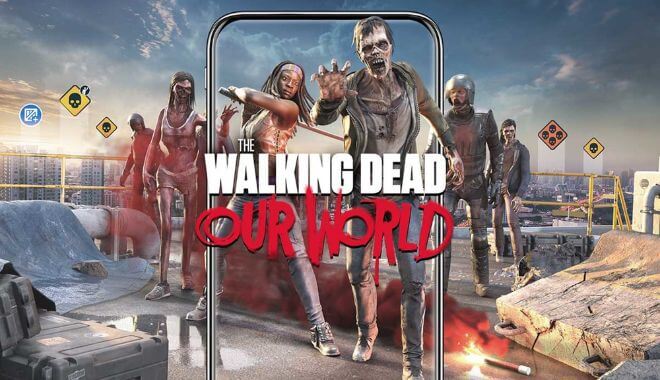
The Walking Dead: Our World

AR Game - The Walking Dead: Our WorldNext Games | 2018 | Free

“The Walking Dead: Our World” offers players a unique blend of real-world interaction and virtual zombie combat. Players can team up with friends or even strangers in the game to tackle these undead foes. They can also embark on missions to rescue survivors, earning extra points and even constructing shelters for the uninfected, adding another layer of depth to the game.

Additionally, the game introduces building elements, allowing players to create shelters for survivors, further enhancing the gameplay’s depth. The game is easy to dive into, with players simply pointing their cameras at the ground to engage with zombies.

Overall, “The Walking Dead: Our World” offers an engaging mix of AR gaming and strategic combat, making it a must-try for fans of the series and newcomers alike.

What Makes It Great

Real-World Integration: The game seamlessly blends the virtual world of zombies with the player’s real-life surroundings, offering a unique and immersive AR gaming experience.

Collaborative Gameplay: Players can team up with friends or even strangers within the game to combat zombies, emphasizing the importance of teamwork and strategy in surviving the apocalypse.

Diverse Challenges and Missions: Beyond just combating zombies, players can embark on missions to rescue survivors, construct shelters for the uninfected, and strategize to use their resources effectively, adding depth to the gameplay.

Difficulty

The game emphasizes strategy; every bullet counts, and players must choose their mode of attack wisely. Additionally, missions involve rescuing survivors, which rewards players with extra points, and there’s an innovative feature allowing players to construct shelters for the uninfected.

With impressive graphics that make the undead appear lifelike in real-world settings, players must be vigilant and strategic to survive in this game.

In-Game Purchases

  • In-Game Currency – in-game currency with real money for buying various items and upgrades.

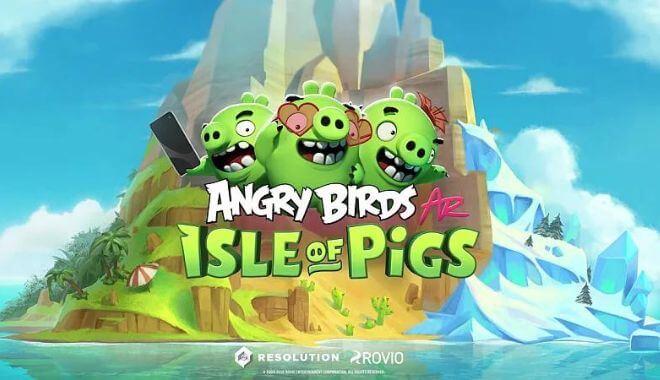
Angry Birds AR: Isle of Pigs

Angry Birds AR- Isle of Pigs AR gameRovio Entertainment | 2019 | Free

“Angry Birds AR: Isle of Pigs” marks a significant evolution for the iconic Angry Birds franchise, bringing the game into augmented reality. Developed by Resolution Games and published by Rovio, this iteration allows players to experience the game’s 40 levels superimposed onto their real-world surroundings.

Whether it’s your kitchen floor or a city park, players can physically move around the structures, identifying weak points and hidden items, adding a layer of strategy and immersion not seen in previous versions.

The game retains the classic Angry Birds mechanics, where players launch birds with unique abilities from a slingshot to topple structures and defeat the mischievous pigs. However, the transition to AR means players now navigate in three dimensions, making trajectory prediction and shot placement even more crucial.

The game’s AR technology is lauded for its stability and realism, with only minor hiccups in gameplay. As the review suggests, “Angry Birds AR” not only rejuvenates the franchise but also stands as one of the most impressive showcases of augmented reality in gaming to date.

What Makes It Great

Augmented Reality Integration: The game seamlessly superimposes its 40 levels onto real-world surroundings, allowing players to physically move around and interact with the game environment, adding a new layer of immersion and strategy.

Engaging Gameplay: Retaining the classic Angry Birds mechanics, the game challenges players to think in three dimensions. The AR functionality allows players to identify weak points and hidden items, and strategize their shots more effectively.

Stable AR Technology: The game’s AR tech is notably stable, with levels appearing grounded in real-world surroundings. This solid illusion enhances the overall gaming experience, making the virtual and real-world blend almost seamlessly.

Difficulty

While the game retains the familiar mechanics of launching birds to topple structures and defeat pigs, the AR dimension adds depth, requiring players to think spatially and consider angles and trajectories in three dimensions. The game strikes a balance between challenge and engagement.

In-Game Purchases

  • Advertisement Removal – Remove ads for a one-time purchase or with a subscription fee.

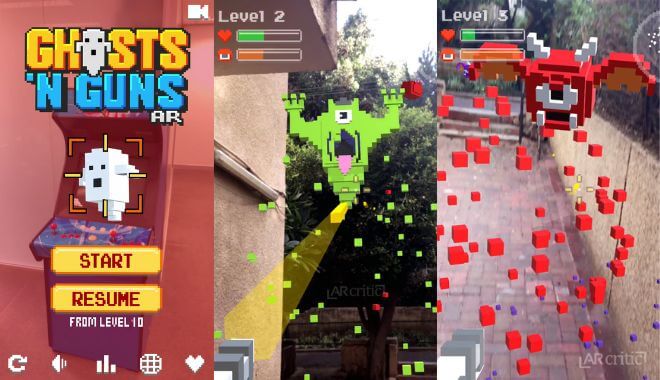
Ghosts ‘n Guns

Ghosts 'n Guns AR gameTurbo Chilli Pty Ltd | 2017 | Free

Ghosts ‘n Guns” is an ARKit arcade game for iOS that thrusts players into a vibrant pixel-art world where they fend off hordes of invading pixel ghosts. The game is played from a first-person perspective, challenging players to eliminate these spectral invaders that appear in their real-world surroundings.

It stands out for its one-touch controls, allowing players to shoot continuously, a feature that proves essential given the unpredictable movement of the ghosts and the sheer number of enemies that spawn.

Coupled with modern AR technology, “Ghosts ‘n Guns” offers a delightful blend of old-school charm and cutting-edge gameplay, making it a must-play for both arcade enthusiasts and new gamers alike.

What Makes It Great

One-Touch Controls: The game features intuitive one-touch controls, enabling players to shoot continuously. This design choice enhances the gameplay experience, especially given the unpredictable movement of the ghosts and the volume of enemies that appear.

Challenging Boss Fights: Beyond the standard enemies, the game introduces boss fights that are both visually entertaining and challenging. These encounters add depth to the gameplay and provide players with a rewarding experience upon completion.

Retro Pixel-Art Design: The game’s pixel-art visuals and soundtrack evoke a sense of nostalgia, reminiscent of classic arcade games. This design choice, combined with modern AR technology, offers players a unique blend of old-school charm and contemporary gameplay.

Difficulty

The game boasts charming pixel-art visuals reminiscent of classic arcade games, and its standout features are the challenging boss fights. These encounters are not only visually entertaining but also offer a balanced gameplay experience, demanding players to strategize and adapt to the erratic movements of the bosses and their accompanying fighters.

In-Game Purchases

  • Premium Upgrade – Purchase the Premium Upgrade to enhance your gaming experience with additional features and benefits.

BBC Civilizations AR

AR Game - BBC Civilisations ARBBC Media Applications Technologies Limited | 2020 | Free

“Civilisations AR” is a groundbreaking augmented reality app developed in conjunction with the BBC Two series “Civilisations.” The app, a collaboration between BBC Arts, BBC R&D, Nexus Studios, and around 30 museums and galleries across the UK, allows users to bring the treasures of these collections into their own homes. By overlaying virtual objects onto the real world, users can explore and interact with over 40 meticulously scanned artefacts from various museums and galleries.

Whether it’s a hidden gem in a remote museum or a renowned masterpiece in a major city, “Civilisations AR” brings these artefacts to life in the user’s environment.

Beyond just viewing, the app encourages users to delve deeper into the history and significance of each artefact, fostering a deeper connection to the art and the BBC Two series.

What Makes It Great

Diverse Collection: The app showcases a curated selection from over 280 artefacts submitted by more than 50 museums and galleries. This vast range ensures users are exposed to a rich tapestry of human history and art from various cultures and time periods.

Real-World Contextualization: Unlike traditional museum visits, the app allows users to place artefacts in their own environment, be it their living room, garden, or classroom. This juxtaposition of ancient artefacts in contemporary settings can lead to new perspectives and interpretations.

Interactive Learning: The AR experience is not passive. Users can move around the artefacts, view them from different angles, and get up-close details, promoting a more interactive and hands-on approach to learning.

Difficulty

There might be challenges in understanding the historical context and significance of each artefact. The experience is designed to be accessible and informative for users of all backgrounds and ages.

Five Nights at Freddy’s AR

AR Game - Five Nights at Freddy’s ARIllumix, Inc. | 2019 | Free

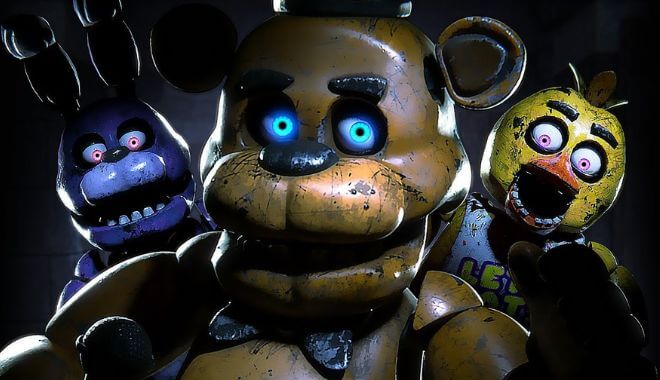
“Five Nights at Freddy’s AR: Special Delivery” (FNaFAR: SD) revitalizes the renowned horror game franchise by introducing augmented reality (AR) into its gameplay. In this iteration, players are thrust into a world where Fazbear Funtime Services delivers animatronics right to their doorstep.

The game’s AR mechanics are straightforward yet engaging. Players use their device’s camera to scan their environment, and when static appears, it signals an animatronic’s proximity. The objective is to locate and zap these creatures before they attack.

Beyond the thrill of the chase, the game offers a mischievous twist: players can design their own animatronics and unleash them on others, hoping to give them a genuine scare.

What Makes It Great

Personalized Horror Experience: The game’s AR feature transforms familiar surroundings into a horror playground, making the scares more intimate and personal. This close-to-home experience amplifies the game’s tension and fear factor.

Community Interaction: The ability to send out custom-designed animatronics to other players fosters a sense of community interaction. This feature not only adds a competitive edge but also encourages players to get creative in their designs to out-scare their peers.

Evolving Gameplay: While the game retains the core essence of the Five Nights at Freddy’s series, the introduction of AR and the ability to create and send out animatronics adds layers of depth and strategy, ensuring that even seasoned players find new challenges to tackle.

Difficulty

The game’s AR mechanics are straightforward: players use their device’s camera to scan their surroundings, and when static appears, it signals an animatronic’s proximity. The game thrives on its fun and campy horror elements, making it suitable for both younger audiences and casual horror fans.

In-Game Purchases

  • In-Game Currency Packs: Purchase packs of in-game currency at different price points for various in-game transactions and upgrades.
  • Animatronic Skins: Customize and enhance the appearance of your animatronics with different skin options available for purchase.
  • Additional Game Content: Unlock extra game content, such as episodes or special challenges, by making in-game purchases.
  • Starter Packs: Acquire starter packs offering items or bonuses to help kickstart your game progress.

Honorable Mentions:

Aside from the 10 recommended titles on the list, here are more augmented reality games that will surely deliver a unique gaming experience:

  • Euclidean Lands
  • Father.IO AR Laser Tag
  • Genesis Augmented Reality Trading Card Game
  • Kings of Pool AR
  • Temple Treasure Hun

Final Thoughts

Augmented reality games have changed how we learn and play. At the same time, it is plain to see that augmented reality games hold a much more significant role in the way we interact with the world around us and with others.

Beyond entertaining, these games have become transformative catalysts. The positive impacts these games have, namely coming together as a society to share great experiences, and even improving health, have proved to be an extreme boon to the game development industry.

Whether you prefer to catch Pokémon, run with zombies, or visit ancient civilizations from your living room, there’s an AR game out there for you. Whatever you choose, these 10 AR games are no doubt the best bet on premier augmented reality entertainment on the market today.

What is PhysX? The Best Guide to Nvidia’s Physics Engine

0

If you know your way around technology, whether you are a hardcore gamer or a casual computer user, the chances are that you have heard of Nvidia. For over 30 years, Nvidia has been bringing quality to computers everywhere, making it the world’s first-ever $5 trillion company. In fact, it is the company responsible for some of the most powerful graphics cards you can get on a gaming rig.

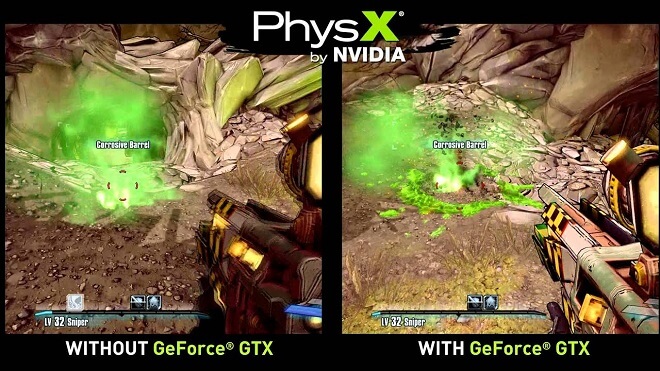
Specifically, this tech giant is the reason why a character’s cape swirls in the wind, or how debris spreads realistically after an explosion in a video game. In particular, it is the magic of PhysX. Open-source engines like these are an excellent opportunity for gamers and game developers to harness some of the impressive horsepower that Nvidia offers. But what exactly is it, and why does it matter for gamers and developers alike?

This article explores PhysX, its features, supported platforms, and how it has become a game-changer in the industry.

What is PhysX System Software?

PhysX is an open-source physics engine development kit, also known as an SDK. Along with the catchy name, is a piece of middleware from Nvidia. This means that it provides accessibility to other platforms, along with the one it was initially intended for.

How It Works

Since it is developed by Nvidia, you can expect it to perform at an extremely accelerated rate. This commitment to some of the fastest processing cores allows for PhysX to deal primarily with fantastic environmental and physical effects. Things like incredible explosions, debris, realistic smoke and fog, detailed character animation and looks, and, most breathtaking, realistic clothes and fabric behavior.

Key Features

  1. Open Source

Open Source, which means that the course code is open for all to use for free, is a fantastic way for developers and creative minds to engage with the game development process for no investment at all but their free time.

  1. Discrete and Continuous Collision Detection

Always improving the gaming physics experience, it deals in both discrete and continuous collision detection. What that boils down to is that they’re using the top software to further immerse gamers by making particular objects interact with the world appropriately.

  1. Classical and Soft Body Dynamics

PhysX deals heavily with the two main facets of physics in games.

  • Classical dynamics are the physics that we’re more familiar with in real life. This includes the motion of objects like projectiles, how machines move and operate, and the way the universe looks and acts. These are basically the building blocks for everything that it does.
  • Soft body dynamics are more specified toward computer graphics and gaming. Soft body dynamics aims to create realistic simulations for gamers and game developers to have aspects of the game’s more minute details, like the way a character’s shirt billows in the wind, all the way to the more critical information, like how bricks in a building move after an explosion.

Supported Platforms

The list of the supported platforms for PhysX is a long and impressive one.

  • Microsoft Windows
  • macOS
  • PlayStation 2
  • PlayStation 3
  • PlayStation 4
  • Xbox 360
  • Xbox One
  • Wii
  • iOS
  • Android

How to Install

Since Nvidia has made PhysX an open-source engine, you can easily download it right from the company’s site at no cost.

Now that you have a better idea of what you are dealing with, let’s start installing the engine, shall we? Mosey on over to the NVIDIA PhysX System Software download page. Here you’ll find the system specs and release history.

All you have to do is press’ download now’ to begin your download, imagine that! After this, it will alert you that the PhysX download contains the NVIDIA display driver and GeForce Experience application.

Continue on and click on ‘Save’ to begin the download to your browser. When this download completes, open up the containing folder and follow the installation steps given to you by Nvidia.

Notable Games

PhysX software seems to have had a hand in the development cycles of some of the most iconic games that have ever been created in our modern gaming landscape. When it comes right down to it, if you have picked up a gaming controller in the past 20 years, you have definitely played a game developed with the help of PhysX and Nvidia.

What games use PhysX system software?

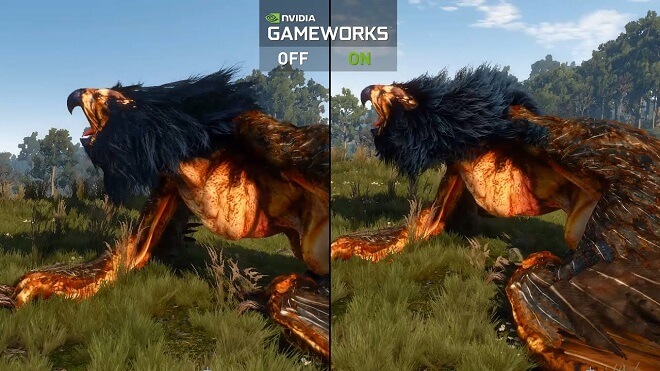
The Witcher 3: Wild Hunt

The Witcher 3: Wild Hunt, Blood, and Wine, Hearts of Stone

  • Developer: CD Projekt
  • Initial Release Date: May 19, 2015
  • Multiple platforms

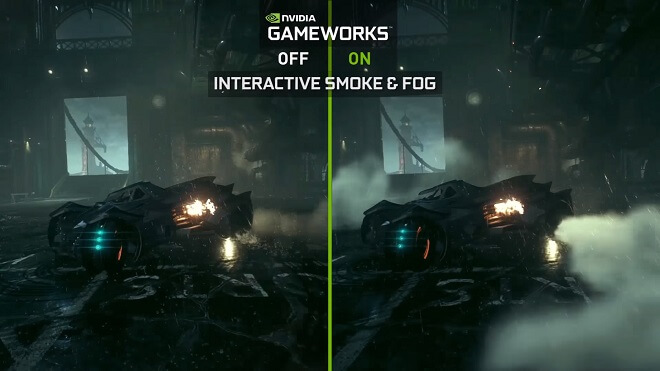
Batman: Arkham Knight

Batman: Arkham Knight

  • Developer: Rocksteady Studios
  • Initial Release Date: June 23, 2015
  • Multiple Platforms

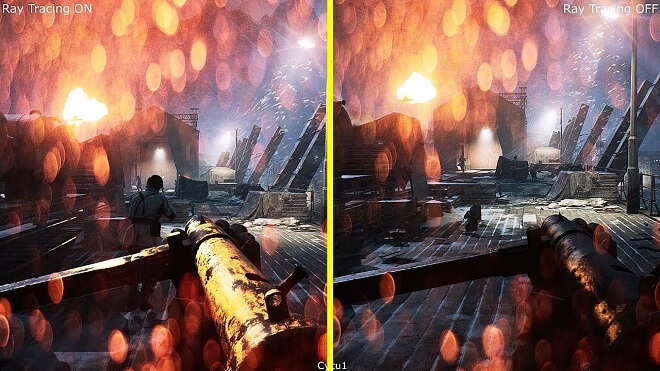
Battlefield V

Battlefield V

  • Developer: DICE, Criterion Software
  • Initial Release Date: November 20, 208
  • Multiple Platforms

Borderlands 2

Borderlands 2

  • Developer: Gearbox Software
  • Initial Release Date: 18 September 2012
  • Platforms: PlayStation 4, PlayStation 3, Xbox 360, PlayStation Vita, Classic Mac OS, Microsoft Windows, Linux

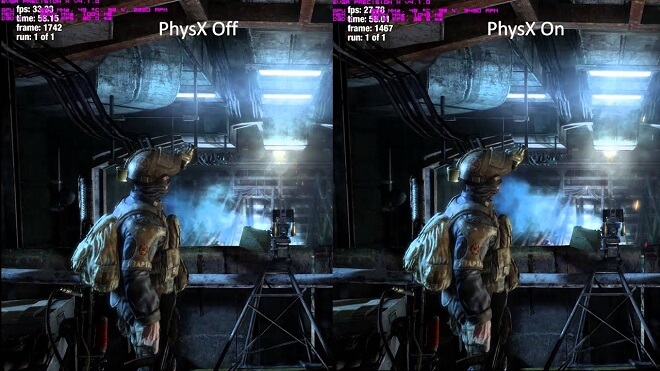
Metro: Last Light

Metro: Last Light

  • Developer: 4A Games
  • Initial Release Date: May 14, 2013
  • Platforms: PlayStation 3, PlayStation 4, Xbox 360, Microsoft Windows

More games…

  • Cyberpunk 2077
  • Call of Duty: Modern Warfare
  • Assassin’s Creed Odyssey
  • Overwatch
  • The Elder Scrolls V: Skyrim

Frequently Asked Questions

Is an Nvidia GPU necessary to use PhysX?

No. While Nvidia GPUs enable users to get the full potential for advanced effects, PhysX can run on CPUs just fine.

Does my game slow down due to PhysX?

Yes, frame rate drops are imminent if there are poorly optimized implementations. However, PhysX improves visuals with the tiniest performance loss when properly optimized.

Is PhysX only for games?

Although it is mostly used in gaming, PhysX can also work in scientific research, simulations, and virtual reality projects.

Can you benefit from using PhysX?

Absolutely! If you use PhysX in your game that you are developing, chances are that you will be dealing with powerful, open-source software that the top professionals in the industry use.

Can I uninstall the Nvidia PhysX system software?

Yes and no. Like with any programs on your system, you can remove Nvidia’s PhysX software through the ‘add/remove programs’ feature. However, there is a strange situation where you can technically uninstall PhysX, but parts remain on your system.

Final Thoughts

The main conclusion that you can quickly draw is that PhysX and Nvidia have had an influential hand in nearly all modern gaming hits of today. They have transformed how people experience digital worlds by making games more immersive and visually stunning.

Overall, Nvidia’s open-source PhysX engine provides developers and gamers alike with some powerful development tools to experience. Whether you’re a developer seeking to propel the boundaries of realism, a player wanting realistic action, or both, everyone wins when interacting with Nvidia’s PhysX engine.

What Does Anti-Aliasing Do? The Ultimate Guide

0

When pursuing the settings of your go-to favorite PC game, there’s your standard set of options like audio options and more. You have probably noticed something called anti-aliasing in the graphics menu in particular.

It includes a bunch of different options to modify your graphical quality. However, what does anti-aliasing do? It sounds impressive, but tweaking with the possibilities even makes a big difference to your game-playing experience? What is aliasing, and why are we against it?

Although perhaps not as severe as it once was, anti-aliasing is still a necessary process, especially in the game design process. If you want your game to appear clean and well-made, you need to harness some of the tricks of the trade when it comes to anti-aliasing.

Let’s see what does anti-aliasing do in games precisely, and how it can assist you with your own game design projects.

What Is Anti-Aliasing?

Let’s determine what aliasing is in the first place and go from there. Interestingly enough, aliasing isn’t a unique phenomenon to video gaming. In fact, it’s quite common in anything that deals with satellite or radio signals, too.

Anti-aliasing a fundamental technique used in computer graphics production that smooths out edges, making more realistic images. This technology blends colors to achieve life-like appearance.

Why is it called aliasing, though? Well, when you see an image, like a string of text, for example, reconstructed through a digital process, what you’re seeing is an alias of that image.

What Does Anti-Aliasing Do? Less is More

Let’s strip away the mystery of what anti-aliasing is. Anti-aliasing is when different forms of software smooth down jagged and unseemingly looking graphics. So yeah, it can make a pretty big difference in an immersive game like Far Cry 5 or even Skyrim.

Luckily for us gamers, anti-aliasing has become less and less of a severe concern, as technology has advanced considerably since the days of extensive anti-aliasing needs. However, it’s still needed in some circumstances, and why take the chance?

Anti-aliasing kind of ties in with the idea of ‘less is more.’ When you have a ton of pixels and edges or jaggies, the game’s scene and graphics seem a little busy.

When you apply some anti-aliasing techniques, you shave down many unneeded pixels and therefore create less’ noise.’ The fewer pixels and jaggies, the better your scenes will look. Less is more.

Jaggies and Moire Pattern

Moiré

Aliasing produces many unseemly and unattractive patterns and images, often breaking images down and making them look poorly constructed. There is even a term for the nasty-looking graphical glitches produced by bad aliasing: jaggies. Jaggies are the nickname for images that suffer from jagged edges due to shoddy anti-aliasing or no anti-aliasing at all.

This is especially important in video games. When we play graphically impressive games on our consoles or powerhouse PCs, we want the best visuals possible. That’s why when we get an alias of images, they can turn out ugly. A particularly infamous example of a byproduct of aliasing is the moiré pattern. The chances are good that you’ve seen the moiré pattern. While not unique for aliasing, it’s an expected outcome of mixed signals and bad digital aliasing.

Types of Anti-Aliasing (With Pros, Cons, and Best Uses)

There are quite a few options for anti-aliasing, and that’s a great thing. While it depends on the game and computer, you may not have complete access to all anti-aliasing types right off the bat. Depending on the hard drive and graphics card you are working with, you may only get a few options.

In graphics options menus, you may see different options for anti-aliasing power, depending on your hardware. If you’re using an old laptop, chances are you might not even be able to use anti-aliasing at all.

However, if you have a gaming rig, you can usually pump up the anti-aliasing capabilities up to 16x, giving you a genuinely smooth graphical experience.

Let’s break down each branch and type and get a better idea of what they’re capable of and when to use them.

Spatial Anti-aliasing

This is the form of anti-aliasing that aims to find a balance between high and low resolution. This basically means that the game or piece of media has a higher frequency than the medium through which it’s viewed.

If you’re playing a game that requires a lot of heavy-duty hardware, but you’re watching the action through a lower resolution monitor, things could end up looking a little wonky.

This is where spatial anti-aliasing comes in. Spatial anti-aliasing smooths outlines and makes everything run at a desirable rate.

Spatial AA Methods:

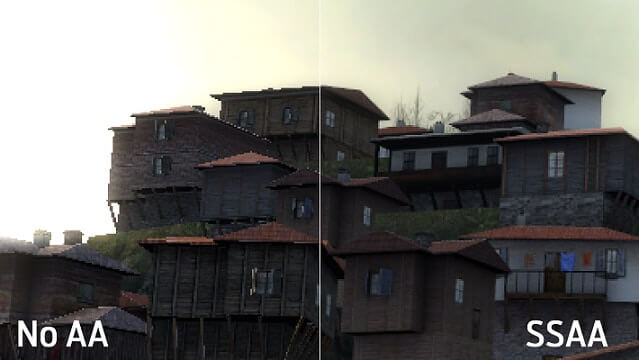
  • Supersampling Anti-Aliasing (SSAA)

SSAA

SSAA was the very first form of useful anti-aliasing and is also referred to as FSAA, Full-Scene Anti-Aliasing.

Supersampling anti-aliasing is pretty cost-heavy due to the software and hardware requirements used to make it work. You could bypass the cost and demanding requirements by quite literally cutting corners and modifying pixel edges manually.

The reason it’s also called full-scene anti-aliasing is due to its integration with photorealistic images. Since that’s the case, games rarely have SSAA options, as game anti-aliasing has moved far past it.

You primarily use SSAA on photorealistic images to make them appear full and more life-like. However, it’s not meant to make everything look good. When used with the wrong type of image, like simple lines, it can actually decrease sharpness and clarity.

Since it’s so expensive to run this type of anti-aliasing and requires significant processing power, many modern titles and game developers have ditched it in favor of newer, more balanced types of anti-aliasing.

Choose your anti-aliasing method wisely!

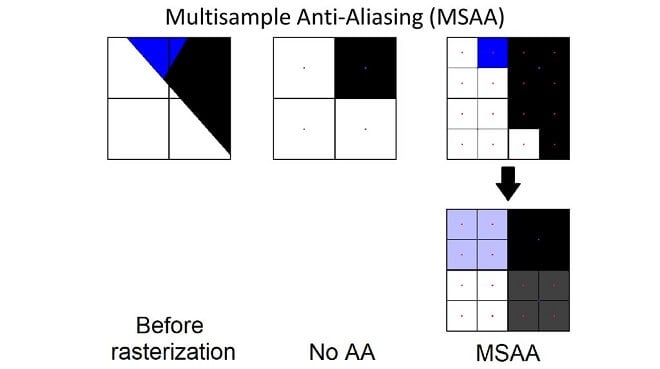
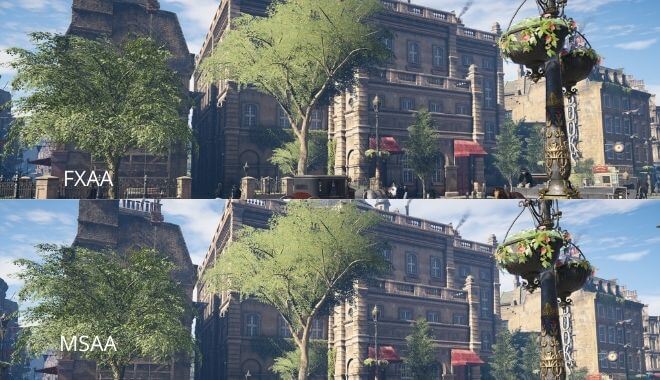
  • Multisample Anti-Aliasing (MSAA)

MSAA

MSAA is the standard and most basic anti-aliasing method you will see in the current gaming landscape. It’s not too impressive in its capabilities, but it gets the job done. However, most AAA titles today, which use deferred rendering, may not support MSAA. Nonetheless, compared to SSAA, it’s much more inexpensive as it’s more straightforward. Processing power gets saved.

  • Coverage Sample Anti-Aliasing (CSAA), EQAA

These are more modern forms of anti-aliasing out there. They stand for coverage sample anti-aliasing and enhanced quality anti-aliasing, and they are suited particularly toward different graphics cards.

CSAA is for Nvidia, and EQAA is for AMD graphics cards.

These two forms of anti-aliasing are even better at improving game performance. It basically raises the quality to the highest form of anti-aliasing, while lowering performance requirements. It does this by doing conditional anti-aliasing, i.e., determining when to use CSAA and EQAA in certain situations instead of it being active all of the time.

Post-Anti-Aliasing

This is the simpler of the two main types of anti-aliasing. Rather than trying to find a balance between both high and low resolutions, this one simply tries to blur edges and other things (like jaggies) after the rendering process.

Post-Process AA Methods:

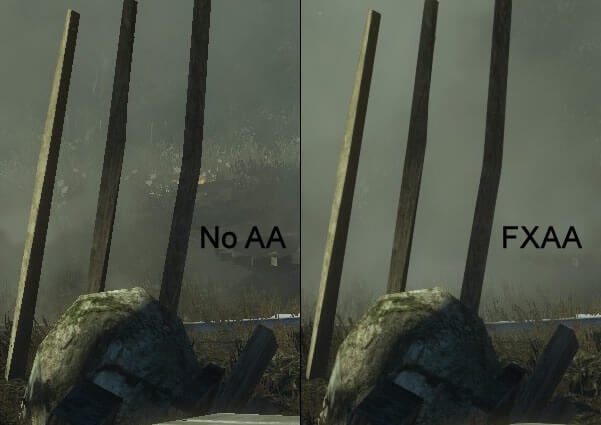
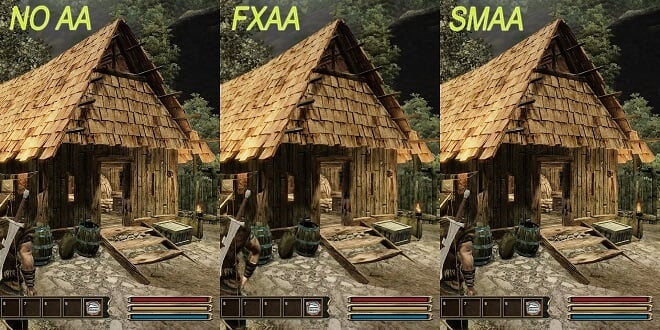
  • Fast Approximate Anti-Aliasing (FXAA)

FXAA

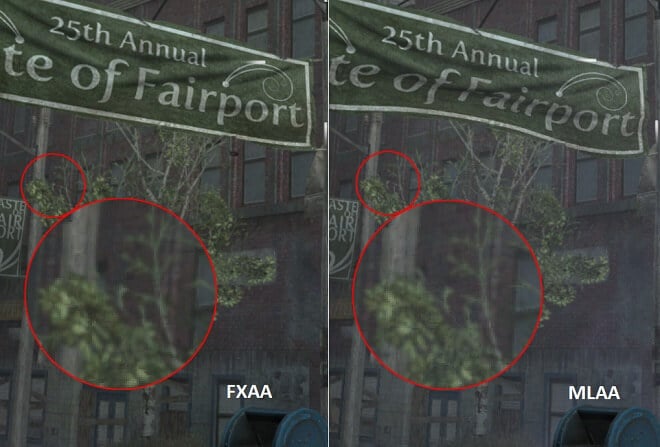
Fast approximate anti-aliasing is just that: fast. Developed by Nvidia, FXAA aims to fix all jaggies in pixels immediately after the pixels are rendered. This is a quick way of smoothing things out, and even covers a wide range of different aliasing.

FXAA is fantastic, as it takes different positive methods of other anti-aliasing techniques and throws out the negatives. It’s quick and can easily judge when and where a pixel needs smoothing.

FXAA was and is extremely popular with nearly everyone. However, modern developers that aim for improved image quality and efficiency now often lean toward TAA, SMAA, and AI-based solutions.

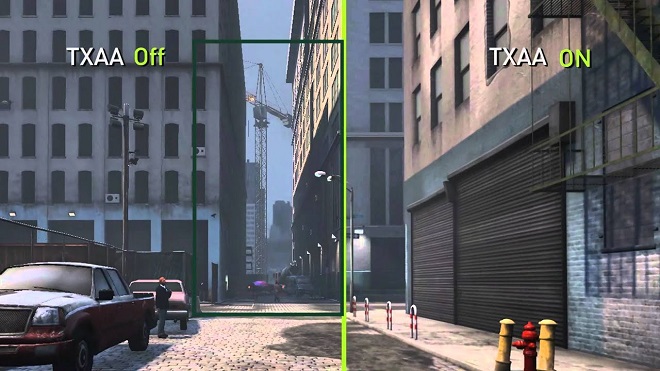
  • Temporal Anti-Aliasing (TXAA)

TXAA

Capitalizing on their success with fast approximate anti-aliasing, Nvidia released the next type of anti-aliasing, TXAA, or temporal anti-aliasing. This is an extremely performance-heavy type of anti-aliasing, but its results are absolutely stunning.

It attempts to stamp out any graphical irregularities like flickering and more, giving you a smooth and cohesive experience.

Which Anti-Aliasing is Best?

Depending on your project and who you ask, the likely answer for which anti-aliasing is best would probably be fast approximate anti-aliasing.

It just works.

The rapid ability for post-processing anti-aliasing makes it a darling in the game development world. It provides beautiful and definite results in the shortest amount of time. Truly the best of both worlds.

There are many different variations of the main types. For example, Sub-Pixel Morphological Anti-Aliasing, or SMAA, combines aspects of FXAA as well as MSAA.

Game developers and graphics card developers are always looking for the best mix, a trade-off between performance requirements and post-processing image quality.

Which Anti-Aliasing Technique Should You Use?

I wish there were a clear answer, as it entirely depends on what you are trying to accomplish. Also, keep in mind that graphics cards sometimes don’t support specific anti-aliasing types, so you need to choose wisely based on your hardware setup.

For example, CSAA is native only to Nvidia, while EQAA is for AMD graphics cards.

It also depends on your preference and what your game is like. If you’re trying for a more cinematic experience and can afford the hardware and software costs and performance, why not try something like TXAA?

If you create a puzzle game where you want to use anti-aliasing on photorealistic images on single screens, try something a little simpler like SSAA. No one anti-aliasing technique truly works for everyone or everything perfectly, so you’ll need to experiment a little bit and determine which types of anti-aliasing work best for your projects.

Which Anti-Aliasing is Best?

This depends on your game development toolkit. If you want quick, on-the-fly anti-aliasing techniques, FXAA might be up your alley. However, if you can spare some serious hardware power, choosing something like MLAA is an excellent choice.

Something to consider is finding a good balance between solid anti-aliasing and preserving image quality. FXAA sacrifices image quality for fast anti-aliasing rendering, while other anti-aliasing types need powerhouse machines to run.

Something in the middle is SMAA, also known as enhanced subpixel morphological anti-aliasing. This blends stable retention of image quality while not requiring too much computer horsepower.

More specifically, something that’s almost a direct combination of the two types of anti-aliasing is called CMAA. Conservative morphological anti-aliasing gives you softer image quality and less blurring. Truly the best of both worlds.

Is It Better to Have Anti-Aliasing On or Off?

It’s a smart idea to have anti-aliasing on with certain forms of anti-aliasing, like CSAA, anti-aliasing kind of turns off when it’s not necessary. This is a great help if you can’t determine when to use it. Other than that, it’s always a good idea to have anti-aliasing on, if your hardware can take it.

While some jaggies or other visual irregularities may go unnoticed, many gamers are incredibly observant and will let you know if what you made doesn’t make the grade in terms of graphical superiority. Just don’t read the comments!

A Quick Note on What to Avoid

Two particular aspects of anti-aliasing can be detrimental to your progress as a game developer.

While having anti-aliasing on a lot can smooth out edges, if you don’t keep it in check, it can actually sometimes make your images blend. This is known as banding. It’s not exactly the end of the world, but if you are looking for great graphics, the last thing you need is banding to occur and make everything turn into one object.

Another aspect to avoid in the practice of anti-aliasing is its blatant overuse. If you’re a beginner, start small! It may be tempting to kick anti-aliasing into overdrive since it makes everything a little prettier. But be warned, overuse can lead to banding and take away from your game’s final experience.

Comparing Some Anti-Aliasing Types

To better illustrate the differences, let’s put some of the most popular anti-aliasing methods against one another and determine which you should use from the results.

FXAA vs MSAA

Compare FXAA vs MSAA

FXAA is the powerhouse that shocked the game development community with its ability to basically eradicate all negative aspects of lousy aliasing. It does a fantastic job of smoothing things out.

However, FXAA might get a little too overzealous with smoothing. This means that some fraction of image quality is reduced due to the sheer power of FXAA.

MSAA does a good job, too, without sacrificing the image quality. Therefore, if you want to maintain the image’s absolute integrity, maybe going with MSAA is an excellent choice. It’s a perfect middle ground between incredible anti-aliasing power vs. a more balanced graphical development experience.

FXAA vs SMAA

SMAA vs FXAA

FXAA, absolutely destroying jaggies, uses very little computer processing power compared to its predecessors. While something like SMAA does a fantastic job of anti-aliasing, it needs a ton of computing power to work.

FXAA may sacrifice some image quality, but it works extremely fast with a fraction of the hardware requirements. This could be reason enough to use FXAA instead of SMAA. However, FXAA uses an automatic sharpening tool when anti-aliasing, so it may look way more detailed than SMAA at first, which doesn’t use a sharpening technique.

MLAA vs FXAA

FXAA vs MLAA

Much like SMAA, MLAA uses a ton of processing power. The power is well-used, though, as the finished product is stunning.

FXAA, as you know, is quick and does a fine job. If you’re creating a game that is atmospheric and slower-paced, using MLAA is an excellent option.

FXAA is better at editing fast-paced games, like first-person shooters, to quickly edit rendered images on the fly.

Tutorials

What better way of illustrating what anti-aliasing can do than by checking out some informative tutorials to help you better understand the visual aspect, as well as implement anti-aliasing into your game?

Basic Anti-Aliasing for beginners (Pixel Art Tutorial)

This is a reliable and informative video about very simple anti-aliasing. User MortMort goes into great detail about anti-aliasing concerning pixel art, one of the leading anti-aliasing beneficiaries. He shows examples of his own work where anti-aliasing has transformed his flat images of pixel art into more detailed and full graphics.

Easy Anti Aliasing Tutorial

YouTube user Sadface_RL gives a straightforward yet effective tutorial on a single image. Using just a circle and line made of simple, one-color pixels, he masterfully demonstrates anti-aliasing fundamentals. No bells and whistles, but remember, less is more.

Anti-aliasing – Interactive 3D Graphics

This short video by Udacity is a basic introduction to anti-aliasing that can give you a clear, concise definition and visual aid for the entire practice of using anti-aliasing. This video is actually a smaller part of a fully online course provided by Udacity.

Chapter 6: Anti-Aliasing

Open Game Art is not only a fantastic open forum to download various sprite sheets and unique characters, but they also give you great information. This basic primer for anti-aliasing shows you the need for anti-aliasing in games, showing you how to clean up images and why it’s needed in nearly every game, from pixel art to 3D masterpieces.

Performance Considerations

After asking the question, “what does anti-aliasing do?,” you are now probably curious about its impact on your game’s performance. Here is a quick explanation. Since SSAA and TXAA are more advanced, they need more processing power and can lower your frame rate. On the other hand, FXAA might not deliver the best image sharpness but it is less demanding.

The Future of Anti-Aliasing

Nowadays, technology just keeps on getting better. For instance, the need for traditional anti-aliasing may decrease as display resolutions increase. Looking forward, people can expect better image quality with less performance cost brought about by new methods that uses AI and machine learning, such as AMD’s FSR or Nvidia’s DLSS.

Frequently Asked Questions (FAQ)

Q: What does anti-aliasing do in games?

A: It makes graphics appear more realistic and less pixelated by smoothing out jagged edges on objects.

Q: Does anti-aliasing impact performance?

A: Yes it does. While there are lightweight options available, highly advanced anti-aliasing methods can lower your frame rate.

Q: Should I always use anti-aliasing?

A: Not necessarily, as it dependes on what you are working with. If you see jagged edges and if your hardware can handle it, then yes. However, do not use it or opt for a lighter method when on high-res displays or with limited hardware.

Q: Can text readability be improved using anti-aliasing?

A: Yes! It makes text appear smoother, which makes small fonts easier to read.

Q: Which type of anti-aliasing is best?

A: There is no ranking types of anti-aliasing. Usage depends on various factors, such as hardware, preferences, and the game itself. Nonetheless, FXAA is a good starting point for most users.

Conclusion

Anti-aliasing has been and will always be a vital force in gaming graphics. With each significant graphical advance in video gaming, anti-aliasing has risen to the challenge of creating a smoother, more beautiful visual improvement.

Whichever type of anti-aliasing you choose for a project will most likely objectively look better than without it. Anti-aliasing is a subtle and useful technique to give your game that extra something it was lacking.

Despite its widespread use and significance within the game development community, being a game developer and actively worrying about what anti-aliasing technique to use is surprisingly low on the list of priorities. Many hardware pieces do all of the heavy-lifting, and game hardware can determine which one works for your game the best.

However, by using our advice, you can stay better informed if you need to manually select which type of anti-aliasing works best for your project.

Regardless of importance or difficulty in choosing, no one likes to see jaggies in their games. Avoid jaggies, avoid the moiré pattern, and you will be good to go. Now get developing!

Gabe Newell: The Unstoppable Force Revolutionizing Gaming

0

If you have spent any time playing PC games on Steam, you owe gaming tycoon Gabe Newell a debt of gratitude. Never heard of his name before? Well, Newell and his company, Valve Corporation, are the ones responsible for transforming and reshaping the global gaming community through legendary Steam sales and groundbreaking games.

In line with this, tons of titles across video game genres keep the industry growing. It’s excellent, and it’s the end product of Valve and Gabe Newell’s hard work. In the same way, Gabe Newell has a staggering net worth, thanks to Valve, Steam, and fantastic games.

I’m sure there are still several questions crossing your mind, such as who is Gabe Newell — and how did he rise to become one of gaming’s most influential figures?

Let’s take a deeper dive and see where Newell came from, what he has accomplished, and what the future holds for him and his company, Valve.

Quick Personal Life and Fun Facts

  • Within the gaming community, Newell is affectionately known as “Gaben,” a moniker derived from his work email.
  • Gabe was a Harvard University dropout before starting a career at Microsoft.
  • Newell is the pioneer of flat culture, which provides people the freedom to create ahead of structure.
  • Gabe’s multi-billion-dollar net worth makes him the wealthiest figure in the gaming space.
  • Newell owns the marine research organization Inkfish and co-founded Starfish Neuroscience.
  • He overcame Fuchs’ dystrophy, a congenital eye condition, through two cornea transplants.
  • Gabe Newell’s life outside of work is as interesting as his professional career, owning several yachts and spending much of his time at sea since the pandemic.

Early Life and Education

Gabe Logan Newell was born on November 3, 1962. He is a native of Colorado. Newell went to Davis Senior High School because he grew up in Davis, California. At an early age, he already developed an interest in computers, programming, and how technology can create immersive experiences.

In 1980, Newell enrolled at Harvard University, intending to study programming and pursue a traditional career path. He spent his college years at the illustrious Harvard University. After three years of study, his education was cut short when he dropped out to join Microsoft. It was a big risk at the time, since the Windows-maker was not yet the tech giant it is today. Although he claimed he learned a lot at Microsoft, his ambitions were bigger than Bill Gates.

From Microsoft to Valve: The Birth of a Gaming Giant

At Microsoft, Newell thrived. Gaben spent thirteen years working as a programmer and a technical executive. He was part of the development of the early versions of the Windows operating system. Later on, Newell recalled that working at Microsoft was “the best place in the world to learn how to be a programmer.” According to the gaming tycoon, this period shaped his approach to software development and business.

After his stint at Microsoft, he was inspired by the innovative spirit of the company and the success of independent game developers. That is why Newell co-founded Valve Corporation along with former Microsoft colleague Mike Harrington in 1996.

Valve’s culture of innovation, nurtured by Newell, pushed the company’s creative freedom to flourish, setting the stage for the company’s achievements and ongoing successes.

Games Credited

Let’s see some of Gabe Newell’s most notable games.

Half-Life

Half-life
Half-life | Image Credit: Steam

Half-Life was revolutionary. Not only did it give rise to the amazingly popular sequels and Team Fortress 2, but it was a fantastic first-person shooter.

Combining action, sci-fi, and horror, there was truly nothing like Half-Life up until that point. Playing as the silent protagonist and scientist Gordon Freeman, players are almost immediately thrown into the dark and dangerous Black Mesa Research Facility.

After a science experiment goes horribly wrong, Freeman faces alien horrors, hostile soldiers, and more.

Half-Life 2

Half-life 2
Half-life 2 | Image Credit: Steam

This is where Gabe Newell and Valve really took off. Half-Life 2, released in 2004, was a watershed moment for gaming.

Taking the influence from its predecessor, Half-Life 2 was an insanely detailed step up. Including a gripping, exciting story mixed with a revolutionary physics engine, Half-Life 2 impressed everyone who played it.

It won numerous awards and is a fantastic game to this day.

Portal

Portal
Portal | Image Credit: Steam

You knew it was coming. Portal was a fantastic and groundbreaking game coming on the tail end of Half-Life 2.

As part of The Orange Box collection, Portal threw players into a challenging puzzle environment, having them use a set of two portals to get to the end of levels and solve puzzles. This was and is still an entertaining game.

It’s also the origin of the popular meme ‘the cake is a lie. I won’t tell you what that means: you have to play the game to find out.

Impact on the Industry

To say that Gabe Newell has had an impact on the game industry is probably the understatement of the century. With the launch of Steam, he and Valve have changed the way that gamers purchase and download games.

While some have criticized DRM and the lack of physical copies of games, Steam has effectively changed the world of gaming.

Why VR Might Not Be Too Far Out

Gabe is confident that not only are virtual reality games going to pick up steam (see what I did there?), but that they are just a few steps away from basically melding our minds with computers. Nowadays, this type of game is very much possible to prosper with the Best VR & AR Hardware being readily available.

His views were made clear around the time of the much-anticipated VR title, Alyx. This game puts you in the shoes of Alyx Vance, one of the main characters from Half-Life 2.

Achievements and Recognition

Over the years, Gabe Newell’s contribution to the video game industry has earned him numerous accolades. To name a few, the awards won by Gabe Newell are as follows:

  • BAFTA Fellowship Award for Games in 2013
  • BAFTA Games Award for Best Multiplayer (Left 4 Dead 2) in 2010
  • BAFTA Games Award for Best Multiplayer (Left 4 Dead) in 2009
  • Game Developers’ Choice Pioneer Award in 2010
  • Game Developers’ Choice Awards for Best Game (Half-Life 2) in 2005

In addition, Gabe Newell was inducted into the Academy of Interactive Arts & Sciences (AIAS) Hall of Fame in 2013, solidifying his status as a true game industry legend. Moreover, Newell has been recognized by IGN in the Top 100 Game Creators and by D.I.C.E. Special Awards for his role in shaping modern gaming. Furthermore, he is consistently listed by Forbes among the richest and influential personalities in the field.

Net Worth: The Wealth Behind the Legend

Gabe Newell’s net worth in 2025 is estimated at $11 billion, mirroring his ownership stake in Valve and the continued success of Steam. As one of the wealthiest people in the US and in the video games sector, Newell’s achievements show how creative leadership can translate into both cultural and financial influence.

Philanthropy and Charity Work

Beyond business, Newell is committed to philanthropy and giving back to communities. In 2020, he helped launch The Heart of Racing to raise funds for children’s charities in Seattle and New Zealand. Among his most famous charitable gestures was sending Gnome Chompski into space in partnership with Weta Workshop and Rocket Lab. Using Gnome Chompski, Gabe Newell aims to raise money for the children’s unit at New Zealand’s Starship Children’s Hospital.

Newell’s philanthropic actions echo his belief in using success to make a positive impact. By combining creativity, spectacle, and community engagement, he has inspired other people in the gaming industry to support charitable endeavors.

Legacy of Gabe Newell

Gabe Newell’s vision, leadership, and willingness to take risks have left an indelible mark on the gaming world. He has transformed how games are developed, distributed, and experienced, while empowering indie developers and shaping the global gaming community.

With games like Half-Life 2, Portal, and Team Fortress 2, Gabe Newell focused all of his ambition, creativity, and determination on innovating games forever. Above all, his impact on the video game industry and the gaming community is permanent, and his legacy will continue to inspire generations of gamers and developers.

Now….where is Half-Life 3?!

10 Best Shoot ‘Em Up Games for Classic and Modern Gamers

0

Shoot ’em up games, also known as shmups, are some of the most exhilarating and enduring game genres in the gaming space. In fact, the origin of the ‘Shmup’ genre dates back to 1962, and new titles are still coming out in modern times. From dodging complex bullet patterns to blasting waves of enemies to setting a new high score, shmups test reflexes, strategy, and timing. It delivers simple but challenging gameplay.

In addition, their appeal is timeless. Specifically, the thrill of perfecting a one-credit clear (1CC) or the nostalgia of classic arcades continue to attract both newbies and seasoned gamers in the scene. Geometry Wars is the perfect example of what gamers and developers refer to as a shoot ‘em up. It is you, your weapons, and countless enemies all bent on seeing you dead.

Considering almost 50 years of its existence, there is no doubt that there is a shoot ’em up game for every playstyle. Whether you are chasing leaderboard supremacy, exploring diver ship load outs, or casually enjoying colorful projectiles, you will surely find a shmup that will challenge and entertain you.

However, with tons of classics and modern options, deciding where to start can be a problem. To help you, this guide provides a walkthrough of the history, sub-genres, essential titles, and tips regarding shoot ‘em up games.

What is a Shoot ’Em Up Game?

Okay, what is a shoot ’em up game? By definition, a shoot-’em-up is a video game genre in which players defeat as many enemies as possible using a single character. Basically, it’s when a player is tasked with defending themselves from an ungodly barrage of enemy fire. In most cases, shmup players control a ship to avoid endless waves of opponents. At its core, the challenge is to survive as long as possible by mastering patterns, chaining attacks, and managing weapons. The enemies in these titles are hellbent on destroying the player, and you have to move and fire fast. Shmups are known for their simple controls, but with intense gameplay that tests both your hand-eye coordination and reaction times.

The Evolution of Shmups

Shooting Games Space Invaders

Shoot ’em up titles have evolved since 1962’s Spacewar! As one of the earliest competitive shooters, it was a competitive multiplayer shoot ‘em up, with two players dogfighting each other on-screen.

I was surprised to learn that we had been so far advanced with multiplayer in the early sixties. Spacewar! Paved the way for emerging titles that would come along in a decade or so, in the form of Asteroids and Space Invaders, cementing the genre’s popularity. In Asteroids, the player is constantly bombarded by the titular asteroids, and you’re frantically shooting and flying around to avoid them. Meanwhile, Space Invaders was a ‘fixed shooter’; the player was confined to the bottom of the screen while the imposing wall of alien invaders kept speeding up and looming over the player. The player is tasked with shooting up and timing their cannon fire just right to win.

Not only were these games breaking new ground, but they were easy to control and had simple, yet captivating visuals. These early classics emphasized reflexes, tight, responsive controls, and high-score chasing elements, still central to modern shooters.

You can thank shoot ’em ups for making video games a pop culture phenomenon they are today. What would the world of gaming be like without the invention of the shoot ’em up? I dare not even imagine such a world. Not only that, but older shoot ‘em ups have held up pretty well. You can easily play Asteroids and Space Invaders from an Internet browser.

My fellow classmates and I would often get in trouble for accessing such games in class when we were supposed to be ‘learning’ and ‘bettering ourselves.’ Psh! This is the essence of the shoot ‘em up genre. It’s all about survival and defending yourself for as long as you can.

Types of Shoot ‘Em Up Games

As technology progressed, shmups branched into multiple sub-genres. In line with this, modern hits have expanded mechanics with hyper mode systems, break mechanics, and auto-tracking systems, creating more strategic depth than ever before. Today, there are several shoot ‘em up games that offer unique experiences.

  • Bullet Hell (Danmaku)
  • Horizontal Scrolling
  • Rail Shooters
  • Roguelike/Modern Hybrid
  • Twin-Stick/Multidirectional
  • Vertical Scrolling

Top 10 Shoot-Em-Up Games of All Time

shoot-em-ups

Ikaruga

Ikaruga is not just a game; it’s a testament to the golden era of arcade shooters. With its intricate enemy patterns, the game demands perfection and memorization, offering a challenge that keeps players hooked. Its unique polarity system adds depth, requiring players to masterfully switch between two colors to absorb or deflect bullets.

Platforms: Nintendo Switch, Dreamcast, and GameCube,

R-Type Final 2

R-Type Final 2 is a visual spectacle, blending nostalgic side-scrolling action with modern graphics. Its challenging gameplay, vast arsenal of 100 unlockable ships, and intricate power-up systems make it a thrilling experience. It offers both hardcore and casual gamers a journey worth embarking on.

Platforms: PlayStation 4, PlayStation 5, Nintendo Switch, Xbox One, Xbox Series X/S, and PC

Gradius V

Gradius V brilliantly revives the essence of classic arcade shoot-’em-ups, blending nostalgia with modern gameplay. Its intricate power-up system and intense action sequences challenge both reflexes and strategy. Developed by the renowned Treasure, this game is a testament to the timeless allure of side-scrolling space battles, proving that some gaming styles are truly evergreen.

Platform: PlayStation 2

Touhou 6: Embodiment of Scarlet Devil

Touhou 6: Embodiment of Scarlet Devil is a mesmerizing blend of intense bullet-hell gameplay and captivating lore. Crafted by the solo genius, ZUN, it revitalized the shoot-’em-up genre with its intricate bullet patterns and compelling characters. Dive into Gensokyo’s mystique, challenge formidable bosses, and lose yourself in its entrancing soundtrack.

Platforms: PlayStation 4, Nintendo Switch, and PC

DoDonPachi

Dodonpachi Resurrection masterfully brings the thrill of arcade shoot ’em ups. With its vibrant visuals, intricate bullet patterns, and dynamic bosses, it offers a mesmerizing experience. While tailored for touch controls, its essence remains true to the genre, making it a must-play for shmup enthusiasts.

Platform: Arcade, Xbox 360, iOS, PC

Thunder Force IV

SEGA AGES Thunder Force IV on Switch rekindles the magic of classic shooters. With its detailed graphics, intense gameplay, and vertical scrolling that remains unparalleled, it’s a timeless gem. Enhanced with features like ‘Kids Mode’ and online rankings, it’s the definitive way to experience this Mega Drive masterpiece.

Platforms: Nintendo Switch, Sega Genesis, and Sega Saturn

Radiant Silvergun

Radiant Silvergun stands as a testament to timeless game mechanics, blending relentless challenge with a unique, persistent upgrade system. Its precise controls and diverse weaponry offer a deeply rewarding experience, while modern additions like leaderboards amplify its allure. A classic shooter that demands dedication but delivers unmatched satisfaction.

Platforms: Arcade, Sega Saturn, Xbox 360, Nintendo Switch, PC

Mushihimesama Futari

Mushihimesama, a Cave masterpiece, immerses players in a vibrant world of colossal insects. This shoot-em-up offers a unique blend of intense bullet-hell action and a rich, colorful aesthetic. With diverse gameplay modes catering to both novices and veterans, it’s a captivating experience that stands out in its genre.

Platforms: iOS, Arcade, and Xbox 360

Cygni: All Guns Blazing

Cygni: All Guns Blazing is a modern option that makes players go through projectiles and unleash power against enemies. You will still get the old-school action experience, but this time, with modern graphics and more cinematic visuals.

Platforms: PlayStation 5, Xbox Series X/S, and PlayStation 4

Espgaluda II

Espgaluda II, a masterpiece by Cave, offers a visually spectacular shmup experience that feels both fresh and well-designed. With its flexible risk/reward scoring system, it caters to both long-time fans and newcomers, ensuring an intense gameplay journey.

Platforms: Nintendo Switch, Android, iOS, Arcade, Xbox 360, and i-mode

How to Get Better at Shmups

Here is an easy guide to improve your skills at shoot ’em up games:

  1. Practice Patterns
  2. Start Easy
  3. Focus on Survival
  4. Use ‘Continues’ Wisely
  5. Study Advanced Mechanics
  6. Watch Replays & Score Attack Modes

The Future of Shmups

Shmups have been around since video games were basically invented. They have been there every step of the way: through countless births and deaths of great franchises, genres, and game gimmicks.

What does the future hold for it? Mobile platforms have been a great boon for the shmup genre, with some addictive titles easily available. You can find some great ones here.

I believe that releases like Geometry Wars give a glimpse of a bright gaming future that includes tons of great new shmup titles.

Game developers are constantly getting new ideas, so I’m confident that we could see any number of successful smash hits that could rival the success of Space Invaders and Asteroids.

Promoting a Video Game: Budget-Friendly Tips To Market Your Game

0

Games are everywhere. They’re on your phone, your tablet, PC, even on your TV channels. Pretty much everywhere.

In a market with so much great content, how do you get your game out in front of the people who want to play it?

If you’re a AAA game developer, you probably have the budget and “the name” to get your products seen.

Every other ad on YouTube is for whatever big game is coming out next. In addition to paying for advertising, the big games get plenty of coverage from blogs and publications, whose readers are hungry for the latest scoop.

An indie developer budget won’t always allow for big-time advertising, and without established clout, you’ll have to work harder to get some press. But you can definitely do it, so let’s take a look at how.

Start Early


As soon as you have a product that is representative of the look and feel of your game, it’s time to start marketing. It can be something as “easy” to produce as a screenshot.

You can scale this up as your game develops. You can produce trailers and game demos. But you don’t have to wait for those to be ready in order to start marketing your game.

By reaching out early, you will be able to build relationships as you keep influencers availed of your progress and big news.

How to market your video game?

To promote your game, first, determine who is likely to be interested in playing your game – certainly, not everyone will have an interest in playing your game; only the players that are already obsessed with your type of game. Once you identify those people, go into the places where they spend time. The more casual the interaction, the better. Continue to post early versions of your game, short video clips from your game. This is superb for platforms like Instagram and TikTok that support short videos. You can typically generate a farm of content that showcases your game. Remember, you only need a few clips to do well.

Once you have created a steady stream of short videos, reach out to mid-tier influencers, these are typically with over 10,000 followers or more. Offer beta testing, early access. Even a cash insensitive is a great idea. Mid-tier creators tend to be easier to get than larger ones, their audiences tend to trust them, and they enjoy finding new games to promote. Offer mid-tier creators early access keys to your game and give them the freedom to review/evaluate your game any way they want.

Finally, polish up your Steam page. A well-edited trailer, quality screenshots, and a clear game description will help establish credibility and will ultimately make all of the other aspects of marketing easier.

how do I advertise my game?

You’ve done your organic social and SEO bits probably at this point. But not much traction. You have a limited budget to advertise. Here is how to do it. First, you want to ensure you target your audience well, use the Meta Business Suite and Google Ads keyword tools to find your audience and they keywords you’ll target. Once established, create multiple copies of ads and push them during peak times. Hiring a top end professional in the ad space is recommended. From keyword bidding to ad copy, it’s a complex game that requires previous experience to carry out well. All campaigns should be closely monitored and updated as they go.

What else should you have?

A website can be helpful. You want a destination to which you can direct people who are interested in learning more.

If this isn’t your first game, the website could be home to your other creations as long as the games are arranged in a separate, distinct way.

You could also have a website that is specifically for the game you’re currently working on.

In either case, you need to keep it up to date. It’s helpful to come up with a loose content-release strategy.

This could be a new screenshot every other week. It could also be a new feature release. Different content will make more or less sense depending on the game itself.

But having this timeline gives you something to point to in your media outreach.

Social media is another excellent tool. Behind-the-scenes videos could be good content for YouTube.

Keep in mind that you don’t want to waste anyone’s time with this (including your own), so make sure it makes sense before you try and execute it.

If your personality doesn’t come through on video then it might not be the best way to go. A video showcasing your day-to-day in the making of this game should be funny and compelling.

A bizarre video of stressed game devs in a fluorescent-lit office building isn’t going to leave people clamoring for more.

But if you have a swanky space and your team has a lot of fun talking to each other, talking about the game, and talking about what they do, you could give the video a shot!

Twitter and Instagram are two other ways to generate some buzz. The thing is, if you don’t have any followers, nobody is going to see your content.

So what do you do? Well, a possible solution is to get thousands of more followers. This can be a challenge.

Think about the people you follower on twitter. Why do you follow them? Have they made a cool game? Do they know what they are talking about?

Do they have good tips and insights about the world of game design and development? Do they just make hilarious content?

It is likely a combination of those elements that gets you to subscribe to different people. Building that kind of rapport and clout takes time.

The bottom line is you either need to generate excellent, engaging content yourself, or you need to curate that excellent content. People will follow you if you can make yourself an authority in your field.

This strategy can take a lot of time, and it might be time you don’t have…

“I Don’t Want to Build a Raving Social Media Fan Base Right Now”


H’ok, fine. If that’s the case, then you have another option!

Reach out to the people that have already established themselves! They are all over the place!

Think about all the channels through which you get good game information: YouTube, Blogs, Twitter, Magazines (online or print), etc.

There are plenty of people in those fields that A.) is looking for stories and under the radar games, and B.) have established audiences of thousands, or hundreds of thousands, or millions of people.

If you can get a quality game in front of those loyal, ready-to-play fans, you will be in excellent shape.

OK, you’ve decided that you want to reach out to influencers with sizable fan bases that would get a kick out of your game.

This is a great option because it doesn’t cost you anything, but it’s also going to take a bit of work on your part, and some trial and error too.

You’re going to have to pitch these influencers when you contact them.

There are definitely right and wrong ways to do this; email pitches are a little outside the scope of this article but give it a quick google and you’ll find all kinds of “email pitching tips.”

Here are some quick tips: First, you need to stand out. The more popular these people are, the more emails they’re getting from people like you (and all kinds of other people too, probably) looking to get their own games in front of a big audience.

Don’t waste their time with a long, rambling email. Instead, use short sentences and get to the point.

Show them that you value their time. Comment on something they’ve done.

“Hey PewDiePie, My name is Gregory and I’m working on this awesome 4D simulator game. It’s the future.

I really dug your piece a while back on inter-dimensional time travel. It was really poignant, in fact I actually pulled a good bit of inspiration from it when I started designing this game.

Listen, I’d love to hear what you think. Would you have a quick 3 minutes to watch a trailer I put together for the game?

Either way, thank you for what you bring to the gaming community, and thanks for hearing me out.

All the best,
Gregory”

It’s short, it’s sweet, and it doesn’t waste anyone’s time. It’s much more compelling than just saying “review my game on your channel.”

Getting him to agree to give you 2 minutes of his time is significantly easier than trying to convince him to sit down and play your game for an hour and a half.

Obviously, elements of the email will change based on your game and how far along you are in development.

It’s good to send pitches around your milestones or checkpoints in the project, that way the influencers have something to write about or tweet about.

Take an indie rock band. If they wanted to get a write up in a magazine, which offers looks more appealing to the editor?

Hi, we are an indie rock band, we are from NYC, we have been playing for three years, we are working on an album, we would love to have a write-up. (you already know this is the boring one.)

Hey, we are a New York City-based indie rock band. We’re coming up on our first album release in a few months, and we have a new single we’re ready to release. Would you have five minutes to talk about the possibility of debuting it on your e-mag?

Number two is worlds better. Worlds better!

Here’s another quick tip: Look for games that have things in common with your own, figure out who has reviewed them, and reach out to those reviewers, making mention of the similar comparisons!

Other Good Options


Crowd-sourcing can be a good option. You’ll get a lot of traffic for your project, and some of those could result in backers.

There are other devs on there too, and building those relationships could result in future collaborations.

Marketing at cons requires a booth, which can be pricey.

Groups like Indie Mega Booth and IndieCade offer some help for those of you on indie budgets.

They don’t always get you a discount game booth at an event, but they can help get you other kinds of exposure. Give them a look.

If you don’t get a booth or can’t afford a booth, you can always go to cons to hand out swag or fliers that will get people to your game/website/funding page.

Events can be excellent networking opportunities not just for your game, but for your career as well.

The final option we’ll look at in the world of YouTube ads. When used correctly, you can make a little bit of money go a long way. YouTube has a powerfully specific advertising tool.

It lets you pick what kinds of videos you want to play in front of (as in specific channels), what kind of users you want to advertise in front of (as in their other interests), and even where in the world you want the ads to run (as in USA? Australia? Britain?).

Test different segments of the market, and see where your greatest support bases lie.

Nothing to It But to Do It


There are so many options for you, and there are ways to advertise while accommodating all kinds of budgets.

A lot of it will be trial and error, especially starting out. Mix up your outreach methods. See what ends up working for you and your game.

Inaction is the real way to fail, experimenting with different approaches should count as a win, even if it doesn’t yield the results you had hoped for.

If it was easy, everyone would do it! But with some serious commitment, you could garner some excellent support for your game.

Why the Best Slots Have the Best Design Teams

0

In the world of gaming, design drives everything. Players may be drawn in by bright colours or catchy themes, but the real magic of a great slot game comes from the design team behind it. Slot developers compete in a crowded market, and what separates the average games from the industry leaders is not luck but craftsmanship. It takes skilled artists, UX designers, sound engineers and mathematicians working together to create an experience that feels polished, engaging and worth returning to.

Design Is More Than Looks

At first glance, slot games may look simple, but a top-performing title requires thoughtful visual identity, balanced mechanics and seamless animations that guide the player through each spin. Everything on the screen is intentional. The way symbols align, the clarity of colours, the pacing of effects and the structure of the interface all shape how players interact with the game.

A strong design team understands how to make a game intuitive. If players can instantly understand how the slot works without feeling overwhelmed, the design has succeeded. This clarity comes from applying core principles of layout, pacing and visual hierarchy, many of which align with the broader fundamentals. These principles help shape interfaces that feel natural and engaging from the very first spin.

Creating Atmosphere and Emotion

A great slot is also a great piece of entertainment. That means the visuals and audio must work together to build a distinct atmosphere. A fantasy-themed slot needs rich environments and immersive effects. A retro or arcade-style game benefits from playful animations and nostalgic sound cues. Good design teams know how to match the theme with an emotional tone so that every spin reinforces the world they have built.

Music and sound effects can influence how satisfying the gameplay feels. The rise of modern audio engines has made it possible to create layered soundtracks that adapt to potential wins, bonuses or symbol interactions, giving the experience more personality and energy.

Balancing Fairness and Excitement

Behind the visual layer is a complex mathematical structure. Designers and game mathematicians collaborate to ensure the slot feels exciting while maintaining fair probability distribution. The rhythm of near misses, bonus triggers and symbol variety must be carefully tuned. If a slot pays out too unpredictably or feels flat, the experience suffers. The best design teams understand this balance and build gameplay loops that help keep players engaged without becoming confusing or repetitive.

This matters especially in the world of digital platforms, where any top online slots games have to aim to try to keep players entertained. Players have many choices, and only a well-crafted design can keep them interested.

Why Good Design Leads to Long-Term Success

When a slot game becomes popular, it is rarely by accident. Strong design creates a clear identity, and that identity builds trust. Players return to games that are visually appealing, easy to understand and emotionally rewarding. Many design insights within the broader gaming community show that consistency in style, UX clarity and thematic depth allows games to grow into long-term favourites.

In the end, the best slots succeed because their design teams understand how to shape experience, not just graphics. They blend art, logic and emotion into something cohesive and memorable.

Best Practices for Game Dev Teams to Avoid Virus Infections

0

Many people start dreaming about working in the sphere of game development as soon as they discover the joys of playing. They imagine coming up with exciting plots and then bringing them to life scene by scene, character by character. However, the reality of game development is much more complicated.

The entire game dev team has a ton of responsibilities, including writing code, creating assets, testing new builds, and using tools to synchronize communication and file sharing. In these conditions, it’s easy for virus infections to sneak in and endanger every little thing you’ve built. In this guide, we’ll be discussing the best practices for game dev teams to avoid such viruses: stick to them, and make safety one of your key assets.

Making Sure Each Involved Computer Is Safe

Using the Internet means endangering your device. Even Mac, which is considered the safest brand of computers for game developers, can be subjected to nasty infections if you allow yourself to be careless. Take a fuq virus as an example: it can hijack your browser and take over, and the best way to remove fuqcom virus Mac is by using an antivirus app. Sounds like a basic safety rule, but it works only in combination with others, so let’s take a look.

Keep All the Systems Updated

Software creators always introduce small safety updates to fix the identified security holes and take care of the problems before they actually occur. Unfortunately, game developers are often so focused on the final goals that they fail to take these standard protection mechanisms into account.

As a game developer, you are probably using Unreal Engine, Photoshop, Visual Studio, Illustrator, and other similar systems. To protect them, you need to:

  • Activate automated system and browser updates, or at least check for them on a daily basis.
  • Restart your device or tool when the system asks for it, and check it with the antivirus.
  • In case of any issues, make sure the certificates for each system are up to date.

This basic approach will guarantee that your computer stays safe, which will extend automatic protection to all the SDKs, engines, plugins, asset packs, and Git commits you are working with to make your game happen.

Use Only Licensed Tools

Many game developers are tempted to use pirated tools and cracked paid scripts from GitHub, as it’s an easier, cheaper alternative to buying the official versions of whatever can help them create their game. That’s a serious mistake.

For one thing, by failing to buy licensed tools, you are compromising your reputation and working together with your own enemies. Among all pirated software content, games rank third at 27.36%: people who pirate them devalue your time and effort. Tool developers are in the same boat; they are your partners, so it’s only respectful to buy subscriptions instead of pirating them.

What matters even more is that by using pirated tools, you are endangering your product. Here is why:

  • Cracked versions of professional tools contain malware more often than not.
  • The virus might not be immediately visible, but it will start infecting your computer.
  • Pirated tools come with frequent lags that can result in the destruction of your project.
  • If something goes wrong, you’ll have no one to contact, as you were using tools illegally.

That’s why sticking to licensed tools should be one of the first safety practices for game developers.

Securing All the Game Files and Codes

Protecting your files and codes is another approach that should be your everyday practice.

Use a Reliable Version Control

Version control allows saving and backing up changes you are making to your game. Codes, animations, prefabs, blueprints — if even five minutes of your work are lost because of a virus, the results can be disastrous.

Choose industry-standard version control tools that can save your work. Here are the most common options for game developers:

  • Git, including GitHub and GitLab, is a favorite option of indie and Unity teams.
  • Perforce Helix Core is a standard for larger AAA or Unreal projects.
  • PlasticSCM is another favorite of Unity teams looking for better merge handling.

Apart from doing the essentials of game development, these tools guarantee automatic backups, controlled permission access, and even logs that will warn you in case of any suspicious activity.

Check the Assets You Receive

As a game developer, you have to use external assets like textures, sound effects, plugins, animations, etc. Unfortunately, any of these files can have a virus, and that’s why you need to scan all assets separately as soon as you receive them.

Create a new folder, extract relevant assets there, and scan them individually. If everything seems fine, you can add them to your project.

Building Safe Conditions

The third major safety practice entails creating safe conditions for you, your team, and your game.

Test All the Builds and Devices

Every build and every device might contain a virus infection, even if you get it from a seemingly safe party. Game dev team can’t work without using Android and iOS test phones, test PCs, Xbox devkits, etc. — you need to know how your game will function across devices.

So, scan each build and device before distribution; use secure transfers only, such as Google Drive, internal file servers, and encrypted cloud storage. Do factory resets for all devices every several weeks, and never use them for personal purposes.

Maintain Email Safety

Fake plugin updates and forged marketplace receipts can pose a huge risk to game developers. These days, attackers use sophisticated methods that might be hard to spot, so you need to be extra vigilant.

Even if a colleague sends you something, verify that they actually did it. Don’t open .exe, .scr, .js, .cmd, and .apk files blindly. Use two-factor authentication, especially for your work email, and make sure your team does the same.

Team Effort: Ensure Game Development Safety Together

By now, you know what best practices can help you secure the process of game development. Make certain every member of your team works following the same principles.

Everything, from opening the wrong email to forgetting to test one single build, can lead to a disaster on a global scale, and it’s up to your team to prevent it from happening. If you all show equal dedication to safety, no virus infection will stand a chance against your effort.

Make Better Gaming Videos: Complete Beginner’s Guide

0

Gaming evolved from being a hobby or a pastime into a lifestyle. It has become a way to establish friendships, showcase skills, and start a career to earn money. This sparked the rise of gaming videos on platforms like Twitch and YouTube, wherein a streaming culture has emerged, connecting people who enjoy the same worlds. In Q2 2025, both platforms are the top two in the gaming livestreaming market, with 54% and 24% market share, respectively. This means that there are countless channels out there doing walkthroughs, let’s plays, reaction videos, reviews, and streams every day.

At the same time, sharing your gaming experiences through gaming videos with an audience can be a great way to express yourself and your creativity, all while playing the games you love. For the most successful content creators, making gaming videos can also be very lucrative, but that doesn’t mean it’s easy. With so many creators online, it is hard to determine how you can shine through the noise.

In this article, we’ll cover everything you need to get started and give yourself an edge, so you can get filming and find your followers.

Types of Gaming Videos & Content Ideas

If you are uncertain of what kind of gaming videos to make, there is no need to worry. We got you covered! Here are some popular formats and ideas that already have established audiences:

  • Challenge Videos
  • Highlights & Montages
  • Let’s Plays
  • Livestreams
  • Reviews
  • Short-Form Clips
  • Speedruns
  • Walkthroughs & Tutorials

Tip: Try first the one that fits your personality, style, and choice of games. It makes it a lot easier to break into the game.

Essential Equipment for Making Gaming Videos

Empty gaming studio with RGB led lights powerful personal computer
Image designed by Freepik

The first step to starting a successful gaming channel is to have the right equipment. But, if you’re not too tech-savvy, it can be dizzying to Google all the equipment you’ll need to get started.

  • What’s a boom stand, and do you really need one?
  • Should you cover your room in noise-canceling fabric if you want to record anything?
  • How do you record gameplay footage anyway?
  • How do you edit it?

Very quickly, things can get pretty complex. But don’t panic! What you really need to get started is:

A Laptop Or Computer

It might go without saying, but in order to record gameplay and video footage, as well as to upload your content to YouTube, you’ll need a computer or laptop with a stable internet connection. Your footage can take up a lot of storage space, and you should have a computer that can handle using multiple devices at once. If your computer can handle filming in 1080p, even better.

If you need a better laptop to make your gaming videos, I recommend the Razer Blade 16 (2025). As for desktop computers, the Corsair Vengeance i7600 is a great option.

A Webcam, or a Camera

This is technically optional; not all gaming channels actually film themselves playing. Sometimes, just the audio, gameplay footage, and maybe an animated sprite can work well without ever having to perform live for a camera.

With that said, if you plan on streaming or filming yourself, a camera or webcam is a staple of successful streamers. The most popular webcam for streamers is the Logitech C920 (budget-friendly) or the Elgato Facecam MK.2 (best overall).

A Microphone

Audiences are largely willing to accept an entertaining video even if the video quality isn’t professional grade. But poor audio is always noticeable and can leave the wrong impression on your content. If you can get a high-end microphone with a filter, you’ll breeze past this problem and will be taken much more seriously as a content creator. Among the most popular microphones used by gamers, the Amazon Basics USB Condenser Microphone (budget-friendly) and the Shure MV6 USB Gaming Microphone (best overall) are the top picks.

Recording Software and A Game Capture Card

What is a gaming video without gameplay footage? Well, not much. To record your gameplay, you can use recording software for PC or a game capture card if you’re playing on consoles.

As far as capture cards go, the AVerMedia Live Gamer Ultra S GC553Pro (budget-friendly) and the Elgato Game Capture Neo (best overall) are the perfect options for modern consoles.

However, another strong option is the Avermedia Live Streamer 311 bundle. This set comes with everything: a mic, Avermedia’s own capture card, a webcam, and access to ReCentral (Avermedia’s recording software).

Finally, I’d be remiss not to mention OBS. OBS is free recording software and is widely relied upon by the streaming community. OBS is easy to use, has a lot of personalization options, and even lets you create instant replays during your stream. It’s a perfect screen recorder for any gaming channel.

Video Editing Software

So you have your gameplay footage all filmed and ready to go. You’ve recorded a few reaction shots of yourself, and the sound quality is great–that’s great! But none of that matters until it’s all put together, and to do that, you’ll need to use video editing software.

Adobe Premiere has been around for many years, and for good reason. It’s a professional editing software with a lot of support offered for beginners. However, it comes with a price tag of $22.99 per month for the annual billed monthly plan.

However, if you’re looking for something free, avoid programs like Wondershare Filmora. It’s a relatively new player in the scene and is great for software editing, but the free trial will put watermarks on your videos.

These five are the basics of what you need to get started, but there is a lot more equipment out there that helps improve the quality of your videos. For example, having some film-quality lighting will help your videos stand out from the crowd. Green screen software is a quick way to add professional-looking backgrounds and cool effects to your videos. But these can be expensive and will take some practice to use.

Best Practices For Gaming Videos

On YouTube, Twitch, and all of social media, this is always a big concern. You can create fantastic content, but why isn’t anyone watching or sharing it? At the end of the day, it’s up to your audience. There is no magic wand you can wave to make your gaming videos go viral, but there are some things you CAN do.

Know Your Niche

It may seem practical to focus on only popular or trending video games or topics, as they’re more likely to get views in the short term. However, long-term, it’s better that you work on the topics that you can put your genuine passion towards. It’s a competitive industry; there are millions of gaming channels out there, but that doesn’t mean you can’t find a way to stand out.

Maybe you only review games fans have sent you. Or you could specialize in terrible horror games on Steam. Or it could be that giving an authentic viewpoint on gaming news and your own charisma is enough to attract an audience.

Whatever it is, getting those subscribers will only happen if you make your own niche, not if you follow what everyone else is doing. If your current brand isn’t working, you can always change it. But be careful, audiences find it easier to latch onto a content creator who stays consistent, rather than one who changes their style regularly based on what’s trending.

Know Your Audience

Also, it’s important to try to figure out who your audience is. If your gaming videos are about speedrunning 2D Nintendo games, awesome! But it means you have to market your videos towards people who like speedrunning and retro games, not necessarily to gamers who watch Fortnite tournaments.

There may be some crossover between the two markets, but it’s better to cater to the fans you know are interested. It’s ok to have an audience that starts out small; try to get a read on what they like, and do it well. This doesn’t mean dwelling on the negative comments and taking every criticism to heart, but engaging with your fans on some level is a great way to get more of them.

Be Consistent With Uploading Your Videos

The internet is fast-paced, and its memory is short. If you only upload a few times a year, your channel may never get the large following you want. Your gaming videos should come out on a consistent schedule so that your subscribed audience can come to expect and anticipate them.

Here is a useful tip: the best time to upload to YouTube is early afternoons on weekdays, and in the morning on weekends.

It helps to have content ready to go at least once a week and upload it during those windows to ensure you get the most views right away. If you’re just starting out, it’s better to have several weeks’ worth of content filmed and edited BEFORE you start uploading. That way, you’ll be sure you have something for your audience ready while you’re filming future content. It’s a lot less stressful that way.

Create An Intro and An Outro

Creating an intro for your show is essentially a requirement. In the first 15 seconds, you’ll want to make a good impression. Youtubers making gaming videos just for fun don’t have to have an intro or outro, but a professional gaming channel almost always will. It emphasizes to your audience that your content isn’t just a one-off entertaining video, but a brand. There are many ways to do it, too. The go-to style here is animated motion titles and text.

An animated intro can set the tone of your content, build hype for an episode, and show newcomers that you have put some real work into your videos. Likewise, a good outro can keep your viewers watching to the very end, and can get your audience from one video to another through a call to action.

In short, both how you start a gaming video, as well as how you finish, will determine the lasting impression you leave on your viewers.

Make Custom Thumbnails And Titles

A thumbnail is the first thing a potential viewer will see of your video, and how interesting it looks will determine whether or not they click it.

When creating a thumbnail, it’s important to remember that half of the people using YouTube do so through a mobile device. Any text you use should be large, images eye-catching, and descriptive of the best part of the video. Also, make sure you keep the thumbnails stylistically similar enough that your followers can tell each video belongs to the same channel.

As far as titles are concerned, it’s best to hint at the content of the video without spoiling it. A title such as “I dropped and broke my new system” and an image of the broken system tell the whole story, so why watch the video? But a title like “I made a TERRIBLE mistake!” only hints at the story, and the capitalized word is more eye-catching.

All of this is a skill that takes some practice to master. But making great custom thumbnails and titles will help you make sure as many people click on your videos as possible.

Tagging Your Videos

Before someone can click on your video, they need to find it. Tags are keywords attached to your videos that allow viewers to search for them. However, with so many gaming videos and using so many tags, it can be a struggle to find which tags would give you the best results.

The best advice is to make the first tag the most important and relevant to your video, and then add the rest based on the order of importance.

YouTube and Twitch are very competitive, but if you follow these instructions, your tags should help bring potential subscribers right to your videos.

Video Length

How long should you make your gaming videos? The answer largely depends on the type of video you are making. You have about a minute to make sure someone who clicks on your video will actually watch it. So generally, a shorter video should aim for around two minutes in length.

However, YouTube and Twitch tend to reward content creators based on how long audiences watch their content. For this reason, a video between 10 and 15 minutes is the goal you want to aim for. Try not to actively waste time to reach this threshold, as your audience will likely notice, begin to get bored, and leave early.

Lastly, keep in mind that the longer the video, the more time it will take to produce and edit it. Plan your filming days and the release schedule of your videos accordingly.

Promoting Your Channel

As with many jobs, social media has completely changed how content creators have to work. To promote your gaming videos, it’s a good idea to have a regular social media presence.

Having an active Facebook and Twitter account allows you to regularly engage with your fans, keep them up to date about your latest gaming videos, attract newcomers, and report if something happens that will cause a delay in your usual scheduling.

Don’t forget to also promote your social media in your gaming videos as well. That way, you’ll get more interaction on both social media and your actual gaming videos.

Most importantly, you should make a habit of doing a call to action at the end of your videos. In a call to action, you ask your audience to subscribe to your channel, to like and comment, or to engage with your content in some way. Why do this? Because an audience is much more likely to engage with a video after a content creator they trust asks them to.

Quick-Start Checklist

I know it is a lot to take, so here is a checklist to help you organize everything and ensure that you do not miss a thing.

  • [ ] Decide on your video format and content idea
  • [ ] Prepare your equipment, including the computer, mic, webcam, lighting, and more.
  • [ ] Install recording and editing software
  • [ ] Set up and test your recording setup
  • [ ] Record your gameplay, along with the desired add-on, such as a commentary
  • [ ] Edit your video for clarity and engagement
  • [ ] Make a striking custom thumbnail and an interesting title
  • [ ] Make videos and upload content on a regular schedule
  • [ ] Market your video on social media and other available platforms
  • [ ] Engage with your audiences and keep learning

Ready to Make Your First Gaming Video?

When the struggle hits, remember that every successful creator began at the bottom with one upload. I mean, the world’s biggest YouTube star, Mr. Beast, started making videos about himself playing Minecraft in 2012. Now, he has over 450 million subscribers. It proves that making gaming videos about your favorite video games can be a dream job.

With these tools and tricks on your side, and a bit of practice, you are well on your way to creating a successful gaming channel. Whether your gaming channel succeeds or not will depend on your charisma, passion, and dedication.

Have fun, stay consistent, and let your passion shine through.

Tweening in Animation: What It Is & How It Works

0

Have you ever heard about Tweening? Do you know what it is for? Are you aware how it impacts animation?

Most people believe that animation is iconic because of the drawing skills of the artists or top-notch voice acting. They think that these factors are what enable animation to captivate audiences for over a century and bring stories and characters to life with incredible motion and expression. However, that is not exactly on point. The secret behind those smooth, lifelike transitions is the fundamental technique called tweening.

This article explores tweening, how it works, what makes it essential, and how artists can use it in modern animation software.

What Does Tweening Mean?

Tweening, short for inbetweening, refers to the process of creating images in-between keyframes. In other words, it pertains to the intermediate frames ‘in-between’ others to animate aspects of a scene. The frames that do the heavy lifting in terms of tweening are called keyframes. These keyframes, when properly utilized and implemented, give the impression of sleek, smooth movement.

A Brief History of Tweening

Tweening, rightly so, has a long and celebrated history in animation. Any animation you see has it, whether it’s the Lion King or your favorite Internet cartoon. Let us take a quick trip down memory lane.

The process can be rooted in traditional, hand-drawn animation. Animator Dick Huemer developed inbetweening in the 1920s. Since then, it became widely used in the industry due to its efficiency. Specifically, this innovation helped lead animators have more focus on drawing the keyframes and have assistants fill in the transitions. As time went by and as technology evolved, so did animation. Nowadays, there are even generative tools that use AI in animation, making the process accessible to animators of all skill levels.

Traditional vs. Digital Tweening

Let’s look at some crucial aspects of tweening animation that make it one of the cornerstones of art.

Traditional tweening is the tedious version of animation. This means every frame gets created by hand. Nonetheless, traditional, hand-drawn animation from the good old days had a pretty solid system in place to make animating a bit easier.

Generally, many people work together to accomplish this. The key animators would draw these keyframes, then hand the finished frames off to someone else, called an ‘inbetweener.’ The inbetweener pulls everything together, cleaning up rough edges and animations, along with doing some revisions of their own. This made the workflow as an animator smoother and less of a headache. Obviously, not every team or individual has the resources or manpower to have an inbetweener help them out.

On the other hand, digital tweening is the faster and more efficient version of the animation process. It is where the term ‘keyframes’ gets dropped, substituting for ‘tweens.’ Instead of manually drawing everything, the work becomes automated using modern animation software.

Types of Digital Tweening: Classic vs. Motion Tweens

Animation programs often offer various tweening methods since different projects call for different techniques.

Take a closer look at the two main types of tweens:

  • Classing Tweening is ideal for basic 2D animations. It leans more toward the traditiona technique, which involves frame-by-frame transitions and properties, such as angle, frame size, and location. However, it is not the best option for complex 3D projects.
  • Motion Tweening is more suited for interactive works like games or motion graphics due to its flexibility. Compared to the classic, this one is more automated. Plus, it is also useful in 3D environments.

How to Create Tweening Animations: Step-by-Step in Adobe Animate

Inbetweening
If we were to use Adobe Animate (which any aspiring animator should be), the steps to create a sleek, seamless tweening animation is actually quite simple.

But hold on! You need to know just a few aspects like terminology and what specific functions do.

  • The Timeline
    • This is where all of your animations are. It’s the overall timeline of your project.
  • The Tween Span
    • The tween span is the period of time where objects within a scene change. For example, the tween span consists of frames in which a character’s legs move.

Step 1: Create

Once you have your two separate frames (without a keyframe), the next step is to create said keyframe. To do so in Adobe Animate, you simply click on the asset or graphic, right-click, then select Create Motion Tween.

Step 2: Edit

Once you have selected where you want to insert keyframes and what they are, you need to do a bit of surgery on the animation timeline.

Check the ‘stage,’ making sure that the desired duration of animation is correct, along with whatever object or graphic you are inserting.

Step 3: Check and Finalize

After you are done editing and deliberating, go ahead and check if the tweening animation worked out as you intended. You can do this with the ‘onion skin’ feature, which allows you to see several frames at once. This is perfect for ensuring your principal animation, along with keyframes, are in perfect sync.

Adobe Animate is only one of the options you have at your disposal. Among the tools that animators commonly use are Adobe Animate, Autodesk Maya, Blender, Houdini, Synfig, and more.

Frequently Asked Questions

Q: What’s the difference between keyframes and tweens?

A: Keyframes refer to major poses or moments, while tween are the frames that go into the space between them.

Q: Do I need to tween every frame?

A: Not necessarily. Most of the time, animators draw every other frame (on twos) for slow motion and draw every frame (on ones) for fast action.

Q: Can I use tweening in 3D animation?

A: Yes, because the principles of tweening apply in 2D and 3D animation. However, you may notice differences in tools and techniques.

Conclusion

There you have it. That’s why tweening animations are some of the most important aspects of any form of animated media.

Without them, you’d be watching a choppy, unintelligible mess. Bugs Bunny would be about to bite his carrot in one scene, with it being gone in the next. The lack of continuity would absolutely ruin animation.

Luckily for us, there are easy ways to engage in tweening animation to bring a little life to your work.

What is Min Maxing in Games: The Virtues of a Game Strategy

0

Smart Strategy, Powergaming Precision, and a Touch of Obsession Turn Ordinary Players into Masters of Efficiency.

Play Clever, Not Sloppy

If you’ve ever sat staring at a character creation screen, sliding points around like it’s life or death, you’ve already min-maxed

Most of us just don’t call it that. Maybe you dumped charisma for strength or sacrificed speed for power because, hey, who needs to be charming when you can one-shot a boss? That, right there, is the essence of min-maxing in games—squeezing every ounce of performance out of your build until it’s a fine-tuned machine.

Some call it obsessive. Others call it strategy. But no matter if you’re tweaking your gear in Elden Ring, crunching damage numbers in Diablo IV, or chasing big rewards in online cash jackpot slots, the idea is to play clever, but not sloppy.

The Core Idea: What Is Min-Maxing in Games?

In plain English, min-maxing means minimizing your weaknesses and maximizing your strengths. Every game has a system of stats, perks, and skill trees, and players who love min-maxing live to break those systems wide open. They’re the type who read patch notes like bedtime stories and calculate every tiny stat bonus before hitting “Start Game.”

The funny thing is, this mindset isn’t new. Long before video games, min-max strategy came from tabletop RPGs like Dungeons & Dragons. Back then, you’d get players who’d roll the perfect barbarian: unstoppable in battle, hopeless in small talk. That’s min-maxing in its purest, nerdiest form.

From Dice Rolls to Digital Arenas

Once video games took off, that same mentality jumped genres. RPGs, MOBAs, shooters, even sports sims, anywhere stats exist, and it’s players looking for shortcuts to perfection. Min-maxers became part mathematician, part magician.

In online games, it’s more than theory. It’s survival. A min-maxed build can mean the difference between climbing ranks in League of Legends or staying stuck in Bronze. And while developers constantly tweak the field to balance it, players keep finding ways around it. That’s part of the thrill.

Why Min-Maxing Became an Art Form

You can’t really talk about powergaming techniques without acknowledging the community behind it. Forums, spreadsheets, and build calculators are all monuments to the min-maxer mindset. People spend hours testing every combo, every ability, every modifier. It’s equal parts science and obsession.

But here’s the real secret: min-maxing isn’t just about dominance. It’s about curiosity. There’s something satisfying about peeling back a game’s systems and figuring out exactly how it ticks. For some, that’s where the real fun begins, and it ends with the perfectly built character ready to take on the game.

Tabletop vs. Video Games: Two Styles, One Instinct

In tabletop games, min-maxing can be… polarizing. Your barbarian might be unstoppable in combat, but maybe your party’s story suffers when your character can’t carry on a conversation. Dungeon Masters love and dread these players in equal measure.

Video games, on the other hand, are built for it. Developers know players will push their systems to the limit, so they design around it. They cap levels, tweak balance, and patch exploits, but no matter how hard they try, the min-maxers always find another edge. It’s like an endless chess match between players and creators.

The Love-Hate Relationship with Min Maxing

Ask any group of gamers about min-maxing and you’ll start a debate. Some see it as the ultimate show of skill. Others turn the adventure into a numbers game.

Both sides are right. It’s a balance. You can be the master tactician, or the person everyone sighs at when you start talking about “optimal damage curves.”

Developers vs. the Min-Maxers

Game studios have learned this dance well. They know that every time they patch a character or rebalance a system, someone’s already calculating how to break it again. They fight back with unpredictability in the form of roguelike mechanics, random modifiers, and builds that reward flexibility instead of formulas.

But here’s the thing: min-maxers keep adapting. They thrive on it. That’s what makes gaming communities so alive—players constantly finding new ways to optimize, outsmart, and redefine what “winning” looks like.

So, What’s the Big Deal About Min Maxing?

At last, what is min-maxing in games really about? Mindset. It’s where a part of your brain hates inefficiency and loves improvement.

No matter if you’re fine-tuning a deck, crafting a sword, or strategizing your next jackpot spin on online cash jackpot slots, min-maxing taps into the urge to make things work better.

So yeah, maybe it’s nerdy. Perhaps it’s a bit obsessive. But it’s also kind of beautiful. Because beneath all the stats and spreadsheets, min-maxing isn’t about perfection—it’s about passion.

Prototyping Video Games: Key Methods for Better Game Design

0

Why Great Ideas Need Proof: The Real Story Behind Prototyping Video Games

An Honest Part of the Design Process

If you’ve ever sat with a game idea buzzing in your head and wondered how they get it from idea to playable game, then you may have realized there are a lot of steps. That bridge between “cool idea” and “actually fun” is where prototyping video games lives. And honestly, it’s one of the most brutally honest parts of the video game design process.

It’s also where you learn fast. Because a prototype doesn’t care about your lore bible or those 50 pages of concept notes, it only cares about how it plays. 

Designers test tiny moments over and over, the same way players experiment with choices in an online blackjack game, where every click reveals what works and what doesn’t. You can even feel that cause-and-effect loop firsthand through BetUS Casino, especially if you want to study decision-making patterns the way designers do during early testing stages.

The Heart of Early Game Creation: Why Prototyping Matters

Every developer has a story about a mechanic they thought was genius until they played it for five minutes and realized… yeah, absolutely not. That’s why prototyping video games isn’t optional. It’s survival. Prototypes strip the game down to its bones — the jump arc, the timing window, the enemy AI rhythm — and they let designers answer the first big question: Is this fun?

And fun is fragile. A tiny stat tweak, a shorter cooldown, a slightly heavier camera, or a shift in player speed can transform how a player responds. That’s why prototyping sits at the front of the video game development pipeline. It’s the pressure test for every idea that could make or break your final build.

Choosing What to Prototype First

Developers don’t start with everything at once. They usually chase the “core loop” — the action players will repeat hundreds or thousands of times. The core loop includes mechanics like shooting, jumping, and navigating conversation trees. 

Whatever defines the experience becomes the first game development prototype. If your game is about movement, build that sandbox first. If it’s about combat, drop in bare-bones enemies and start swinging. If it’s a social sim, lock in the dialogue flow.

The order matters because early mechanics influence every subsequent design decision. If your movement feels heavy, you build slower enemies and more expansive spaces. If your shooting feels snappy and aggressive, suddenly your levels need verticality and cover placement. Choosing the wrong system to prototype can waste weeks or months of development time.

Watching Real Players Always Changes the Plan

There’s nothing more humbling than watching a player break your prototype in 30 seconds. They button-mash where you expected precision. They speedrun a puzzle meant to last 10 minutes. They ignore your beautifully placed tutorial sign.

But that’s part of the magic. Player behavior is the loudest truth-teller in game design.

Designers study where players stop, hesitate, or get annoyed. They examine surprisingly effective strategies, as well as moments where the game fails to communicate well. These little behavioral cracks tell designers what needs tuning, teaching, or tossing out entirely.

Finding Balance Issues Before They Become Nightmares

Balance issues are sneaky. A weapon that feels slightly too strong during a prototype becomes completely busted once skill levels ramp up. A movement system that seems smooth in a test environment might make levels unintentionally easy. Even tiny math problems in crafting or economy systems can warp an entire gameplay session.

This is why early prototypes matter. They reveal:

  • Unintended overpowered choices
  • Difficulty spikes
  • Loops that encourage boring strategies
  • Systems that look good on paper but feel wrong on screen

The earlier developers find these problems, the cheaper they are to fix. Waiting until full video game development to address a minor issue makes it exponentially harder to unwind.

Different Types of Game Prototypes (and What They Solve)

1. Paper Prototypes

Old-school, scrappy, surprisingly effective. Designers sketch UI layouts, combat flows, or level routes to simulate interactions without writing a single line of code.

2. Graybox / Whitebox Prototypes

These are blocky, texture-less environments used to test pacing and layout. If a level feels good when it’s ugly, it’ll be great when polished.

3. Mechanic-Only Prototypes

Small, isolated test builds where devs focus on one thing — a dodge roll, a timing mini-game, a card system, anything that needs to shine before being added to a complete game.

4. Vertical Slice

The polished “sample” of the game. It’s the point where everyone decides, “Okay, this is what we’re making.”

Each type supports a different stage of the video game design process, but all of them rely on brutally honest testing.

Final Thoughts: Let the Game Tell You What It Wants to Be

The best games evolve through listening. Listening to players, listening to the feel of the mechanics, and listening to the prototype when it screams “this doesn’t work.”

That’s the real power of prototyping video games. It doesn’t promise perfection. It promises clarity. It permits developers to be wrong early so they can get it right later. And at the end of the process, when the systems click and the world breathes, the prototype is the invisible blueprint behind every satisfying moment.

The Untold Strategy Behind Splitting Aces Blackjack

0

The Decision Mechanics That Have Always Fascinated Everyone Alike, Be It Players or Game Designers

Rules Are Easy, Decisions Are Not!

Blackjack is one of the most popular and classic casino games in existence. It dates back centuries, to the 1700s, and has changed little over time. The rules are easy enough to learn in minutes, but they are packed with decisions that can take years to fully understand. That tension — between simplicity and depth — is what keeps Vegas rooms full, and hollows out the wallets of tourists from Las Vegas to Monte Carlo to every online casino with a virtual blackjack table.

Initially, it’s just you, the dealer, and a race to 21. But as soon as you plunk down a bet, you see that blackjack is not a passive game — it rewards skill, calculated risks and emotional control. 

But nowhere is that interplay more evident than in the mechanics which fascinate both players and game designers: splitting aces blackjack.

Splitting may look like a small option the first time you encounter it… Then, it suddenly becomes the decision that separates casual players from strategic thinkers. It’s one of the few moments in the game where the outcome sits almost entirely in the player’s hands. That’s why people study it, debate it, and sometimes lose their minds over it.

What Makes Splitting in Blackjack So Compelling?

Before diving deeper into what are aces in blackjack and when to split them, it’s worth understanding why this mechanic matters beyond just the mathematical strategy.

Player Agency

Splitting creates one of the purest examples of player agency in any casino game. The cards don’t tell you what to do. The dealer doesn’t tell you what to do. You choose, knowing that choice can double your bet and either rescue a losing hand or send it straight into disaster. This decision point forces real evaluation: odds, psychology, and risk tolerance.

Meaningful Choices

There is no universally correct answer. Every split decision depends on context: the dealer’s upcard, your own hand value, betting position, and table rules. Two players could make different choices with the same cards, and both might be right depending on strategy and goals. That is exactly what turns a card game into a thinking game.

The Illusion of Control vs. Actual Control

Psychology research tells us people enjoy games more when they believe their decisions influence the outcome. Splitting dares you to believe you’re steering the ship. You choose whether to split, but you have no control over the next card that is dealt. That friction between mastery and luck is what produces the addictive “flow” state blackjack players know well.

Calculated Risk & Resource Management

Splitting requires placing an additional bet equal to the original one. It’s a financial decision wrapped inside a strategic decision. You’re not only playing the odds; you’re also managing capital. Designers dream of mechanics like this because they raise tension without complicating the rules.

Blackjack Rules Splitting: How It Works

If you’re dealt two cards of the same value, such as two 6s or two 8s, you can split them into two separate hands. After splitting, you place another bet equal to the first one, and you’ll play each hand independently—hitting or standing until satisfied or busting.

This is where players often ask when do you split in blackjack? The answer requires knowing which pairs offer an advantage and which should be avoided.

Pairs You Should Avoid Splitting

Some pairs may look tempting, but splitting them usually reduces your probability of winning:

  • Tens – 20 is a power hand. Never break something great just to gamble on something average.
  • Fours – Splitting typically results in weak hands. Keeping an 8 and hitting once gives better odds.
  • Fives – A total of 10 gives you an excellent setup for 21 or a strong double-down opportunity.

Knowing what not to split is as important as knowing what to split.

Double Ace in Blackjack: One of the Most Powerful Moves

So, what about the star of the show: splitting aces blackjack?

Splitting Aces is one of the strongest strategic plays in the game. When you split them, each hand starts with an Ace, giving you two chances to hit 21 with any 10-value card (which is nearly a third of the deck). However, most casinos only allow one card per Ace after splitting. So don’t expect long card-drawing battles; you get one shot per hand.

Still, the probability advantage makes splitting aces the right move almost every time.

Do You Get Multiple Cards After Splitting Aces?

No. Typically, you receive only one card per Ace. If you draw a 10, congratulations—you’ve created the most feared hand in blackjack. If not, you still start with a powerful foundation.

What Is the 777 Rule in Blackjack?

Sometimes, players ask about the 777 rule in blackjack, which actually refers to a side bet commonly called Blazing 7s or Super 7s. It pays out when sevens appear in your initial cards, and the payout increases with each additional 7. It’s independent of your main bet and doesn’t alter the splitting strategy.

Can You Double Down After Splitting Aces?

Generally, no. Standard rules prohibit doubling down after splitting aces. Some tables allow exceptions, so always check the table rules before playing aggressively.

Splitting, particularly splitting aces, turns a straightforward hand into a moment of strategy, psychology, and controlled risk. It’s where the game breathes.

How Online Poker Has Taken on Aspects of Gamification Inspired by Video Games

0

Poker rooms stopped functioning as simple card tables years ago. The current generation of online poker platforms operates more like video game environments, complete with achievement systems, daily missions, and leaderboards that track player performance across multiple metrics. According to EvenBet Gaming, these mechanics challenge players, reward skill development, and deepen engagement with the game, creating a more dynamic structure that keeps users returning. The online poker market is projected to reach $11.4 billion by 2030, according to Business Wire, with growth fueled by cross-platform play and new competitive formats that incorporate video game-inspired engagement strategies.

The Financial Impact of Gaming Mechanics

The global online poker market is expected to reach USD 37.19 billion by 2030, growing at a 29.24% CAGR during 2025-2030, as reported by MarkNtel Advisors. Platforms offering personalized suggestions and features like team challenges and leaderboards have seen up to a 50% increase in daily active users, based on GameAnalytics data. Key industry players like GGPoker and PokerBaazi have reported a 25-35% boost in average revenue per user as a result of increased engagement through gamification initiatives.

Mobile gaming accounts for 70% of all online poker traffic according to SiGMA World, creating conditions for video game-inspired mechanics that function well on smartphones. In India, the number of active players has tripled from 2 million in 2018 to over 6 million by 2024, with gamification playing a role in attracting players who expect interactive, video game-like features.

Progress Systems Replace Traditional Bankroll Building

Modern poker platforms have adopted tiered progression mechanics that function differently from conventional bankroll management. Players accumulate experience points through gameplay that unlock access to higher-stakes tables, exclusive tournaments, and cosmetic rewards. PartyPoker’s loyalty system grants players bronze through diamond status based on rake generated, while online poker games on platforms like GGPoker award “trophies” for completing specific hand combinations or tournament placements. These systems run parallel to actual monetary gains, creating dual advancement paths that keep players invested beyond financial outcomes.

The progression framework borrows heavily from role-playing games, where character development occurs through repeated actions. Players track their advancement through visual progress bars that fill as they complete hands, win pots, or participate in scheduled events. PokerStars introduced “Challenges” that reset weekly, offering small rewards for achieving predetermined goals like playing 500 hands or finishing in the top three of five tournaments. This constant reset cycle maintains player activity even during losing streaks, as progression points accumulate regardless of monetary results.

Technological Infrastructure Supporting Gamified Poker

AI-based player matching, real-time behavior analytics, and dynamic odds algorithms optimize matchmaking and fairness in online poker platforms, as documented by GlobeNewswire. Gamification elements such as loyalty tiers, achievements, avatars, leaderboards, and virtual currencies create a video game-like structure, particularly appealing to younger users. Augmented reality and virtual reality are being explored to replicate live poker environments, giving users a sense of presence and social immersion while playing remotely.

The U.S. online poker market was valued at $1.4 billion in 2024, while China is forecasted to grow at an 18.4% CAGR to reach $2.4 billion by 2030. Integration of secure payment gateways and cryptocurrency options has enhanced transaction flexibility, while AI-driven player analytics and anti-cheating algorithms improve trust and fair play.

Regional Adoption Patterns

The Asia Pacific region is expected to grow at the highest CAGR of over 11% from 2025 to 2030, with localization and mobile-first strategies being key to attracting player demographics, according to Grand View Research. Growing internet access and smartphone penetration in this region create conditions for gamified structures that resonate with local players. North America generated over 21% of market revenue in 2024, with operators investing in user interfaces and promotional strategies that incorporate gaming elements to retain players.

Custom Market Insights reports that the Global Online Poker Game Market size was valued at $6.27 billion in 2025 and is projected to grow to $22.36 billion at a CAGR of 15.2% by 2034. Consumer preference for more interactive and competitive online sessions directly fuels the growth of gamified poker. Increasing disposable income, smartphone penetration, and the acceptance of real-money gaming drive market expansion, with gamification serving as the bridge between traditional poker and modern gaming expectations.

The Line Between Gamification and Gamblification

EvenBet Gaming identifies a distinction between healthy gamification and “gamblification,” where mechanics push for profit at the expense of player well-being through pressure-loop rewards and unclear payout systems. These tactics can invite regulatory attention and erode player trust. Proper implementation of gamification tools enhances the player interface while avoiding excessive monetization tactics.

Personalized offers and pass-based reward systems encourage user spending on a regular basis by providing in-game incentives and loyalty badges, leading to enhanced monetization through increased player lifetime value and average revenue per user. The social aspect of these gamified features helps platforms reduce user churn by building a community around their offerings.

Business Benefits and Player Retention

Gamification in online poker delivers longer sessions, more logins, bigger rake, and better lifetime value, with new players converting faster when there’s a mission to chase, according to EvenBet Gaming. Gamification supports skill development by teaching strategy, confidence, and adaptability without feeling like homework, while enabling effective audience segmentation where freerolls can be offered to beginners and high-stakes bounties to veterans.

Slotegrator’s analysis reveals that successful implementations focus on creating meaningful progression systems that reward skill development rather than simply encouraging extended play sessions. In 2025, gamification serves as both a player acquisition tool and a retention mechanism, forming a core part of any serious poker room’s strategy. Operators integrate new strategies that entertain and build long-term player relationships, moving beyond simple point accumulation to create comprehensive player ecosystems.

League of Legends 2026 Preseason Update: How the New Item System Reinvents Champion Roles

0

Every League of Legends preseason brings its own set of major expectations for the players.  The 2026 preseason is shaping up to be one of the most impactful, with some even calling it an overhaul.  Riot is focusing on champion identity and team composition as a broader theme.

In this article, we’ll focus on the new item system and what it brings to the game.  We’ll also try to understand the update in the context of the previous ones.

From Mythic Chaos to Champion-First Design

To understand the most recent update, we should take a step back and remember how Mythic first came to be several seasons ago and what it meant for the players.  The main goal was to simplify first-item choices and give champions clearer power identities.  It’s fair to say that it didn’t work out as planned.

Instead, it boxed players in and made them choose predictable upgrades, making the game somewhat boring.  In the subsequent seasons, Riot tried to get out of the whole thing by introducing more class-driven item lines, pruning outlier passives, and changing the shop interface.

During 2024 and 25, there were several patches.  These focused on building diversity, improving item clarity, and making pacing adjustments to reduce snowballing.  All of these combined led to the 2026 pivot that we’re now witnessing.

The 2026 Item System: Goals, Structure, and New Design Levers

The most significant change of the 2026 update is the separation of items into two groups: core items and tech items.  Core items are the ones that directly enhance a champion’s natural strengths, and tech items provide situational counters.  Such a structure allows players agency rather than requiring mandatory purchases.

There are three major goals of the change:

Increase build diversity without overwhelming players.  The system should offer a variety of routes, not dozens of possible paths, if LoL wants to keep attracting new players.

Smooth power curves.  Champions can no longer rely on a single, powerful purchase to win.  Instead, power should ramp up naturally with consistent gains.

Improve comeback potential.  One of the issues players have been complaining about is the early-game spiral, and adjusting item prices and adding anti-burst options will help address that.

Tanks and Engage Champs Become Play-Making Bruisers

For years, tank itemization was the primary factor in staking health and resistance.  According to the best crypto sports betting sites, this was noticeable in the betting odds, as they were changed in favor of those staking these features.  Experts such as those at CCN claim these sites are the best for making safe, fast wagers from abroad.

The 2026 preseason changes offer sub-archetypes within the tank role instead.  There are hard-engaged tanks that have new cooldown-oriented and mobility-boosting options.  Peel-focused tanks, on the other hand, receive more anti-burst and anti-dive effects.  Meanwhile, bruiser-tanks—champions who blend damage with survivability are in a way a hybrid combining the features of both.

Anti-crit auras, anti-shield tools, vision control actives, and objective-based bonuses are used to push tanks into a more strategic role.  Tanks will no longer have a single standard built for the whole frontline.  Instead, they can be adjusted to fit the team and its goals.

ADCs and Mid-Lane Carries: Items That Amplify Fantasy, Not Replace It

Marksmen and many mid-mages have had a problem with linear builds.  There was one crit item, a damage spike, and a predictable three-item curve.  The latest update is made to break up this monotony and give carriers more distinct branching options.

There’s now an option to choose between safer sustain/on-hit lines, high-risk execute-oriented burst builds, or hybrid utility trees depending on matchup and team comp.  Mages also gain build options which are tailored around poke, waveclear, scaling burst, or roaming pick potential.

Now, when paths are less clear, carriers can adjust their identity mid-game.  For instance, an ADC might pivot from tank shredder to anti-assassin survivor.  Similarly, a mage can shift between lane control and all-in teamfight damage.  This also makes drafting more flexible, allowing the team to choose a champion and decide its specific playstyle later in the game.

Junglers and Objective Control Rewritten by Itemization

Jungle has been one of the most volatile roles in LoL in recent years.  The new update will finally attempt to stabilize it.  This is done by adding objective-focused tools and more precise distinctions between gankers, farmers, and tank junglers.  Itemization is therefore used to shape how a jungler will be played, a theme throughout the update.

Tank junglers will have more vision and anti-burst activities.  These are designed for contesting pits and securing teamfight openings.  Farming carries will get scaling-oriented items that reward efficient clears.  The outcome will therefore be to have three clearly distinct junglers: tempo gank, farm-to-carry, or frontline engage.

Supports and the Vision Economy Reimagined

Support itemization has gone through a few versions over the last couple of years, and the latest update will further refine this process.  Enchanters now lean into proactive shielding and anti-burst tools while mobility enhancements let them reposition allies during fights.  Engage supporters will get longer lockdown chains and more teamfight-centric activities.  These help initiate or counter frontline dives.

Both of these sub-roles will benefit from an updated and expanded vision economy system.  New active items will provide zone control around major objectives, resulting in a support position with a more strategic role in the game.

Winners, Losers, and Meta Predictions

Some of the champion archetypes will have a clear advantage under the new system.  This is most obvious for flexible champions such as bruisers, fighters, battle mages, and juggernauts.  Their kit allows them to switch from offensive to defensive use when needed.  Enchanters also benefit from more impactful utility items.  They will mostly be used mid-game.

On the other hand, the champions that rely heavily on cheap lethality won’t do as well after the update.  Burst assassins without fallback tools and tanks without play-making tools will now feel outdated.

In general, drafts will now be more modular.  This means that instead of picking full team identities in champ select, teams will draft flexible champs.

How Players Should Prepare for the New System

 Since the main new quality of the system after the update is diversity, the players have only one way to prepare for it.  The best way to go is to experiment and try different paths out until you figure out which one suits you the best.

Testing several builds during the same championship is the most effective way to test the system.  Do one for snowballing, one for scaling, and one for countering specific enemy threats, and you’ll see how diverse the setup is.  Normal and flex queues are ideal for testing strategies.

Conclusion

The 2026 preseason is more than a usual update.  It’s one of the most significant overhauls of the whole game system.  It changes how champion roles function and how team strategies develop from the start.  Items can no longer be used as rigid power spikes, but more as flexible tools to be used gradually and to express the champion’s specific identity.

Players who understand the meaning of this change will be able to experiment with different paths to test the full potential of this update.  New items will invite all the players to redefine their roles from the ground up.

Twitch Explained: A Beginners Guide to Streaming Success

0

Twitch arrived in 2011 as a niche platform for gamers, and then it made national headlines in 2014 when Amazon bought Twitch for $1 billion. From there, it transformed into the world’s leading live streaming platform. The streaming tool now has more than 240 million monthly active users and over 100 million downloads, based on Usage and Growth Statistics. An in-depth examination of the numbers would show that Twitch has tapped into a largely unexplored, but significant, aspect of the gaming world: it’s just plain fun to watch others play. Whether you are fond of art, gaming, music, or talking with people, this platform offers a vibrant space to share passions and connect with audiences worldwide.

If you are unfamiliar with Twitch and wondering how to get started, this guide will cover everything you need to know. Read on to learn how to create an account, set up your first stream, the essential streaming equipment, tips for growing your channel, and more.

Understanding Twitch

Twitch is a live streaming video platform that allows gamers to stream their games for others to watch while they play. First introduced in June of 2011, Twitch focuses on music broadcasts, esports competition broadcasts, and video game playthroughs. It quickly became the go-to destination for gamers and has since expanded to include creative content, live events, and talk shows.

In fact, by October of 2013, Twitch had garnered 45 million unique views, and by early 2014, the channel had claimed the title of the fourth largest source of Internet traffic in the United States. It has been an upward shift ever since, especially in terms of user growth.

Why Twitch? The Power of Community

The platform’s success can be rooted in its core strength of interactive community and live or on-demand streams. It is not just about watching content; it is also about connecting. Twitch features chat interaction, community-driven events, co-streaming options, and Twitch Drops. At the same time, people love it as they can chat with streamers in real time, participate in polls, earn channel points, and engage through emotes, making every broadcast a shared experience. In the same way, it provides the tools and audience to grow for anyone who wants to make friends, learn new skills, or entertain.

Getting Started: How to Stream on Twitch

Twitch Streaming
Twitch Streaming | Image designed by Freepik

If you are prepared to share your content with the world, check out this step-by-step guide to launching your first Twitch stream:

  • Review the community guidelines.

Read safety etiquettes and any reminders before agreeing to anything.

  • Create a Twitch account.

Visit the official website and sign up.

  • Activate two-factor authentication

Enable 2FA as it is required to conduct a broadcast.

  • Customize your channel.

Upload a profile picture, write a short channel description, add panels, put banners, and emotes. Likewise, plan your first stream to attract the target audience.

  • Set up your equipment

Secure the necessary hardware and software designed for streaming. This includes a computer, webcam, microphone, accessories, and internet.

  • Install streaming software.

Download streaming software, such as OBS Studio, Restream Studio, Streamlabs OBS, XSplit, or Twitch Studio. These allow you to capture your audio, screen, and webcam for broadcasting.

  • Connect Everything

Access your installed streaming software and connect it to your account. You also have to set the game, microphone, and webcam as sources in the software.

  • Go Live!

Ensure the ideal settings (bitrate, frame rate, and resolution), select the title and category, and start streaming!

How Do Twitch and Its Users Make Money?

Twitch itself makes most of its money through subscription fees and advertising. Users can pay a monthly fee for Turbo, which allows them to view the site’s content without ads.

Its revenue-sharing model with broadcasters has ultimately resulted in increased revenue for the platform and has attracted scores of talented gamers to the platform.

Any broadcaster on the platform is eligible to apply for Twitch’s partnership program, which entitles the broadcaster to a percentage of subscription and advertisement revenue.

Twitch’s platform often hosts gaming tournaments as well, which creates potential reward opportunities for the winners for smartwheater.

Tips for a Successful Stream Launch

Doing the basics is not enough. If you want to succeed in this, you will need to go the extra mile and develop good habits.

  • Be consistent
  • Engage your audience
  • Leverage co-Streaming
  • Focus on creativity
  • Join streaming communities

10 Facts We Bet You Didn’t Know About Twitch

Even though Twitch is still a relatively young platform, it has done an excellent job of building up a rabid, loyal fan base, and considering its nature, its numbers are quite impressive. Who knew that so many people were interested in live streaming?

Here are 10 of the most interesting facts about Twitch we were able to dig up:

  • More than 50,000 live broadcasts are happening on Twitch at any given moment.
  • Twitch’s largest audience comes from the United States, accounting for nearly 1 in 4 users.
  • Men make up 63% of viewers, while women continue to grow as a key audience segment.
  • It serves as a hub for younger, tech-savvy audiences, as 73% of users are under 35.
  • With over 1.67 billion views in 2025, League of Legends remains the most-watched game.
  • In October 2025, the platform attracted a whopping 1.16 billion visitors.
  • Over 7 million unique streamers share content with he world monthly.
  • 6.5 million streamers went live in October of this year alone.
  • In the same month, viewers in the streaming site logged more than 1.4 billion hours of content watched.
  • During its peak months in May 2021, the platform had an all-time high record of 2.3 billion hours of watch time.

Final Thoughts

Twitch is more than just a gaming platform — it is the perfect place for creativity, community, and entertainment. The numbers prove that. All you have to do is combine the right equipment, plan your first stream, engage genuinely with viewers, and take everything to heart. Your audiences can sense if you are being authentic or if it is all for show. Keep in mind that success in this landscape requires consistency, creativity, and lots of focus. Most importantly, be patient and do not rush things. Things like this can take time. Start small, enjoy the process, and let everything flow and grow naturally.

Happy streaming!

3 Reward Schedules from Casino Design That Can Improve Any Game

0

Any regular casino player will say that one of their favorite aspects of playing their favorite games is the excitement of receiving rewards. Of course, winning jackpots will always be the top attraction for players but fun rewards systems keep games exciting.

When game designers are looking for ways to keep players coming back for more, reward systems play a key part in the platform and game design. Rewards heighten excitement, trigger dopamine spikes and give players greater motivation to keep playing. 

Games like slots can become repetitive but adding side missions with the option to win rewards or dropping variable rewards give players added incentives and distractions that maintain interest.

These are some of the top reward schedules from casino design that can improve any game:

Variable Rewards

Sometimes the excitement of receiving a gift on your birthday or the holidays is all about anticipating what is in the wrapping paper or box. You might spend time wondering what it could be and hoping that it is something you have been wanting for a long time.

Variable rewards are very similar, you don’t always know what to expect and this heightens the excitement even more. You picture in your mind that you are going to receive the best reward available. Even though the big rewards are rare, the anticipation of winning them drives players on to keep playing and increases dopamine levels when you get close to landing your targeted reward.

Players don’t know how big the next reward will be so the anticipation carries on building, providing a more engaging element to any type of game.

Loyalty Rewards/VIP Schemes

Another schedule of rewards that adds more excitement when playing casino games is the possibility of gaining loyalty rewards or accumulating enough points to qualify for a VIP scheme. 

Loyalty rewards can range from earning points per spin or bet, that count towards bonus credits, free spins and cashback to expensive gifts and access to exclusive tournaments.

Being welcomed into a VIP scheme is a huge motivation for many players who love to be part of an exclusive club. Getting access to enter tournaments that non-VIPs are not allowed to enter also adds to the glamor of being a VIP.

Some other perks of being in a VIP scheme can include having a dedicated manager who will handle any queries you have and who can sometimes offer bonuses that are personalized to your interests. The promise of VIP treatment can turn playing any type of casino game into a very worthwhile pursuit. You can play a range of slots here that will help you to work towards loyalty rewards and give you access to lots of other great bonuses like deposit matches and free spins.

Gamification Rewards

Gamification has been a welcome introduction to casino platforms and games designs. Based around the popular gamification features in video games that have worked so well and stood the test of time, gamification in online casinos adds an extra dimension for players to explore.

Types of gamification include level progression, missions or quests, leaderboards and tournaments and story progression. It is often described as creating a game within a game, increasing interactivity and engagement by giving players something extra to aim for outside of the slot game that they are playing.

Progress bars linked to reward tiers motivate players to keep playing their game to get higher up the bar, while side missions with rewards allow players to experience a different type of gameplay to try and complete challenges.

Gamification is not just about financial rewards, often it is more based around emotional rewards. Success in gamification features can give players a sense of accomplishment, in addition to any betting successes that they achieve.

Leadership boards are another type of gamification that revolves around striving to be competitive and gaining social recognition. Casinos often set up leadership boards for slot games and provide each player with a ranking and those with a competitive nature are driven to perform better than their competitors.

Why Reward Schedules Are So Effective

If casino games did not have reward schedules, players would be more inclined to stop playing or to explore other casinos to find out what different experiences they offer. Good rewards systems nurture loyalty from players who are focused on reaching the next reward level or who are working their way up a leadership table.

Players feel like their efforts are being recognized by the casino operators and as many rewards, such as free spins, encourage you to continue playing for longer, the casino keeps players coming back for more.

25 Most Popular Anime Films of All-Time: Top Picks

0

Anime movies are some of the most breathtaking spectacles in film. They blend breathtaking visuals, emotional depth, and imaginative storytelling. These films also showcase painstaking attention to detail and the mix of drama, action, romance, and other genres. It is what made them captivate audiences worldwide. From enchanting classics to modern masterpieces, anime films have become a global phenomenon, breaking box office records and transcending language and culture.  

Of course, the reasons for the successes are the minds behind the films. Directors like Hayao Miyazaki have enchanted audiences for decades with their work. Films by people like him have ignited people’s interest in animation. So, if you’re an aspiring animator yourself, check out our list of free and paid 2D animation software to get you started.

In line with this, fans of this type of film have taken watching different titles to heart. However, with so many titles available, choosing can become a real challenge. Nonetheless, fear not, because a list of top anime movies is exactly what you need, and I’m here to deliver.

How We Choose Films

This list highlights anime films that have made a huge impact based on objective metrics. The criteria include commercial success, critical acclaim, cultural influence, and fan devotion. We have listed timeless classics, modern hits, and historically significant works. With some data sourced from IMDb and Box Office Mojo, it is worth noting that this list is more of a guide rather than a definitive ranking. Nevertheless, these films are essential viewing regardless of whether you are new to anime or a lifelong fan.

The Best Anime Movies

1. Your Name (2016)
Best Anime - Your Name (2016)

Director: Makoto Shinkai

Your Name. is a great blend of drama, fantasy, and romance. The summary alone pulls you in: “Two strangers find themselves linked bizarrely. When a connection forms, will distance be the only thing to keep them apart?”

However, it’s so much more than that. The two main characters, Taki and Mitsuha, find themselves drawn towards one another, and all seemingly connected to a mysterious natural disaster…I wish I could say more, but it’s truly a work of art that you need to see to believe.

This anime movie has grossed over $355 million — earning some of the most impressive records: the fourth-highest-rated film of all time in Japan, the highest-grossing anime and Japanese film (again, of all time!), and the 9th-highest-grossing non-English film worldwide, to name a few. Do you need any more convincing to check out this anime movie?

What Makes It Great

Touching Slice-of-Life Moments: The anime doesn’t just rely on grand visuals; it also captures the beauty of everyday life. Scenes like characters having breakfast or snapping food pictures are emotionally resonant and heartwarming.

Unique Artistic Identity: While the influence of legendary animator Hayao Miyazaki is evident, Makoto Shinkai, the director, brings his own unique style to the table, setting the film apart from others.

Rich Thematic Depth: “Your Name” is not just a simple story; it’s a layered narrative that combines elements of comedy, action, and time-travel drama, offering a rich and complex viewing experience.

Interesting Facts

  • Notably, “Your Name” became the top-grossing anime film ever, surpassing Studio Ghibli’s “Spirited Away.” It’s the sole anime to exceed 10 billion yen at Japan’s box office.
  • In “Your Name,” director Makoto Shinkai subtly nods to his past work. Taki’s restaurant, “Il Giardino Delle Parole,” references his earlier film “The Garden of Words,” and Mitsuha’s school teacher is Yukari Yukino, the heroine from the same movie.
  • In “Your Name,” the pivotal location is the fictional town of Itomori, inspired by the real-life Hida City in Gifu Prefecture. Following the film’s immense success, Hida City experienced a boost in tourism.

2. Grave of the Fireflies (1988)
Grave of the Fireflies 1988

Director: Isao Takahata

Based on a short story by the same name written by Akiyuki Nosaka, Grave of the Fireflies was animated by a little studio you may have heard of: Studio Ghibli. You know you’re getting amazing animation right off the bat.

Grave of the Fireflies tells the emotionally harrowing story of brother and sister Seito and Setsuko trying to survive during and in the aftermath of World War II.

This isn’t a feel-good movie, but it’s emotionally powerful and beautiful. The two find themselves going through many hardships, starting with a firebombing in Kobe, the loss of their mother, and the desperate struggle for survival in a country that is torn apart by war, food shortages, and death.

Check out this anime movie if you are looking to be emotionally moved, experience great animation, and have a powerful story about bonding between two siblings that can’t be matched.

What Makes It Great

Human Impact of War: The strength of the storytelling lies in director Isao Takahata’s firsthand experiences of war. The film brings to life the human cost of conflict, capturing moments of “pure shell shock” that are as beautiful as they are terrifying.

Anti-Hollywood Narrative: The film challenges Hollywood’s typical portrayal of heroism in desperate times. Instead, it advocates for humility, patience, and self-restraint as the real keys to survival.

Enduring Relevance: Even 30 years after its release, the film’s message about the human impact of war continues to resonate. It serves as a counter-narrative to the stereotypes often associated with anime.

Interesting Facts

  • Grave of the Fireflies’ initial theatrical release was accompanied by My Neighbor Totoro as a double-feature in Japan. The release was a box office failure.
  • “The Grave of the Fireflies” is based on a real girl’s story.

3. Princess Monoke (1997)
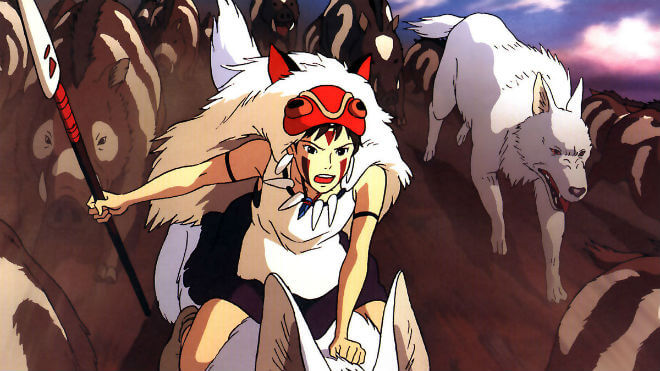
Princess Monoke 1997

Director: Hayao Miyazaki

Princess Mononoke is a heavy-hitting anime movie that tackles several issues, namely conservation of nature and environmental concerns.

Uncharacteristically violent for a normal Ghibli film, Mononoke tells the story of Ashitaka, searching for the cure to a curse, and finding himself caught up in a conflict between forest spirits and an evil mining company. Bloody, but brilliant, this film highlights some of the best high-octane animations from Miyazaki.

You won’t forget the haunting image of San, the titular character, covered in blood after hard-fought combat. Although it’s unlike many of Ghibli’s films, it stands apart in a beautiful and lasting way, and is worth checking out, along with earning the number 3 spot of the best anime movies of all time.

What Makes It Great

Moral Ambiguity: The film challenges conventional storytelling by presenting characters and situations that don’t fit neatly into “good” or “evil” categories.

Cultural Impact: The anime’s nuanced approach was a point of contention during its U.S. release, suggesting that cultural perspectives can significantly influence the reception of art.

Environmental Relevance: The film’s themes of conserving the environment and the complex relationship between humans and nature make it particularly relevant in today’s context of environmental crisis.

Interesting Facts

  • “Princess Mononoke” dethroned E.T. as Japan’s box office champion after a decade with its impressive 18.25 billion yen (approximately \$134 million) earnings.
  • Princess Mononoke didn’t just break commercial records. In 1998, it became the first animated film to be nominated for and win the top prize at the Japanese Academy Awards.
  • “Princess Mononoke” stage adaptations were previously declined, but the UK’s Whole Hog Theatre received approval with their unique pitch. It sold out in the UK nine months before opening and later found success in Tokyo with larger audiences.

4. Kiki’s Delivery Service (1989)
Kikis Delivery Service 1989

Director: Hayao Miyazaki

Another of my personal favorite top anime movies is Kiki’s Delivery Service. You knew Studio Ghibli would make another appearance, and it’s easy to see why.

Kiki’s Delivery Service tells the story of Kiki, a young witch who runs a courier service, trying to fit in and feel like she belongs during her mandatory year of independence. She struggles with a lot of different things, loss, identity, and even depression.

A quote that sticks out to me is when Kiki is feeling low and says:

“I think something’s wrong with me. I make friends, then suddenly I can’t bear to be with any of them. Seems like that other me, the cheerful and honest one, went away somewhere.”

Some heavy stuff. Not as depressing as Grave of the Fireflies, but it examines the inner workings of the emotionality of growing up and feeling like we don’t belong. The friendship between Kiki and her cat, Jiji, is so heartwarming.

He’s Kiki’s best friend and can even be considered an extension of Kiki herself. Check out this anime movie to see beautiful animation, a touching story, and classic elements of Miyazaki all in one.

What Makes It Great

Exploration of Loneliness: The film tackles the often-overlooked aspect of growing up: loneliness. Even when surrounded by friendly faces in a new city, Kiki feels isolated. This emotional depth adds a layer of realism to her character and the story.

Evolution of Relationships: The film shows that relationships, even those as close as the one between Kiki and her cat Jiji, evolve over time. This change is portrayed as a natural part of growing up, adding a bittersweet element to the narrative.

Interesting Facts

  • The Town By the Sea is Modelled After Stockholm: The town where Kiki lives, Koriko, is inspired by the Swedish cities of Stockholm and Visby. The film’s artists and Miyazaki even traveled to Sweden for research.
  • It was Ghibli’s First Big Hit: The film grossed Yen 3.6 billion, making it a massive hit in the Japanese film industry. Before this, Miyazaki wasn’t a global icon.
  • Cameo by Director Hayao Miyazaki: A man with glasses who appears at the end of the movie is modeled after Director Miyazaki. This was a rare inclusion of his figure in his films.

5. Ghost in the Shell (1995)
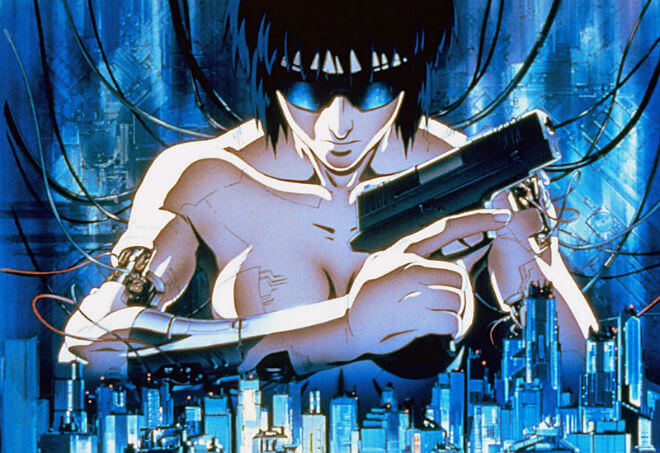
Ghost in the Shell 1995

Director: Mamoru Oshii

Aside from the controversy surrounding the casting of Scarlett Johansson in the live-action adaptation, Ghost in the Shell is a wild ride from start to finish.

Originally a manga from 1989 written by Masamune Shirow, it tells the story of a cyborg police officer named Motoko Kusanagi and Batou hunting down a mysterious hacker called “The Puppet Master” in New Port City in the mid-twenty-first century. This anime movie has influenced other works like The Matrix and other cyberpunk works.

On Metacritic, Ghost in the Shell has a score of 76, with it garnering great reviews as well as winning a bunch of awards, namely the #20 Best Movie of 1996, (beating out The Hunchback of Notre Dame, Matilda, and Twelve Monkeys), the #23 Most Discussed Movie of 1996, and the #6 Most Shared Movie of 1996.

User reviews are glowing, with users saying that there is a beautiful balance of peace, serenity, and neo-noir action.

It originally was a box office failure, but thanks to dedicated fans, it ended up making up its budget by raking in \$43 million in sales since its release. If you love drama, thrillers, and a wild story that’ll keep you guessing, Ghost in the Shell is right up your alley.

What Makes It Great

Philosophical Depth: The anime doesn’t shy away from asking big questions about the nature of consciousness and identity. It’s not just an action-packed cyberpunk tale but also a philosophical inquiry.

Artful Action Sequences: The anime is praised for its meticulously choreographed action sequences, which are not just thrilling but also serve as a vehicle for deeper philosophical dialogues. It’s a blend of mind and muscle, making each scene more than just eye candy.

Artful Action Sequences: The anime is praised for its meticulously choreographed action sequences, which are not just thrilling but also serve as a vehicle for deeper philosophical dialogues. It’s a blend of mind and muscle, making each scene more than just eye candy.

Interesting Facts

  • Relevance to Modern AI Ethics: The film’s story about an AI evolving to demand recognition as a new life form is more pertinent today than when it was made in 1995.
  • Sequels and Remakes: The film has seen various remakes and sequels, including a 2008 reboot and a 2017 live-action version.

6. Perfect Blue (1997)
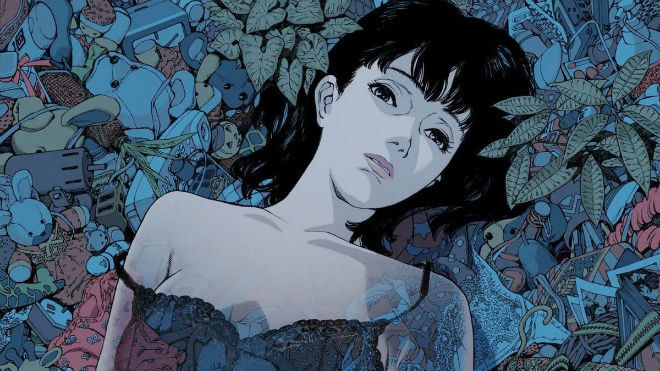
Perfect Blue 1997

Director: Satoshi Kon

Another thriller for you. Perfect Blue is the story of a former pop idol, Mima Kirigoe, seemingly being stalked by an obsessive fan. However, it is not all as it seems, as the fan seems to be a ghost of her past. Which is it? You’ll have to watch to find out.

It explores deep themes, like what the true cost of fame is, and whether we know ourselves. It has it all. Twists and turns, beautiful, striking animation with paranoia and dreamy visuals will keep you pulled in for the entire 81-minute running time. This movie had me on the edge of my seat the whole time.

Not only that, but I found myself thinking about this film long after I had finished it, and THAT is the trademark of one of the top anime movies.

What Makes It Great

Visual Storytelling: Satoshi Kon’s unique visual style and editing techniques are praised for adding to the film’s psychological depth. The film uses the medium itself to make the viewer feel Mima’s disorientation and breakdown.

Confrontational Narrative: The film is often called a” masterclass of confrontation,” forcing the viewer to confront the psychological degradation of the protagonist. This makes the film’s message more intimate and powerful.

Interesting Facts

  • Influence on Hollywood: The movie has influenced several Hollywood films, including Darren Aronofsky’s “Black Swan” and Christopher Nolan’s “Inception.”
  • Live-Action Version: A live-action version was eventually made in 2002 but received mixed reviews.
  • Katsuhiro Otomo’s Involvement: The creator of Akira, Katsuhiro Otomo, was credited as a “Special Supervisor” to help sell the film.

7. A Silent Voice (2016)
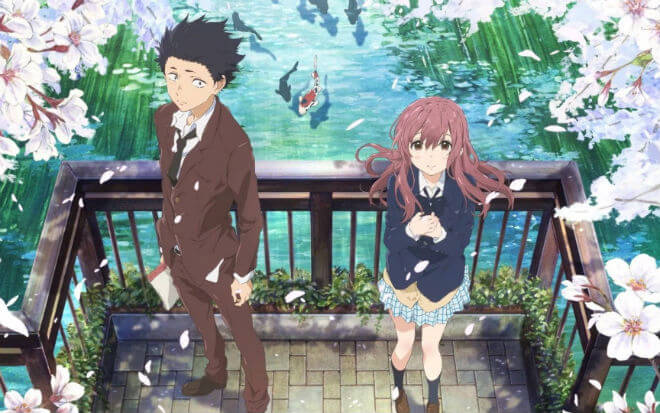
A Silent Voice 2016

Director: Naoko Yamada

Based on the manga of the same name by Yoshitoki Ōima, A Silent Voice is based around a young boy named Shōya who finds himself on a bridge about to commit suicide. He reminisces about his past and why he’s arrived at the bridge.

Shōya had been bullying a deaf student named Shōko Nishimiya and had alienated himself from his classmates for doing so, becoming the victim of bullying himself. He sets out for possible redemption with her throughout the film. This is a great anime movie with a strong anti-bullying message, as well as emotional depth that will resonate with anyone who watches it.

With beautiful nuances in the animation, color, and a unique, haunting soundtrack, A Silent Voice will keep you up late at night thinking about the impact it has had on you. Will Shōya get redemption and atone for his bullying? Only one way to find out!

What Makes It Great

Deafness as a Metaphor: The film ingeniously uses the concept of deafness to explore broader themes of isolation and miscommunication. This adds a layer of complexity, making it more than just a story about bullying but a deeper look into the intricacies of human interaction.

Feminine Sensibility: Directed by Naoko Yamada, the film brings a unique, delicate touch, especially in how it handles the romantic elements between characters. This feminine perspective adds a different flavor to the anime, distinguishing it from other works in the genre.

Innovative Visual Storytelling: The anime employs creative visual symbols, like the blue crosses on characters’ faces, to represent the protagonist’s feelings of being an outcast.

Interesting Facts

  • The film won several awards, including 2016’s Best Animation Feature Film at the Japanese Movie Critics Awards.
  • Young Author: Yoshitoki Oima was only 18 years old when she started working on A Silent Voice.

8. Castle in the Sky (1986)
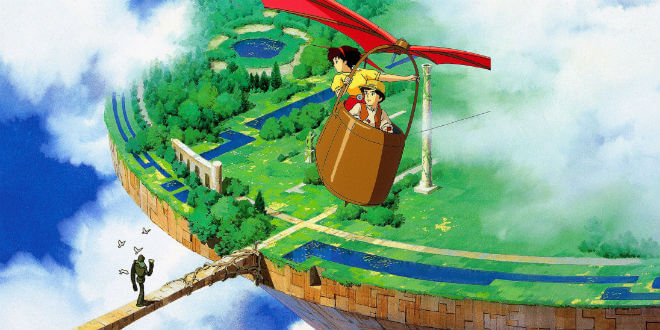
Castle in the Sky 1986

Director: Hayao Miyazaki

Another gem by Studio Ghibli, Castle in the Sky tells the story of Sheeta and Pazu, two kids who find themselves on an epic search for an airborne island named Laputa. However, their search for the island isn’t without its hardships; airship pirates are on the hunt for Sheeta and her mysterious amulet.

Later in the quest, you learn more about Sheeta’s origins and those of the mysterious island of Laputa. It’s a great anime movie for those who crave adventure with Hayao Miyazaki’s patented, iconic style of animation. One scene I loved was when Sheeta gets her braids to get shot off, which has to be one of my favorites in all of the animation. Check it out!

What Makes It Great

Historical and Literary Roots: The film draws inspiration from Jonathan Swift’s “Gulliver’s Travels,” adding a layer of literary depth to its narrative. This connection to classic literature enriches the story and gives it a timeless quality.

Narrative Pacing and Structure: The story is immaculately paced, keeping the audience engaged from start to finish. The mystery surrounding Laputa and its ancient technology serves as the narrative’s core, providing enough intrigue to sustain interest throughout the film.

Character Depth and Empathy: The characters of Pazu and Sheeta are crafted in a way that makes the audience empathize with their quest. Their interactions with the roguish pirates add charm and complexity to their journey, making the characters relatable and endearing.

Interesting Facts

  • The movie was financially successful in Japan. It became the highest-grossing film of 1986 in the country.
  • Castle in the Sky received widespread critical acclaim. It has a 95% approval rating on Rotten Tomatoes, with praise for its storytelling and visual splendor.
  • The movie’s English-language adaptation was released in 1998. It introduced a whole new generation of viewers to the enchanting world of Studio Ghibli.

9. Nausicaä of the Valley of the Wind (1984)
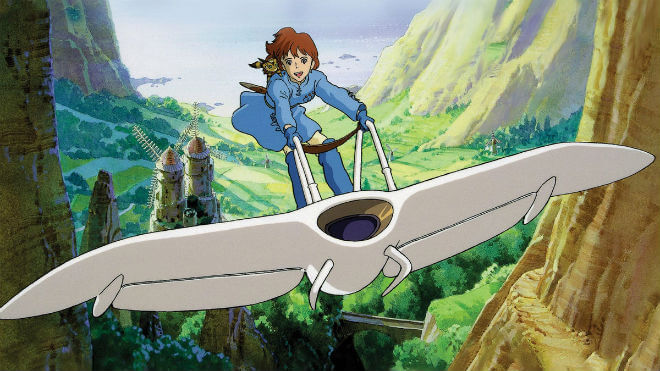
Nausica of the Valley of the Wind 1984

Director: Hayao Miyazaki

Yep, you guessed it: Miyazaki again. There’s a reason he’s a legend, and this further proves that he has some of the most enduring and powerful animations in anime movies. It’s based on the manga of the same name by Hayao Miyazaki himself. Right away, the unbelievably beautiful environments Studio Ghibli had created blew me away.

Nausicaä of the Valley of the Wind comes in with an impressive 86 on Metacritic, no small feat. Publications like The New Yorker, IGN, and The AV Club have praised it as a remarkable animation feat.

Users likewise say that Nausicaä of the Valley of the Wind ranks up there with some of Miyazaki’s best work, period.

You’ll find yourself becoming almost distracted by the beauty and detail of each environment. However, the story itself is just as beautiful. It involves Nausicaä, who attempts to save a jungle of insects from a kingdom trying to eradicate it. It takes place 1,000 years after the cataclysmic war that wiped out industrialized society.

This film serves as a chilling allegory to not only the warnings of our industrial expansion on nature, but it also harkens back to an earlier entry on the list, Princess Mononoke (which Miyazaki would make 13 years later). A thing I love about Miyazaki is his attention to detail and love of the natural world, showing that it’s worth saving and being mindful of your own life.

What Makes It Great

Musical Brilliance: The score by Joe Hisaishi uses a mix of orchestral and synthetic styles to create a sonic landscape that complements the film’s retro-futuristic technology and idyllic natural settings. This musical layer enhances the thematic richness of the film.

World-Building Excellence: The setting and worldview in the anime are thoroughly thought out, grounding the narrative and adding a layer of consistency. This attention to detail sets it apart from much of modern anime, providing a more immersive experience for the viewer.

Visual and Emotional Complexity: The film’s animation style can be described as minimalist yet extravagant, capturing a wide range of emotions in its characters.

Interesting Facts

  • Originally Planned as a Short Film: Initially, the project was supposed to be a 15-minute short film. However, it eventually became a feature-length film.
  • Color Palette: The film uses a total of 263 distinct colors, contributing to its vibrant art style.
  • U.S. Release Edits: The U.S. release was heavily edited, leading Miyazaki to enforce a “no cuts” rule for foreign releases.

10. Cowboy Bebop: The Movie (2001)
Cowboy Bebop The Movie 2001

Director: Shinichirō Watanabe

The wildly popular and wildly stylish neo-noir sci-fi series goes feature-length. The Bebop crew, Spike, Faye Valentine, Jet Black, Edward, and, of course, Ein, are back to follow the trail of a terrorist who plans to eradicate the population of Mars with a deadly virus. Only the Bebop crew has what it takes to put a stop to it.

Director Shinichirō Watanabe has said that he viewed Cowboy Bebop as miniature films, and indeed viewed the film as just an extension of that premise. Lovers of the anime will not be disappointed; it retains that signature style from the anime TV series and adds an amazing musical score and visual flares that tie this work to the series in a beautiful way.

It takes place story-wise between episodes 22 and 23 of the original show, and you can tell that nothing is out of place. This is a no-brainer for fans of the show who want to see more of the crew.

What Makes It Great

Multilayered Narrative: The series masterfully blends humor, action, and deep contextual elements. It explores existentialism, loneliness, and the meaning of friendship and love, adding depth to the story and making it more than just an action-packed anime.

Visual and Action Elements: Despite its age, the animation by Sunrise still complements the narrative effectively. The action scenes, which include martial arts, cowboy-style gunfights, and spaceship battles, are still impressive, adding to the series’ enduring appeal.

Character Complexity: fans are praising the series for its deep character analysis, making the protagonists, who are essentially losers and anti-heroes, incredibly likable. Their flaws are highlighted as their main source of appeal, adding a dramatic element to the series.

Interesting Facts

  • Limited Original Run: During its original run on TV Tokyo, only 12 of the 26 episodes were aired due to mature themes
  • Impact in the U.S.: The anime made history in the U.S. by being the first anime broadcast on Adult Swim. It was well-received due to its Western influences and mature storytelling.
  • Initial Toy Sponsorship: The series was initially envisioned as a project to sell toys through a sponsorship from Bandai. However, the company pulled out due to the anime’s dark tone.

11. The Secret World of Arrietty (2010)
The Secret World of Arrietty 2010

Director: Hiromasa Yonebayashi

Based on the 1952 children’s fantasy novel, The Borrowers, The Secret World of Arrietty introduces us to the Clock family—four-inch-tall people who live in a family’s house. The Clock family borrows small items to furnish their own homes. However, on an expedition, their daughter Arrietty gets discovered. Arrietty is on a nighttime mission when she’s seen by the family’s son, Shō.

She’s warned that her existence is at stake and to never interact with humans. Nevertheless, she tries to pursue a friendship with Shō. This anime movie has such impressive animation coupled with an engaging and heartfelt story on existence, life, and friendship. The aspects of everyday life are captured in such a magical way in Hiromasa Yonebayashi’s debut film.

It even reminds me a little of Spirited Away. This version of the story blows the 1997 American version out of the water.

What Makes It Great

Atmosphere Over Story: anime focuses more on creating a mesmerizing atmosphere than on intricate storytelling. The visuals and the setting are so captivating that they sometimes overshadow the actual plot, making the viewer feel like they’ve watched a well-made episode of a series that has yet to unfold.

Underlying Messages: While the anime may not dive deep into personal tragedies, it does focus on the ignored “little people” and their frugal lifestyle, contrasting it with the excesses of modern society. This adds a layer of thought-provoking undertones to the film.

Musical and Design Elements: The music by French artist Cécile Corbel adds a unique layer to the anime’s atmosphere. The interior design, a mix of Japanese and European post-war styles, also contributes to the film’s distinct ambiance.

Interesting Facts

  • Box Office Success: The film became the highest-grossing Japanese film at the Japanese box office for the year 2010, and has grossed over US$145.6 million worldwide.
  • Awards: The film won the Animation of the Year award at the 34th Japan Academy Prize award ceremony.
  • Book Sales: Around 125,000 copies of the Japanese edition of “The Borrowers” were sold, reaching the Oricon charts for the first time in two years.

11. Neon Genesis Evangelion: The End of Evangelion (1997)

Neon Genesis Evangelion The End of Evangelion 1997

Directors: Hideaki Anno, Kazuya Tsurumaki

Another anime movie from a TV series, fans of the dark, philosophical, and entertaining Neon Genesis Evangelion have to watch this. As the title says, it’s the end, although an alternative one. Shinji Ikari and his fellow mecha EVA pilots fight mysterious life forms called ‘Angels’.

This series and this anime movie include strong thematic content, emotionally straining moments, and thoughts on the future of humanity. The EVA pilots are faced with the impossible task of defending Earth from the encroaching angels, by all means, an invincible force of supernatural beings.

User Vegeta-2 on IMDb says about the film:

“Never before has a movie put me through so many emotions. Anger, joy, fear, depression, hope, all flowed through me as the epic film unfolded before me. I was left emotionally wrung out the first time I watched it, and my view of life has been changed forever because of it.”

Just be warned, if you haven’t seen all the TV episodes, you will be totally lost in this movie. Oh, and hope you haven’t developed too much of an emotional attachment to the characters.

What Makes It Great

The Challenge of Self-Acceptance: The anime pushes its characters, and by extension its audience, to confront their fears, insecurities, and the pain of existence. It challenges us to accept these as part of life and to move forward.

The Art of Storytelling: anime serves as a medium that can connect people on a primal level, transcending the limitations of language and overt speech. How does this form of storytelling impact our understanding of complex emotional and psychological themes?

The Duality of Human Nature: anime explores the dual nature of humanity—our desire for connection and our inherent capability to cause pain. It raises the question: Can we ever truly connect without causing or sharing pain?

Interesting Facts

  • Box Office: It grossed ¥2.47 billion in Japan, which is approximately $19 million.
  • Awards: The film was honored at the Awards of the Japanese Academy, the Animation Kobe, and the 15th Golden Gloss Award. It also won the 1997 Animage Anime Grand Prix.

12. The Girl Who Leapt Through Time (2006)
The Girl Who Leapt Through Time 2006

Director: Mamoru Hosoda

A favorite of mine—time travel movies. Teenager Mokoto can travel through time, unaware of the consequences her actions have on others in the past. Mokoto uses this ability much like I think many would—by fixing mundane and frivolous problems with your own life. Think of how many mistakes you could easily fix.

But Mokoto shows that it isn’t that easy, or free of consequences. This movie had me emotionally torn up. It’s supposed to be about time travel and ends up being an amazing lesson on life, the choices we make, and the solidity of them. The character designs were by the animator of Neon Genesis Evangelion, Yoshiyuki Sadamoto, a nice little touch I enjoyed.

What Makes It Great

Visual Expression: One of the standout features of the anime is its unique visual expression. The art design has a minimalist approach that still manages to be rich in depth. It successfully captures the essence of old-school ’80s anime while also feeling modern.

Longevity and Re-watch Value: The anime has a unique mood that gives it longevity in terms of re-watch value. In between the low-key sci-fi adventure, there is always something new to discover and some deeper emotions to explore. This makes it a timeless piece that can be enjoyed multiple times, each viewing offering something new to find.

Adaptation Excellence: The anime is an adaptation of a novel; it surpasses its source material in every way. The characters in the anime version are more developed, and the storytelling is slowed down to focus on drama and character depth.

Interesting Facts

  • The movie received critical acclaim and won several awards, including the Japan Academy Prize for Animation of the Year in 2007.
  • Soundtrack: The movie’s soundtrack is composed by Kiyoshi Yoshida, adding another layer of emotion to the film.

13. Tokyo Godfathers (2003)
Tokyo Godfathers 2003

Director: Satoshi Kon

Tokyo Godfathers tells the story of 3 homeless people on Christmas Eve who discover a baby and attempt to search out its parents. With the script co-written by the same writer of Cowboy Bebop and Wolf’s Rain, I knew the writing would be good, and I wasn’t disappointed.

The story cut me right to the core, with lovable characters and their determined quest to find the missing mother of baby Kiyoko.

IMDb user InzyWimzy says:

“There’s a strong sense of karma here with ‘what goes around comes around.” Doing nice things, and you most likely will be rewarded.

However, turning your back or refusing to help someone in need may come back to haunt you when you are stuck with no one to turn to. Hey, maybe it’s never too late to learn a lesson, no matter how much it hurts.”

For me, this was one of the top anime movies.

What Makes It Great

Inventive Storytelling and Direction: The film stands out for its captivating storytelling, guided by the expert direction of Satoshi Kon. It’s not just another anime; it’s a compelling journey that involves a diverse cast, from gangsters to immigrants.

Deep and Relatable Characters: What makes “Tokyo Godfathers” truly special is its characters. They’re not just figures on a screen; they’re complex, flawed, and incredibly human. As the three homeless protagonists embark on their quest, they not only seek to reunite a child with her mother but also find redemption and self-worth.

Interesting Facts

  • Public Limelight: “Tokyo Godfathers” was Satoshi Kon’s third movie but his first step into the public limelight, premiering in 2003.
  • Critical Reception: The film was not widely seen in the U.S. upon its initial release in 2004, but has gained more attention due to its restoration and availability on VOD.

14. Whisper of the Heart (1995)
Whisper of the Heart 1995

Director: Yoshifumi Kondō

As much of a reading fan as I am, this one really got to me. Whisper of the Heart is about two people: Shizuku, a girl who loves reading books, and her love interest, a boy named Seiji. Looking through the checkout cards of the books she reads, Shizuku discovers it’s the same person, who ends up being Seiji. It’s animated by Studio Ghibli, and it shows.

The environments in Ghibli movies are unmatched, and it’s no exception here. You’ll never hear ‘Take Me Home, Country Roads’ the same way ever again.

See our favorite animated movies list.

What Makes It Great

A Fusion of Dream and Reality: The anime is not just a simple teen drama; it’s a blend of dreamlike elements and real-world experiences. This fusion adds a layer of depth to the story, making it relatable yet magical.

The Power of Detail: The anime is lauded for its hyperreal detail, from the cozy clutter of Shizuku’s flat to the panoramic landscapes of Tokyo. These details are not just for visual appeal; they serve to immerse the viewer in the world of the characters. The Blu-ray version of the film even enhances these details, making the viewing experience even more enriching.

A Message of Hope and Self-Belief: The anime aims to inspire viewers who “tend to give up too easily on the idea of being the star of their own stories,” according to Miyazaki’s film proposal. This underlying message of hope and self-belief elevates the anime from being just a love story to a tale that can inspire people of all ages.

Interesting Facts

25th Anniversary: The film celebrated its 25th anniversary in 2020 and is considered one of Studio Ghibli’s most emotional works.

15. When Marnie Was There (2014)
When Marnie Was There 2014

Director: Hiromasa Yonebayashi

Another one to tug on your heartstrings, When Marnie Was There is a Family/Drama film in which we see a beautiful and close friendship develop between the main characters, Anna and Marnie. This is a great, poignant view of friendship. When Anna is staying with her foster parents in Hokkaido, she meets the mysterious blonde-haired Marnie.

Marnie makes Anna promise to keep their secrets from everyone. These secrets you find out during the viewing of this anime movie are shocking. You can’t miss this story—it’s so filled with heart and reality that I’m not used to in anime movies. Truly one that sticks out, and from Studio Ghibli before their short hiatus, too.

What Makes It Great

A Farewell to Studio Ghibli’s Legacy: The film is considered something of an elegy for Studio Ghibli, as it was the last film from the studio for some time. This adds an extra layer of emotional resonance to the movie, making it not just another entry in the Ghibli canon but a poignant farewell.

Raw Emotional Material: The film doesn’t shy away from exploring deep emotional issues. Anna, the protagonist, is not just sad; she’s borderline suicidal. This raw emotional material makes her character arc more impactful, as it feels like a fight for survival rather than a mere fantasy.

Blurring the Lines Between Reality and Fantasy: The film plays with the concept of reality and fantasy, especially in the relationship between Anna and Marnie. It’s as if both characters are what the other needs to get through their respective worlds, adding a layer of complexity to their friendship.

Interesting Facts

  • Second Directorial Work: This was Hiromasa Yonebayashi’s second directorial work after “The Secret World of Arrietty” in 2010. It was also his final film before leaving Studio Ghibli to join Studio Ponoc.
  • Academy Award Nomination: The film was nominated for the Academy Award for Best Animated Feature at the 88th Academy Awards.

16. A Letter to Momo (2011)
A Letter to Momo 2011

Director: Hiroyuki Okiura

Momo is a young girl who travels to the island of Shio and begins to live among its people, learning their ways and customs. However, all is not as it seems.

Weird goings-on begin to happen on the island of Shio, and Momo soon finds herself banding together with Kawa, Mame, and Iwa, three Imps with distinct personalities, to discover the source of these strange happenings. Like many others, I found A Letter to Momo much like My Neighbor Totoro, but it honestly seems like a more modern improvement on that old classic.

I was surprised by the comedic elements and how much I enjoyed them. Add to that the crazy emotional latter half, and you have my ideal movie.

What Makes It Great

A Long Journey to Completion: The film took seven years to make, showcasing the meticulous effort put into its detailed, hand-drawn production. This long journey adds a layer of depth and authenticity to the movie, making it a labor of love that resonates with audiences.

Focused Storytelling: The film stays focused on Momo’s emotional journey, making her the central element around which everything else revolves. This focus ensures that the narrative doesn’t stray into unnecessary subplots, making the emotional payoff in the end all the more powerful.

Playfulness Amidst Grief: The film manages to incorporate playful elements without undermining its emotional gravity. The imps bring a sense of humor and childishness, which serves as a counterbalance to Momo’s grief. This blend of playfulness and emotional depth makes the film a well-rounded experience, appealing to both the heart and the mind.

17. Vampire Hunter D: Bloodlust (2000)
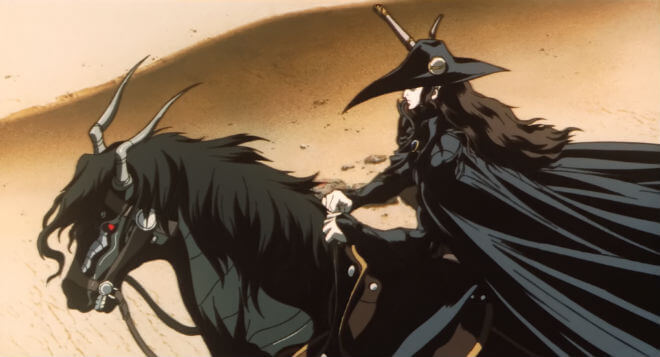
Vampire Hunter D Bloodlust 2000

Director: Yoshiaki Kawajiri

Now for a quick change of pace. Here we have an action/adventure movie based on the Vampire Hunter D series of novels written by Hideyuki Kikuchi. This is the story of the future in which vampires have been hunted down by the ruthless D, a half-human, half-vampire hybrid.

The animation is so perfect in this movie, and the subject and themes are so gripping. With a mix of western, Dracula, and drama, D is tasked to hunt down the daughter of a wealthy man who has been abducted by a vampire. Things heat up quickly, and soon, things aren’t what they seem. This is truly a unique and enjoyable anime movie.

What Makes It Great

Provocative Character Design: The film showcases provocative and imaginative character design, a hallmark of director Yoshiaki Kawajiri. The antagonists in the movie are particularly noteworthy, as they are designed to be freaky and unsettling, adding another layer of excitement and intrigue to the story.

Emotional Complexity: Despite being an action-packed film, “Vampire Hunter D: Bloodlust” doesn’t shy away from emotional complexity. The characters, especially D, face prejudice and have to grapple with their own inner demons. This adds a layer of depth to the film, making it more than just a visual spectacle.

A Blend of Genres and Influences: The film is noted for its eclectic blend of genres, incorporating elements of action, adventure, and horror. It also draws inspiration from various sources, including Westerns and the Dracula mythos.

Interesting Facts

  • Unlike most anime, English was the initially recorded dialogue track for “Bloodlust,” which was later dubbed in Japanese.
  • Adaptation: The film is based on the third novel of Hideyuki Kikuchi’s “Vampire Hunter D” series, “Demon Deathchase.”

18. Wolf Children (2012)

Wolf Children 2012

Director: Mamoru Hosoda

The director of The Girl Who Leapt Through Time brings you this lovable anime movie. Wolf Children centers around Hana, the human mother of half-wolf, half-human hybrids, and her struggle to raise them as a single parent after her lover dies trying to get food for the family.

This anime movie paints a loving portrait of a single parent trying to provide for her children in the aftermath of loss. Not only is single parenthood difficult, but Hana has to hide the fact that her children can change into human and wolf forms. The thing that stayed with me so long was how lovable the characters were.

It helped me care about their troubles and whether they’d be okay in the end. Overall, a beautiful story about family, growing up, and sticking by those you love.

What Makes It Great

Realism in a Fantasy Setting: The film takes a fantastical premise and grounds it in reality, making it emotionally resonant. The challenges Hana faces in raising her half-wolf, half-human children are portrayed in a way that feels genuine and relatable.

Dynamic Relationships: The film excels in portraying strong, dynamic relationships among its characters. Whether it’s the bond between Hana and her children or her interactions with the villagers, each relationship is unique and adds depth to the story.

Emotional Resonance: The film’s emotional power is highlighted as one of its strongest points. It manages to capture a range of emotions, from joy to sorrow, in a way that feels deeply affecting. Scenes like the family playing in the snow are described as gorgeously animated and emotionally resonant, leaving a lasting impact on the viewer.

Interesting Facts

  • Director’s Journey: “Wolf Children” is directed by Mamoru Hosoda, who also directed “Summer Wars” and “The Girl Who Leapt Through Time.” This is his third stand-alone feature and the first by his fledgling Studio Chizu. His previous films were by Madhouse
  • Box Office Success: The film earned more than $50 million in Japanese cinemas, which is phenomenal for an anime film not linked to Studio Ghibli or an established franchise. For comparison, Hosoda’s “Summer Wars” earned $17 million.

19. Tatsumi (2011)
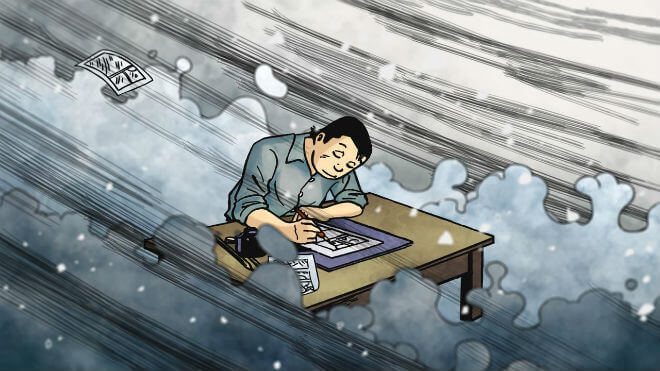
Tatsumi 2011

Director: Eric Khoo

This anime movie is somewhat a biography of Yoshihiro Tatsumi and his unconventional animation style, gekiga. It’s a Singaporean anime movie, based on Tatsumi’s biography, A Drifting Life. The film follows Tatsumi’s life from working on comics to inventing the gekiga style.

A user on IMDb states:

“The animation style, which looked a lot like simple cut out animation, played to the production house’s strengths, where things are kept simple based on the artistry of Tatsumi himself, therefore having his books serving as natural storyboards, with the obvious understanding that the look and feel of the film cannot and should not venture too far that it doesn’t look like what had been designed by its creator.”

What Makes It Great

Unique Visual Experience – One of the standout features of “Tatsumi” is its unique visual experience. The film doesn’t aim to look like traditional anime, but instead focuses on linework and atmosphere.

Exploration of Adult Themes: “Tatsumi” delves into adult subjects and themes, reflecting the gekiga style of manga that Yoshihiro Tatsumi pioneered.

Narration Over Animation: The film relies heavily on voice-over narration to tell its stories, rather than intricate animation.

20. From Up on Poppy Hill (2011)
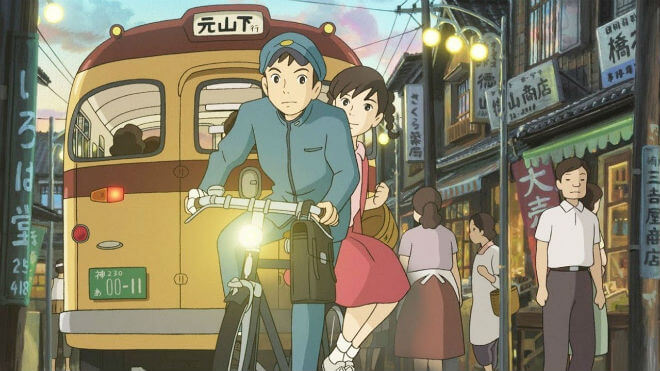
From Up on Poppy Hill 2011

Director: Gorō Miyazaki

This anime tells the story of students trying to save their school clubhouse from demolition before the Tokyo Olympics in 1964. This is primarily a character piece. The characters are so strong in this anime movie, and the subject of friendship is so prevalent and touching throughout the film.

It’s no surprise that Hayao Miyazaki wrote the script; his signature style is omnipresent. Umi and Shun are two friends who work so hard to keep their clubhouse standing, and in the process, strengthen their friendship.

What Makes It Great

A Different Kind of Miyazaki Film: While the film is a collaboration between Goro Miyazaki and his legendary father, Hayao Miyazaki, it diverges from the fantastical elements often associated with Studio Ghibli films. Instead, it opts for a more straightforward narrative focused on ordinary college students.

A Clubhouse as the Hero: The film’s unique focus is not just on its human characters but also on a ramshackle old mansion named the Latin Quarter. This clubhouse is a labyrinth of performance spaces, studios, laboratories, galleries, and other areas favored by its bohemian members. The Latin Quarter serves as a metaphorical hero, embodying the collective spirit and creativity of the students who inhabit it.

Interesting Facts

  • Review Score: The film received a score of 7 out of 10 from IGN, indicating it’s a “good” film but not without its flaws.
  • Cultural Upheaval: The film is a meditation on the cultural changes Japan was undergoing. It captures the tension between the old and the new, especially with the student body divided on whether to preserve their old clubhouse or embrace progress.

21. The Tale of the Princess Kaguya (2013)

Director: Isao Takahata

This movie was nominated for the Academy Award for Best Animated Feature at the 87th Academy Awards. It tells the story of a young girl found in a bamboo stalk and raised by those who discovered her. She grows into an alluring, captivating, and lively presence. The art style of this movie is so attractive and fluid, I really can’t describe it better without you seeing it.

Just know it’s alluring, much like the character of Princess Kaguya herself.

What Makes It Great

A Visual Feast of Impressionism: The film abandons the traditional anime style for an impressionistic approach, using lush illustrations that bleed on and off the screen. This artistic choice allows for a more realistic reflection of the human experience. The film’s art style amplifies Kaguya’s innocence and makes her emotional journey even more poignant.

A Philosophical, Dreamy Story: The film is not just visually stunning but also deeply philosophical. It delves into themes of youth, maturity, and the impermanence of life. The knowledge that Kaguya will one day return to her home on the moon adds a layer of tragedy that lingers in the background of every scene.

Interesting Facts

  • Box Office: The film debuted in first place during its opening weekend in Japan, producing ¥284 million (US$2.8 million). By February 2014, it had produced ¥2,313,602,733 ($22,613,153) at the Japanese box office. The total worldwide production was $24,149,665.
  • Critical Reception: The film received overwhelmingly positive reviews and holds a score of 100% on Rotten Tomatoes with an average rating of 8.3/10.
  • Based on a Folktale: The film is based on the Japanese folktale “The Tale of the Bamboo Cutter,” one of Japan’s most famous and oldest narratives.

22. Barefoot Gen (1983)
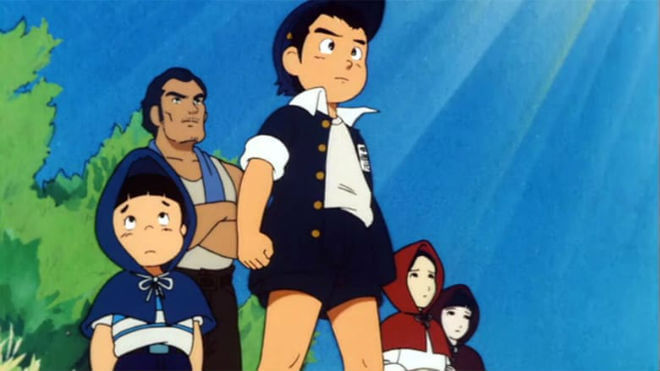
Barefoot Gen 1983

Director: Mori Masaki

Based on the anime manga series, Barefoot Gen takes place during the events of the bombing of Hiroshima, giving a dramatic view of the tragedy. Gen and his family are suffering from the effects of the war: food shortages, air raids. And other assorted panics. Sometimes the best anime movies have to be very dramatic and realistic.

The story reminds me a lot of Grave of the Fireflies. It is less cartoonish and more realistic in not only art style but in the story too. That may seem to be a bad thing, but it serves the movie well.

What Makes It Great

A Personal Account of an Unimaginable Tragedy: The anime “Barefoot Gen” is not just a work of fiction; it is a personal account of the horrors of the atomic bombing of Hiroshima. The film’s creator, Keiji Nakazawa, was a survivor of the bombing, and the story is based on his own experiences. This lends an air of authenticity and emotional weight to the film that is hard to match.

The Unflinching Gaze at the Aftermath: The film doesn’t shy away from showing the devastating effects of the atomic bomb, both immediate and long-term. From the graphic portrayal of the explosion to the haunting scenes of its aftermath, “Barefoot Gen” forces the viewer to confront the realities of war and its human cost.

Interesting Facts

  • Based on Real Experience: The anime is based on the manga “Barefoot Gen” by Keiji Nakazawa, who was just 6 years old when Hiroshima was bombed. The manga was first published in 1973 and ran for over a decade.
  • 40 Years Before Oppenheimer: The anime “Barefoot Gen” was released 40 years before Christopher Nolan’s filmOppenheimer,” which also deals with the atomic bomb. The anime tells the story of the bombing of Hiroshima from a Japanese perspective.

23. Ninja Scroll (1983)
Ninja Scroll 1993

Director: Yoshiaki Kawajiri

Taking place in feudal Japan, a lone swordsman, Jubei, has to fight against a demonic clan of warriors trying to overthrow the shogunate. With the help of others, namely Dakuan and Kagero. Dakuan is a former spy, and Kagero is a ninja. Ninja Scroll has been cited as being one of the most influential anime movies, influencing movies like Ghost in the Shell and The Matrix.

IMDb user mike-moran says:

“A great movie to just sit back and enjoy, not in the mindset of Akira, Ghost in the Shell, or Perfect Blue, just a great all-out action film. When I first saw this movie, I was amazed by the high quality of the action and the animation. To this day, they both still stand the test of time.

One of the best anime set around the time period of feudal Japan, although the main reason to see this film is for the characters. Not so much for the good guys but the villains. The designs of the villains are outstanding, and their individual powers are uniquely brilliant.”

What Makes It Great

Fast-Paced, High-Stakes Action: “Ninja Scroll” distinguishes itself with its fast-paced action sequences. Unlike some anime where battles can drag on for episodes, this film gets right to the point. Characters meet, fight, and someone dies—all within a few short minutes. This rapid pacing keeps the audience on the edge of their seats and allows for constant growth in the story.

Intricate Character Development: The film does an excellent job of revealing character details gradually, adding layers of complexity as the story progresses. For instance, Kagero is not just a beautiful female ninja; she is also a poison taster with a body that has become toxic. This adds a unique twist to her character and the dynamics between her and other characters.

Interesting Facts

  • Influential Anime: Alongside “Akira” and “Ghost in the Shell,” “Ninja Scroll” is considered one of the most influential anime films ever made. It has been cited as an influence on the Matrix franchise.
  • Global Popularity: By May 1996, the North American video release of “Ninja Scroll” had sold more than 70,000 copies, becoming Manga Entertainment’s best-selling title at the time.

24. Sword of the Stranger (2007)
Sword of the Stranger 2007

Director: Masahiro Andô

Once again, we find ourselves following a skilled swordsman in his wanderings, specifically through Sengoku-period Japan, and his interactions with a colorful cast of characters. Kotaro, our swordsman, finds himself caught up in the conflicts of the pandemonium of Japan. Tasked into service to help an injured person, Kotaru has to use his skills to make it out alive.

The detail in this anime movie is unreal. I mean, it was awe-inspiring. I’m not sure if I’ve seen such impressive animation.

What Makes It Great

Action-Packed Sequences: The anime features some of the most intricately staged and gorgeously animated fight scenes in anime history.

Hollywood-Style Narrative: The film adopts a Hollywood-style narrative arc, blending it with strong character archetypes.

Balance of Style and Substance: The anime successfully balances style and substance, ensuring the story remains compelling without overreaching.

Cultural Representation: The film touches upon the dynamics between China and Japan, which could be seen as a reflection of their historical or modern-day relations.

Interesting Facts

  • International Festivals: The film has appeared at many international film festivals and won the award for Best Animated Feature at FANTASPOA (International Fantastic Film Festival of Porto Alegre) in Brazil.
  • Critical Reception: The film received positive reviews and was nominated for Best Animated Feature Film at the 2008 Asia Pacific Screen Awards. It was also Japan’s submission for Best Animated Feature at the 81st Academy Awards.

25. Spirited Away (2001)

Director: Hayao Miyazaki

Closing the list is one of the most beloved anime movies ever created. It follows the journey of a 10-year-old girl and her family after moving into the suburbs. She explores a world where humans are transformed into other creatures and is ruled by gods, spirits, and witches.

What Makes It Great

The film bravely tackles environmental and cultural themes with emotional depth and universal storytelling.

Interesting Facts

  • Real-life inspiration: Director Hayao Miyazaki came up with the idea of the film after seeing the sullen 10-year-old daughter of his friend.
  • Academy recognition: Spirited Away won an Oscar in 2003 for the Best Animated Feature award.

Recurring Themes & Storytelling Styles

Popular anime films often explore universal themes:

  • Coming-of-age Identity
  • Emotional depth
  • Environmental consciousness
  • Existentialism
  • Friendship
  • Nature of humanity
  • Perseverance
  • Self-disovery
  • Surreal and fantastical elements
  • Technology’s impact on society

Recurring themes like these resonate deeply with audiences. They not only provide entertainment but also meaningful reflection. It explains why the films on the list leave lasting impressions. 

What Are Your Favorites?

While every fan has their own top picks, the titles on this list are surely some of the most popular and influential anime films of all time. With so many works to choose from, you will find that anime films offer incredible depth, variety, and artistry, whether they are heartwarming stories, epic adventures, or mind-bending thrillers.

Grab your popcorn and start the anime movie marathon. Happy watching!

HacknPlan Review 2025: Features & Pricing for Game Devs

0

Designing a game can be a struggle and a massive challenge to an extent. Between programming, animating, writing, narrative designing, game testing, producing, and project management, it is easy for even experienced teams to get lost in the chaos. There are a lot of moving parts, and if you are not on top of your organization, you are toast. That means staying organized is not only a convenience but also essential for completing projects efficiently.

While tools like Excel, Google Docs, and Trello can help keep track of tasks, they were not built specifically for game development. Game projects have unique needs, such as direct integration with game design documentation, milestones, semantic organization, and task prioritization. Luckily for disorganized (and organized) game developers everywhere, some tools can help. That is where HacknPlan comes in. By 2021, it has already reached 200,000 registered users and over 300 studios subscribed to its premium services. This established it as a well-known and widely used project management tool designed for game developers.

To help you learn more about this tool, this article will provide a thorough HacknPlan review that explores its features, pricing, and more.

What is HacknPlan?

HacknPlan is essentially “Trello for game developers,” but with much deeper features built to cater to the specific workflow of game production. In 2015, it spent months in an open beta mode. It was a productive time for the team behind Hacknplan–the designer scoured forums across the web for feedback. Then, after Version 1.0 was released to the public in 2017, it transformed into a full-fledged game production tool. HacknPlan supports teams of all sizes, from amateurs to indie developers to mid-sized studios.

By definition, HacknPlan works as an SaaS production tool for game development studios. It assists creators in building games through various features that can be used for documenting, evaluating, planning, scheduling, and tracking the development process.

HacknPlan lets you create projects. Once you have a project, you can make task boards that show the tasks you or your team members need to complete.

The tasks bar comes with customizable headings. The stock headings include categories like programming, art, design, writing, marketing, bugs, and more–all categories you’d associate with a game dev project. The headings are customizable, so if you need to tweak them to better fit your project, you can.

Within each heading, there are options for subcategories. These subcategories are also customizable. The programming category includes stock subcategories like:

  • Feature
  • Physics
  • AI
  • Documentation

The design category includes subcategories like:

  • AI
  • Mechanics
  • Gameplay
  • Level

And again, all of these are customizable.

Creating Tasks in HacknPlan

Hacknplan
Hacknplan | Image Credit: hacknplan.com

When you create a task, you have a ton of great options.

First of all, you can assign each task to a project. This window defaults to whichever project you’re currently in. But being able to assign tasks to other projects could come in handy if an idea strikes you while you’re working in a different HacknPlan project.

You can give your task a title and also designate its importance (the settings range from “low” to “urgent”). And there’s a space for due dates.

There is an “estimate cost” category, which lets you estimate how long a certain task will take (aptly named). This can be set to different metrics, such as “hours” or “points.” This feature ultimately lets you track how closely you’re following your metrics. You can see how close your estimates are to the time it actually takes.

You can assign users to each task, which lets your team members know who needs to do what. You can also assign tasks to specific categories and subcategories, such as the “gameplay” subcategory of the “design” category.

Tasks can be attached to milestones, too. Milestones are important to project benchmarks you can set to keep your project and your team on track. The milestone feature seems like a way to potentially reduce bottlenecking–your team can see which of their tasks are tied to the important checkpoints in the progress of the game.

You can also assign design elements to tasks. The stock elements include categories like character, level, zone, stage, object, and world. This feature is HacknPlan’s attempt to let you put your game design document into the tool.

A common problem with game design documents is how they’re almost immediately out of date after they’re published. If updates are easy to make to the codex-like GDD in HacknPlan, you might be able to keep it from falling by the wayside.

The task board also includes a description section, in case further explanation or update notations are required.

And finally, you can assign different platforms to tasks–Xbox One, Linux, iOS, etc.

As your team begins their tasks, they can slide their task board from the “planned” overview column to the “in progress” column. There are columns for “testing” and “completed” tasks, as well. These column titles can be changed, and more columns can be added.

The Strengths and Weaknesses

Pros:

  • A generous free plan suitable for individuals and small teams
  • Customizable boards that adapt to any project structure
  • Responsive developer support and an engaged community
  • Specifically designed for game development workflows
  • Sufficient integration between design documentation and task management

Cons:

  • Certain UI elements may take time to get comfortable with
  • Higher costs for larger teams or studios
  • Steeper learning curve due to feature-rich interface
  • The free plan comes with strict limitations on storage


Pricing Structure

HacknPlan offers various pricing to suit different users.

Personal Plan (Ideal for hobbyists)

If you’re a student, a small indie developer, or even just design games as a hobby, the personal plan is for you. With no fees at all, your features are slightly limited compared to the premium plans, but you can still create unlimited game projects. You can also add an unlimited number of users to your projects. One thing the personal plan lacks is attachment storage, which is offered in the two premium plans.

The personal plan gives you the following:

  • You can manage projects with no limit in members
  • You can join Studio organizations

It’s free, so it’s a great option for getting your feet wet with the tool. If you enjoy it and want to shell out for premium options, HacknPlan has two choices for you.

Personal Plus Plan (Ideal for advanced users)

The personal plus plan costs 7 euros per month. So, if you are only developing projects for a few months out of the year, then the month-to-month plan might make sense. But if you’re going to be developing games and using the tool year-round, you’ll save money with the annual payment option.

The personal plus plan gives you access to four notable features:

  • You can customize the tool visuals
  • You can integrate with Google, Slack, and GitHub
  • You receive priority email support for any issues you encounter
  • You get a 50MB max attachment file size, with a 2GB attachment storage cap

Studio Plan (Ideal for professional teams)

The studio package is the priciest of the bunch – 9 euros if you decide to pay monthly. This one is tailored to professional studios that don’t mind paying a little bit extra in order to get access to everything that HacknPlan has to offer. You purchase a single account, which lets you manage the members you invite to your project (and pay for their seats).

The studio version gives you:

  • Advanced metrics reporting features
  • An attachment file size of 250MB and a max storage size of 5GB per user

Aside from the standard packages, users who prefer to gain extra storage can choose from the following add-ons:

  • 250 GB (+10 euros a month)
  • 1 TB (+25 euros a month)
  • 10 TB (+50 euros a month)

Should You Use HacknPlan in 2025?

If you are a game developer searching for a project management tool that really understands game development workflows, then it becomes a no-brainer — HacknPlan is a strong choice. With its free plan, developers can try task boards, milestones, and design integration. On the other hand, the premium plans open up advanced features for teams managing several projects.

Moreover, this SaaS production tool streamlines game development tools. HacknPlan makes it easier for developers to focus on creating innovative games instead of dealing with unnecessary chaos.

If you are “today years old” when you discovered HacknPlan, there is no need to be shy! It is better late than never, especially when it comes to tools that make things easier for you.

What Is DLC: Guide to Downloadable Content in Games

0

Have you ever put countless hours into finishing a game, collecting items, maxing out stats, and finding all the secrets it has to offer? However, after completion, you only find yourself wishing there was more to explore. Maybe the ending was not that satisfying, or you just were not ready to leave the world behind. It is common in highly engaging and immersive games. Well, that is where DLC (Downloadable content) comes in. However, what exactly is DLC, and how does it work? Let us dive in!

Quick Definition: What is DLC?

Generally, DLC refers to additional digital material that gamers can download after the initial release of the main game. This extra content enables game developers to continue improving their games by adding new stories, missions, characters, weapons, levels, cosmetic items, map packs, or even major expansions that can modify gameplay.

DLC is usually distributed online, either for free or as paid content. Some additional content is included on the game discs but locked behind payment (on-disk DLC). Meanwhile, most modern titles are accessed through online distribution platforms.

DLC can truly be the redeeming quality for developers and gamers alike, and there have been some truly great DLCs. However, there are also those DLCs that proved to be more of a train wreck than a benefit to the game’s overall presentation.

In line with this, you must know that DLC is official content released by the game’s publisher or developer. This type of content is distinct from fan games, mods, and ROM hacks, which are fan-made and unofficial.

A Brief History of DLC

Adding new content to games is not new. Early PC games offered expansion packs sold on discs. There was also the GameLine Service and the SEGA Channel, which allowed players to download full games via telephone lines and SEGA Genesis through cable TV lines, respectively. As internet connectivity improved, downloadable extras became common, with Xbox Live and PlayStation Network leading the way in the early 2000s. Today, DLC is a core part of the gaming business model. It delivers both extended gameplay and higher revenue streams for developers. DLC is a standard part of gaming, from indie hits to blockbuster franchises.

Common Types of DLC

Cyberpunk 2077: Phantom Liberty
Cyberpunk 2077: Phantom Liberty | Image Credit: Steam
  • Bonus Content: Artwork, behind-the-scenes features, or soundtracks.
  • Cosmetic Items: Additions that don’t affect gameplay, such as outfits, skins, or visual changes.
  • Extra Content Packs: More characters, gameplay features, weapons, or vehicles.
  • Game Modes: Solo, cooperative, or multiplayer modes for more ways to play.
  • Map Packs: New areas or additional mode maps.
  • Season Passes: Bundles that include discounts for future DLCs.
  • Story-Based Expansion: New chapters, endings, or quests that expand the story.

How Do You Get DLC?

Nowadays, it is easy to access DLC for most modern games. You can buy or download it directly from digital stores. Specifically, players can find these across the Nintendo eShop, PlayStation Store, Steam, and Xbox Live Marketplace. In fact, some games even offer Complete, Definitive, or Game of the Year editions, bundling the base game with all DLCs.

Why Do Developers Release DLC?

Many reasonable factors push developers to keep making and launching DLC. For instance, it allows them to add new features or fix issues post-launch. Similarly, extra content keeps players engaged with extended gameplay and new storylines. Of course, it also helps in generating more revenue, supporting the ongoing creation of games and content.

Hardware and Platform Considerations

To enhance the DLC experience, your hardware and platform matter. Particularly, PC players can opt for a gaming PC with a sufficient Cooling System, CPU, GPU, and RAM. Some recommended models include the Omen by HP 25L gaming desktop or the Victus by HP 15Z-FB200 gaming laptop.

On the other hand, console users should avoid the internet connection limitations. Meanwhile, those who leverage online gaming platforms should be aware of download speeds and the visual memory unit restrictions that can affect performance.

Advantages and Disadvantages of DLC

Benefits:

  • Creative additions
  • Cost-effective game development
  • Extended gameplay
  • Developer support
  • Highly-engaged players

Challenges:

  • Additional Expenses
  • Compatibility issues
  • Divided communities
  • Incomplete base games
  • Pay-to-win concerns
  • Imbalance in player advantages

Interesting Facts

  • Unlockable Characters… at a Price: “All The Bravest” had players pay for the chance to unlock iconic “Final Fantasy” characters. However, the character you received was random, leading to potentially high costs for desired characters.
  • NPCs as DLC Advertisements: In “Dragon Age: Origins,” players could encounter NPCs that essentially acted as advertisements for DLC content, breaking immersion.
  • Cyberpunk 2077: Phantom Liberty: This expansion was built with the game’s 2.0 update in mind, making it feel like a playground for the revamped Cyberpunk’s best features. It’s noted for its intense combat, rich narrative, and the challenging decisions it presents to players.
  • Cuphead: The Delicious Last Course: Despite being one of the shorter expansions, it’s renowned for its stunning animations and increased difficulty level. It demands mastery of both old and new Cuphead tricks, rewarding players with exhilarating boss battles.
  • Battlefield Bad Company 2: Vietnam: This DLC is lauded for its exceptional maps, soundtrack, and refinements to the base game’s multiplayer modes. It’s considered one of the most intense multiplayer FPS experiences of its era.
  • Dishonored: The Brigmore Witches: Recognized as the series’ finest expansion, it combines a compelling narrative with challenging gameplay elements, making it a standout in the Dishonored franchise.

Our Take on Released Downloadable Content

While everything still boils down to preference and personal playstyle, one can generally separate the good DLC from the not-so-good ones.

Best DLC Examples

  • Cyberpunk 2077: Phantom Liberty
  • Bloodborne: The Old Hunters
  • Elden Ring: Shadow Of The Erdtree
  • Dragon Age Origins: Awakening
  • Grand Theft Auto IV: The Lost and The Damned

Worst DLC Examples

  • Asura’s Wrath: Episode Pack – Part IV
  • Destiny: The Taken King
  • Oblivion: Horse Armor
  • The Saboteur: The Midnight Show
  • The Sims Series

Frequently Asked Questions About DLC

Q: Is DLC always paid?

A: No, some minor updates or bug fixes are free, but major expansions have a price most of the time.

Q: Can I play a game without buying DLC?

A: Yes, the base game is always playable on its own. It is standalone content.

Q: Can DLC be shared or transferred?

A: While some platforms allow family sharing, DLC is usually tied to your account.

Q: What is the difference between DLC and a mod?

A: The distinction lies in the status or authenticity. DLC is official developer content, and mods are fan-made.

Conclusion

Although DLC can be some of the best and worst aspects of a game, it has become an integral part of gaming. Gamers love it as it offers both opportunities and challenges for players and developers. Moreover, it contributes to the longevity of a game by introducing new worlds and engaging players with season passes, bonus content, and story expansions. Other DLC can add simple aesthetic items that really serve no purpose. In addition, poorly executed DLC can frustrate fans with paywalls, incomplete base games, and fragmented player bases. Overall, DLC is a great way to keep a game selling and fans satisfied with the developers’ creative vision.

Game on, and make the most from your gaming adventures!

Explore All Video Game Genres: The Ultimate Guide

0

The emergence of a variety of video game genres is one of the best things about gaming today. In detail, numerous titles now offer endless worlds to explore and countless ways to play. This makes video games more popular than ever: they flood our newsfeeds, fuel social interactions, and offer hours of entertainment with countless genres to choose from.

Whether you are a newcomer or a seasoned player, understanding video game genres can help you find your next favorite adventure. Luckily, this article will define video game genres and discuss the main game genres. At the same time, it will feature some of the most popular games in each genre and help decide which genre is right for you. So, do not skip anything, as it will provide the complete guide to video game genres.

Understanding Video Game Genres

Before diving deep into the kinds of video game genres, it is first ideal to understand what it is. By definition, a video game genre is a category of a game. It is decided based on their core gameplay mechanics.

For example, a “shooter” makes players aim and fire at targets, regardless of its setting or incorporated themes. Moreover, a role-playing game allows gamers to take on the role of a character and make decisions that will shape the entire journey.

Video game genres play a vital role in aligning a game with the varying preferences of every player around the world. This is mostly beneficial nowadays, where statistics indicate that there are around 3.32 billion active video game players worldwide.

A Brief History of Video Game Genres

Physicist William Higinbotham is widely known as the person who invented the first video game. In particular, he created “Tennis for Two” on October 18, 1958. The game’s mechanics are somewhat similar to “Pong,” which was popular during the 1970s. William’s work was essentially a sports simulation game, although it was in the most basic form due to the technology available at that time.

Since then, video game genres have transformed from simple arcade classics to cutting-edge titles that we now play on various advanced gaming platforms. As technology and creativity evolved, so did the ways people play.

Let us now dive into the main genres, their key features, and some of the best examples in each category.

Video Game Genres: Breakdown

First Person Shooter

Apex Legends
Apex Legends | Image Credit: Steam

FPS games have a deep history in gaming, arguably spanning back to the 1970s. Today, FPS games are among the most popular genres on the market. Titles like those in the Call of Duty and Battlefield franchises have solidified FPS as one of the most enduring genre-specific game genres in modern history.

In FPS games, the player character perspective is from, get this, the first person. The player is usually given a large arsenal of weaponry (specific to the setting of the game) and set out to vanquish foes.

FPS is the genre perfect for players seeking an adrenaline rush. FPS titles throughout gaming history have usually been fast-paced, action-packed, and plain fun. Sometimes, FPS games even have a deep storyline.

The newer Wolfenstein games, namely Wolfenstein: The New Order, not only had you gunning down baddies, but also examined nuanced topics like the nature of the conflict, post-traumatic stress disorder, purpose, and identity.

Then, of course, there’s multiplayer. Game developers brought multiplayer to a new level, with many players preferring the multiplayer portion to that of the single-player missions.

Real-Time Strategy

Age of Empires II
Age of Empires II | Image Credit: Steam

The real-time strategy (RTS) genre of games has its roots in the 1980s with a game called The Ancient Art of War. The player is required to partake in rock-paper-scissors-type gameplay between different types of warrior units.

In the genre today, we’ve moved past that simple concept and fleshed it out immensely: players are usually required to build bases, spawn units, and destroy the opponent.

A personal favorite of mine, the Age of Empires franchise, blends good old RTS with a strong edge of history. Specifically, Age of Empires II: Age of Kings throws the player into the RTS format of gameplay while playing through real-world scenarios like the Hundred Years’ War, the Spanish Reconquista, and the battles between William Wallace and the Kingdom of England.

If you’re a gamer who likes to micromanage things, build structures and units, and vanquish your foes with an army of longbowmen, real-time strategy games are right up your alley.

Role Playing Games

Dungeons & Dragons
Dungeons & Dragons | Image Credit: Steam

In my opinion, role-playing games are some of the most significant and fun games ever made. The roots of RPGs are as old as imagination itself. If you really want to narrow it down more, however, you could look to the famous Dungeons and Dragons, developed by Gary Gygax and Dave Arneson in 1974.

It’s a fantasy role-playing game in which players, along with a dungeon master (the one controlling the story and the players’ interactions), quest through dungeons using tabletop pieces, many-sided dice, and a bunch of creative brainpower.

There’s really nothing the player can’t do. You can create a character with a rich backstory: their wants, needs, phobias, etc. The sky is the limit.

Some of the standout titles that we all know and love, like The Elder Scrolls series, specifically Skyrim and the upcoming 6th entry into the series, have made RPG gaming more popular than ever. RPGs shine when there are no restrictions except the player’s imagination.

In the Elder Scrolls games, the player can choose between multiple races, each with their own pros and cons.

The game points you in the direction of the main quest, but you are ultimately left to your own creative devices, free to do nearly whatever you want.

On the other hand, you have great RPGs like The Witcher 3: Wild Hunt, where you take on the role of an established character thrown into the political intrigue of a fully fleshed-out world. The options are still there, but this time, an addictive and comprehensive storyline is included.

Games in the Assassin’s Creed franchise are now embracing more RPG elements in their series. Weapons, outfits, and video game characters can be customized, and there is a whole historical world to explore.

If you’re a gamer who loves a good storyline, freedom of choice when playing, or a game to ignite the imagination, role-playing games will fulfill that need.

Massively Multiplayer Online Role-Playing Games

World of Warcraft
World of Warcraft | Image Credit: Blizzard Entertainment

Much like RPGs, MMORPGs (Massively Multiplayer Online Role-Playing Games) will ignite the imagination and throw the player into a detailed world. This time, however, it’s online. The world is now not only populated by some possibly detailed NPCs but also by other human players at the same time.

It originally started back in the 1970s with the release of Mazewar for computers. Players were able to roam mazes, shooting at each other on the predecessors of the internet. Game developer Richard Garriott (creator of the Ultima series of RPGs) then described these types of games like MMOs, which then led to MMORPGs.

Games like EverQuest, Anarchy Online, and Ultima Online were milestones in the genre. The gameplay styles are tailored to a gamer’s play style. Servers can be specified to be PvE (player vs. environment) or PvP (player vs. player), depending on whether you want to avoid more competitive playing scenarios.

In 2004, Blizzard, never satisfied with the nearly perfect games they create, dropped a bombshell on the world of gaming. They developed an RTS, Warcraft, into an MMORPG: World of Warcraft.

The player could choose between the two factions: Alliance or Horde. The player starts off doing menial quests like slaughtering boars for townspeople, eventually battling huge monsters like dragons with their friends later in-game.

Teaming up with other players adds a new dynamic to the playing style. Players can join the different classes to form a comprehensive team to take down some of the most powerful enemies in the game. World of Warcraft has been the gold standard in the genre for over 15 years now, with no signs of stopping.

Multiplayer Online Battle Arena

League of Legends
League of Legends | Image Credit: Riot Games

Online gameplay has become more popular than ever in the last decade. eSports, in particular, has increased tenfold from the early 2000s to become a legitimate sport and source of income for players.

You’ll often see a team of battle-tested gamers lined up in a row with powerful PCs, battling a likewise experienced opposing team for all the money, sponsorships, and bragging rights involved in the tournament. This is where MOBAs come in.

Multiplayer Online Battle Arena games are somewhat of an offshoot of MMOs, in that they are focused only on the competitive play between teams and players. MOBAs are an interesting combination of different genres, namely RTS and RPGs. Matches between teams can last anywhere from 30 minutes to an hour and beyond, depending on players’ skill levels and maps.

MOBAs really came onto the gaming scene with a mod for StarCraft: Aeon of Strife. In the game, players each had their own base they had to defend, fast gameplay to defeat the other team, and whittle down their resources to zero. It developed further into the widely popular derivative Defense of the Ancients (DotA) in 2003.

Ever since, players have been testing their mettle against each other in a variety of different titles, maps, and competitions.

Some of the most iconic eSports competitions and tournaments are courtesy of MOBAs. The game League of Legends is one of the most widely played games in the world, as well as a huge moneymaker for players looking to make a name for themselves on the eSports circuits.

In the 2018 League of Legends World Championship, the overall prize was an insane $6.45 million split between 24 different teams.

The gold and $2.4 million were awarded to the talented team, Invictus Gaming, led by Luo “Ferrari_430” Feichi out of China.

I hope this guide has given you a good idea of what each genre listed can provide for your unique playing style. Whether it be FPS games, RPGs, MMORPGs, RTS, or MOBAs, there is no shortage of choices for you to make.

These days, we are lucky to have the cornucopia of games that we do. Not only is the quality of titles great, but the variation in game genres is extensive. We have your basic genres along with their extensive subgenres. We are going to be taking a quick look at all of these and see some of the best titles defining the genres.

How many different types of video games are there?

Game Types: Breakdown

Stealth Games

Stealth icon

Stealth games have the player act all sneakily, having them accomplish their mission through subterfuge and guile. Are you a good enough gamer to sneak from one side of the map to the other without being seen? Challenging and atmospheric, stealth games allow for experimentation and creativity. Games like Metal Gear Solid, the Thief series, and Splinter Cell are all stealth titles.

Fighting Games

Fighting iconWith the famous release of Street Fighter II in 1991, fighting games saw a huge uptick in popularity. These titles have you facing off against either a human or AI opponent, testing your knowledge of combos and your reflexes. Street Fighter II, Tekken, and Mortal Kombat are some iconic fighting games.

Survival Games

Survival iconIn survival games, players are dropped into a hostile setting (think jungle, desert, the Arctic), usually with little to no tools, and tasked with basic survival. This trend has been growing for the past few years. With games like Rust, the survival genre is becoming increasingly legitimate. These are a mix of strategy, action, and role-playing. Rust, The Forest, and Day Z are survival titles.
Survival Horror Games

Survival Horror iconThese games are sure to chill your blood and give you a scare. The player is thrown into an actively antagonistic setting (usually) populated by eldritch horrors, forcing them to use their combat and intuition to survive. Games like Resident Evil pioneered the genre. Walking through the mansion, stalked by zombies and other horrors, gave the player the option of flight or fight when it came to the ghoulish horrors they came across. It even coined the phrase ‘enter the survival horror in the first game. Silent Hill, Resident Evil, and Alone in the Dark are all survival horror titles.
Text Games

Text iconThis refers to entirely text-based games, where the player types in commands to move the story along. This was usually coupled with role-playing titles. The game would often prompt the player with an open-ended ‘What do you do?’ after describing the environment they are in. If the player wakes up in a cave, the player could type in ‘turn left’, ‘light torch’, and ‘walk forward’ to advance the game. This was a great mashup of fiction writing and role-playing.
Interactive Movie

Interactive iconThe game Dragon’s Lair was a famous pioneer in this genre. In it, there is a pre-recorded ‘movie’, with the player controlling some aspect of the action. In Dragon’s Lair, you need to press the appropriate button to make sure that you don’t fall into a spiked pit or avoid a fireball. This genre added extra immersion for the player. However, the value of replayability is hampered by a linear story.

Role-Playing Games

RPG iconRPGs are games in which the player takes on a ‘role’ of a character in a (usually) fantastical setting, allowing the player to take on the role. These are made famous from tabletop gaming like Dungeons & Dragons, in which players would take their created character and journey through dungeons and towns, using skills to tailor their journey in unique ways.
Massively Multiplayer Online Role-Playing Game

Multiplayer Online RPG iconMMORPGs like World of Warcraft throw players into the setting of Warcraft, in which they can interact with thousands of other players simultaneously playing the same story and doing the same quests. Games like Ever Quest, Star Wars: The Old Republic, and Guild Wars are great examples.
Tactical Role-Playing Games

Tactical RPG iconThese RPGs heavily emphasize, you guessed it, tactics. They are usually set up like classic tabletop RPGs, in which players and enemies are set up on a grid and use their unique skills to make use of the environment through turn-based rolls and moves. Games like Banner Saga, Fallout, and Valkyria Chronicles are all examples of tactical RPGs.
Sandbox RPGs

Sandbox RPG iconThese RPGs emphasize freedom for the player. The player controls a character in a detailed world in which they have nearly complete control. In The Witcher III: Wild Hunt, the player controls the gruff Geralt of Rivia and can engage and complete quests at will. By that same token, Kingdom Come: Deliverance plops the player into early 1300s Bohemia, allowing the player to carry on as a young warrior. You can take part in the story, or you can simply ride around on a horse, hunt, and camp.

Strategy Games

Strategy iconThese games emphasize strategy to complete objectives. Whether playing virtual chess or building your civilization, brainpower is encouraged to get yourself to the end of the game.

This is another genre with multiple subgenres.

4X

4X iconThese games are called ‘4X’ for the tenets of the subgenre: “eXplore, eXpand, eXploit, and eXterminate”. Games like Civilization are the staples of the subgenre, in which you start humbly as a few units, eventually build your cities and arsenals, and destroy enemy players through combat, diplomacy, or technological advancement.
Grand Strategy

Grand Strategy iconThese games are all about the big picture. Many grand strategy games are based on history: games like Europa Universalis and the Total War franchise are grand strategies.
In them, you need to steer a nation or faction to victory, managing the economy, research of technology, and, of course, military might.

Real-time Strategy

Real-Time Strategy iconRTS games are based on gathering resources and crushing your opponent, all in real-time. Games like Age of Empires and StarCraft are the standard. Collecting enough resources to build up your weapons and units to obliterate your opponent is the name of the game.
Mobile Online Battle Area

MOBA iconOut of the mod ‘DotA’, MOBAs have become extremely popular. You are set up on a map with four corners, in which you need to either score more points than your opponent or destroy them. Popular examples of MOBA games are League of Legends, Smite, Heroes of the Storm, Defense of the Ancients, Arena of Valor, Heroes of Newerth, and Vainglory, among others.
Tower Defense

Tower Defense iconThese games are nail-biters. You need to, unsurprisingly, defend your base. The AI will throw thousands of enemy units at you, and you are tasked with adapting and overcoming their onslaught. It requires you to change your playstyle on the fly, as well as make snap decisions to minimize damage to your base and maximize efficiency.
Simulation Games

Simulation Games iconThese titles are all about immersing the player in the action of simulating an activity. They range from flight sims and city-building games. A sense of realism is emphasized, giving the player the sensation of actually performing.

Vehicle Simulators

Vehicle Simulators iconThese games have been around for decades. In them, the player is usually the pilot of a plane or some other vehicle, such as a train. The player pilots the vehicle as best they can, using realistic controls and schematics to land, take off, pull in and out of the station, and more.

City-Building

City-Building iconCity-building has the player construct cities from the ground up. Cities: Skylines and SimCity are great examples of this genre. Not only does the player build buildings, but they also partake in connecting power lines, water mains, highways, and byways.

Life Sim

Life Sim iconThese games allow players to simulate life. Namely, The Sims has the player building both a family unit and a house for them to live in. They are then tasked with controlling everything from job attendance to bathroom breaks. You are there every step of the way, along with the characters’ lives.

Party Games

Party Games iconParty games involve the participation of multiple people, best played at parties and gatherings of 2 or more people. They are multiplayer and usually pit the players against one another. A famous (or infamous, depending on your experience) example of a party game is Mario Party.

Trivia

Trivia iconThese games involve players in answering general or specific trivia questions to score points and win. Trivial Pursuit, HQ, and Trivia Crack are all great trivia games that are extremely popular. Some examples are QuizUp, Jeopardy! World Tour, Trivia 360, Family Feud, and SongPop.

Puzzle Games

Puzzle Games iconPuzzles are great ways to engage in your logic and problem-solving skills. Notable examples include, Portal, Tetris, Braid, Bejeweled, Myst, and Candy Crush Saga.
Board Games

Board Games iconGood, old-fashioned board games have been around forever and occupy players of all ages with engaging, fun gameplay. They are usually party games, bringing multiple people together to either go against one another or work together toward a common goal. Examples are Cards Against Humanity, Risk, and Monopoly.

Sports Games

Sports Games iconThese games are based on multiple sports. They have a few subgenres, emphasizing a specific sport or activity. Some can even be considered simulation games due to their realism and activities. A few examples are namely, Madden NFL, NBA Jam, Wii Sports, FIFA 20, and Tony Hawk’s.

Team Sports

Team Sports iconThese are the bread and butter of sports games. Baseball, basketball, football; all of it is here. Over the years, sports games have gone through innovation and growth, including real players, real teams, and even real venues pulled from everyday life to add to the realism. Different aspects like pitching mechanics, physics when performing a jump shot, and making that perfect pass all exemplify team sports games.

Combat Sports

Combat Sports iconFight Night and UFC are the staples of combat sports. These two sports border on the simulation, as the realism and strategic play drive the successes and failures of the participants. Real fighters populate rosters, and players can set up their dream matchups, such as Muhammad Ali versus Mike Tyson. Popular titles include Fight Night Round 4, EA Sports MMA, UFC 2009 Undisputed, and Fight Night Champion.

Racing

Racing iconWhat is better than flooring it in an expensive car? Racing games allow players to be behind the wheel of cars, whether they be real, tricked out, or just plain normal. These head-to-head games have grown from arcade classics into great simulations. Gran Turismo has the player buy their cars, making it more than a racing game. Notable games are Colin McRae Rally, Forza Horizon 4, Gran Turismo Sport, The Crew, and Assetto Corsa.
First Person Shooters

First Person Shooters iconThe cream of the crop, and some of the most popular games in recent memory, FPS titles have sold millions upon millions of copies and engage players of all ages in the fast-paced action. Call of Duty is the prime example, having addictive multiplayer gameplay, as well as exhilarating single-player stories. A few title are Counter-Strike: Global Offensive, Wolfenstein 3D, Left 4 Dead 2, Doom, Paladins, and Overwatch.
Tactical FPS

Tactical FPS iconMaybe fast-paced is not your style in FPS games. Maybe you want to take it slow, be more methodical in the approach to your objectives. In Rainbow Six, a tactical shooter in which you take control of a special unit resembling a SWAT team, you need to plan out every little detail to make sure your mission is a success. Any mistake could end up with you and your team members checking out early.

Rhythm Games

Rhythm GamesThese games, usually based around music, make the player keep in time with a beat. Guitar Hero allowed players to play along with some iconic guitar-based tracks. Dance Dance Revolution and Just Dance did the same with different genres of music. It is all about keeping in time and hitting all of your marks. Notable examples include Rock Band, Cytus, osu!, Deemo, and Beatmania.
Platformer

Platformer iconThese games, like Mario, have the player take control of a character, usually in the third person. They usually have to jump and navigate around a level akin to an obstacle course. Prime examples are Tomba, Mario, and The Prince of Persia.

Educational Games

Educational Games iconThese games emphasize learning something. They are usually geared towards younger players. The Oregon Trail was a unique educational game, as it had different elements of game genres blended into an educational package that didn’t feel like an educational game. These games can teach kids to read, do math, study better, and get them interested in different subjects in school. Examples include Overland, The Flame in the Flood, 80 Days, and The Banner Saga.

Exercise Games

Exercise Games iconWii Fit was an interesting advancement in gaming, as it introduced a comprehensive fitness tracker for players when they exercised using a specialized mat. Other apps and games have followed Wii Fit’s example, tracking exercise patterns and trends. It helps players lose weight, stay active, and live a better life. It created benefits of video games we hadn’t yet seen before.

Which Genre Is Right for You?

Q: I love fast-paced action and competition. What should I play?

A: First-Person Shooters (FPS) and MOBAs are perfect for adrenaline junkies who enjoy quick reflexes, tactical gameplay, and competitive multiplayer.

Q: I enjoy deep stories and player freedom. Any recommendations?

A: RPGs and MMORPGs give you rich narratives, immersive worlds, and the freedom to shape a character’s journey.

Q: I like strategy and careful planning. Which games suit me?

A: Dive into Real-Time Strategy (RTS) or 4X games, where resource management, tactical decision-making, and long-term planning are key.

Q: I want to stimulate my brain through challenges. What should I try?

A: To engage your logic, pattern recognition, and problem-solving skills, try Puzzle games and Trivia games.

Q: I prefer creative or relaxing gameplay. Any suggestions?

A: Simulation games and Sandbox games that let you build, explore, and experiment can be ideal.

Q: I’m looking for social and group fun. What fits?

A: Party games and Sports games are perfect for multiplayer fun, whether at gatherings or online sessions.

Q: I want a real challenge and skill-testing gameplay. What should I pick?

A: Survival games, Platformers, and Fighting games will keep you on your toes with their skill-based mechanics and tricky obstacles.

Final Thoughts

Video game genres are now more widespread than ever. From action games to Sandbox and Open World Games to Simulation Games to Strategy Games, every player will surely find a perfect match for their playstyle and interest. Nonetheless, one cannot go wrong, as each genre offers unique experiences, challenges, and communities. What are you waiting for? Game on!

List of 3D Environment Modeling Studios in Europe

0

Europe is home to a vibrant and diverse array of 3D environment modeling studios that cater to the growing demand for high-quality game art. These studios are renowned for their creativity, technical expertise, and the ability to bring virtual worlds to life. Whether you’re an indie developer or part of a larger game development team, finding the right 3D environment design company specializes in world-building, can make a significant difference in the success of your project. In this article, we will explore some of the top studios across Europe, highlighting their unique strengths and contributions to the gaming industry. From detailed landscapes to immersive environments, these studios are at the forefront of game art innovation, making Europe a hub for game developers seeking top-notch 3D modeling talent.

The Growth of 3D Environment Art in Europe

The 3D environment art scene in Europe has experienced remarkable growth in recent years, fueled by advancements in technology and an increasing demand for immersive gaming experiences. European studios have embraced cutting-edge tools and techniques to create visually stunning environments that captivate players worldwide. The region’s rich cultural heritage and diverse landscapes provide endless inspiration for artists, allowing them to craft unique and engaging virtual worlds. As the gaming industry continues to expand, European studios are at the forefront, pushing the boundaries of what’s possible in 3D environment design. This growth is not only driven by large game developers but also by a thriving indie scene, where creativity and innovation are celebrated. With a strong focus on quality and detail, European 3D environment modeling studios are setting new standards in the industry, making them a sought-after choice for game developers globally.

Criteria for Selecting Modeling Studios

When selecting a 3D environment modeling studio, several key criteria should be considered to ensure the success of your project. First, evaluate the studio’s portfolio to assess their experience and expertise in creating environments that align with your vision. Look for studios that have a proven track record of delivering high-quality work within your specific genre or style. Communication is also critical; choose a studio that is responsive and transparent, ensuring a smooth collaboration process. Additionally, consider the studio’s ability to meet deadlines and work within your budget constraints. It’s essential to find a studio that not only understands your project’s technical requirements but also shares your passion for storytelling and creativity. Finally, consider the studio’s reputation within the industry, seeking recommendations from other developers or industry professionals who have worked with them before. By carefully considering these criteria, you can select a studio that will bring your game world to life with precision and artistry.

Top 5 3D Environment Modeling Studios in Europe

1. Atomhawk Design (United Kingdom)

Atomhawk Design is a leading 3D environment modeling studio based in the United Kingdom. Known for their work on high-profile titles, Atomhawk excels in creating breathtaking environments that enhance gameplay and storytelling. Their team of talented artists and designers work closely with clients to deliver tailored solutions that meet the unique needs of each project. With a focus on innovation and quality, Atomhawk has become a trusted partner for game developers seeking top-tier 3D environment design.

2. Goodbye Kansas Studios (Sweden)

Located in Sweden, Goodbye Kansas Studios is renowned for their expertise in 3D environment modeling and visual effects. Their team combines artistic flair with technical proficiency to create stunning and immersive game worlds. Goodbye Kansas has worked on a variety of projects, from AAA games to indie titles, showcasing their versatility and commitment to excellence. Their collaborative approach ensures that each project benefits from fresh ideas and cutting-edge techniques.

3. Elite3D (Spain)

Elite3D, based in Spain, is a powerhouse in the field of 3D environment design. With a reputation for delivering high-quality assets and environments, Elite3D has collaborated with some of the biggest names in the gaming industry. Their team specializes in creating detailed and realistic environments that captivate players and enhance gameplay. Known for their attention to detail and creativity, Elite3D continues to push the boundaries of what’s possible in 3D modeling.

4. Platige Image (Poland)

Platige Image, a Polish studio, is celebrated for their exceptional 3D environment modeling and animation work. Their team of skilled artists and technicians is dedicated to crafting visually stunning environments that immerse players in the game world. Platige Image’s portfolio includes a diverse range of projects, from cinematic trailers to in-game assets, demonstrating their versatility and commitment to quality. Their innovative approach and attention to detail make them a top choice for game developers seeking unique and engaging environments.

5. Room 8 Studio (Ukraine)

Room 8 Studio, located in Ukraine, is a dynamic 3D environment modeling studio known for their creativity and technical expertise. Their team of talented artists and designers work collaboratively with clients to create immersive and visually striking game worlds. Room 8 Studio has a proven track record of delivering high-quality work on time and within budget, making them a reliable partner for game developers worldwide. Their commitment to excellence and innovation ensures that each project is a success.

For game developers seeking a 3D environment design studio that aligns with their vision, exploring options like these can be highly beneficial. Each studio brings its unique strengths and capabilities to the table, offering tailored solutions that meet the specific needs of your project. For more insights into selecting the right studio, you can explore our detailed guide on 3D environment design studio services.

Comparison: European vs North American Art Styles

When comparing European and North American art styles in 3D environment modeling, distinct differences emerge that reflect cultural influences and industry trends. European studios often emphasize artistic expression and creativity, drawing inspiration from the region’s rich history and diverse landscapes. This results in unique and visually captivating environments that prioritize storytelling and immersion. In contrast, North American studios tend to focus on realism and technical precision, often driven by the demands of large-scale productions and blockbuster titles. While both regions produce exceptional work, European studios are celebrated for their innovative approaches and willingness to experiment with new ideas. This diversity in art styles enriches the gaming industry, offering players a wide range of experiences and visual aesthetics to explore. As the industry continues to evolve, the collaboration between European and North American studios will likely lead to even more exciting developments in 3D environment modeling.

RetroStyle Games Perspective on European Art Teams

At RetroStyle Games, we have had the pleasure of collaborating with numerous European art teams, and our experiences have been overwhelmingly positive. European studios bring a unique blend of creativity and technical expertise to the table, consistently delivering high-quality work that aligns with our vision. Their ability to adapt to different styles and genres makes them invaluable partners in the game development process. We appreciate the emphasis on storytelling and artistic expression that European teams bring to their projects, enriching the gaming experience for players worldwide. As we continue to expand our portfolio, we look forward to further collaborations with these talented studios, confident in their ability to bring our game worlds to life with precision and artistry.

FAQ: 3D Environment Modeling in Europe

Q: What makes European 3D environment modeling studios stand out?
A: European studios are known for their creativity, attention to detail, and ability to draw inspiration from the region’s rich cultural heritage. They excel in creating unique and immersive environments that enhance storytelling and gameplay.

Q: How do European studios compare to those in other regions?
A: European studios often emphasize artistic expression and innovation, while studios in regions like North America may focus more on realism and technical precision. Both approaches offer valuable contributions to the gaming industry.

Q: What should I consider when choosing a 3D environment modeling studio in Europe?
A: Key factors to consider include the studio’s portfolio, communication style, ability to meet deadlines, and reputation within the industry. It’s essential to find a studio that aligns with your project’s vision and technical requirements.

Q: Are European studios suitable for indie game developers?
A: Yes, European studios are well-suited for indie developers, offering a range of services and expertise that can be tailored to fit different budgets and project needs. Their focus on creativity and innovation makes them ideal partners for indie projects.

Q: How do European studios handle project timelines and budgets?
A: European studios are known for their professionalism and ability to manage projects efficiently. They often provide clear timelines and budgets, ensuring that projects are completed on schedule and within financial constraints.

Conclusion: Why Europe Leads in Game Art Talent

Europe’s leadership in game art talent is a testament to the region’s rich cultural diversity, innovative spirit, and commitment to quality. European 3D environment modeling studios are renowned for their ability to create visually stunning and immersive game worlds that captivate players worldwide. By embracing creativity and pushing the boundaries of what’s possible, these studios have set new standards in the industry, making Europe a hub for game developers seeking top-tier talent. As the gaming landscape continues to evolve, European studios will undoubtedly play a pivotal role in shaping the future of 3D environment design, offering unique and engaging experiences for players across the globe. At RetroStyle Games, we are proud to be part of this dynamic and thriving industry, collaborating with talented European teams to bring our game worlds to life.

How Does Call of Duty’s Play Style Differ from Valorant and CSGO?

0

If you’re a Valorant or CSGO player who is planning to play Call of Duty, you might be surprised at how different their play styles are. The last thing you would want to happen is to be standing while shooting like you do in Valorant or CSGO, because in Call of Duty, that’s one of the quickest ways to get taken down. As a Call of Duty player who tried playing Valorant and CSGO, I was so frustrated because I find it hard to stay still. My natural instinct was to move, slide, and strafe while shooting, basically everything you shouldn’t do in Valorant or CSGO.

It literally felt the same when you were watching a movie on streaming services and suddenly switched to watching a slow-paced documentary. You’re still watching something, but the pacing and energy are completely different. So if you’re wondering how COD’s play style differs from Valorant and CSGO, here’s what you need to know.

COD is about speed and movement.

COD is popular for its fast and intense gameplay so you’ll always find yourself sprinting across maps and jumping while trying to take down enemies. What’s so funny is that standing still in COD is almost like asking to get eliminated because enemies move and appear quickly from every direction. Movement keeps you alive and gives you an advantage if you can move quickly and aim accurately.

Valorant and CSGO focus more on patience and precision.

Valorant and CSGO have a completely different approach. These games reward calm, calculated movements instead of speed. You need to stop moving before shooting to keep your aim steady, because even a small movement can make your bullets go off target. You need to think ahead and keep your aim steady. Rushing blindly will get you nowhere.

If you were able to watch a movie or TV show on satellite TV about shooting or just saw someone shooting a real gun, you’d notice how important careful control is. Every small movement matters, and a rushed shot can easily miss the target. The key difference from Call of Duty is that movement is controlled and deliberate.

Unlike COD, where sliding, strafing, and jumping can give you an edge, in Valorant and CSGO, staying steady and making calculated movements increases your chances of hitting shots and surviving.

COD rewards reflexes over tactics.

In Call of Duty, how fast you react matters more than having a perfect strategy. When enemies can appear behind you or from the side within seconds, your survival depends on how quickly you can aim and shoot. Strategies make sense, but you won’t always have time to plan or discuss because the action happens too fast. That’s why many players practice aim and reflex drills to get better at COD. The quicker your hands and eyes work together, the more likely you’ll win your gunfights.

Valorant and CSGO are more tactical and round-based.

I’m pretty sure you’ve seen how tactical units communicate when you’re watching a movie while TV streaming, or in clips on social media or YouTube. They move carefully, talk through every step, and make sure everyone knows their position before moving. While there are different modes, the ranked games work in a way that when you get eliminated, you’ll have to wait until the next round starts before you can play again.

That’s why communication and teamwork are so important in Valorant and CSGO. Players constantly talk to each other, calling out enemy positions, planning strategies, and coordinating pushes or defenses.

Another big part of this tactical style is using utilities or abilities wisely. In CSGO, that means using smokes, flashes, and grenades to block vision or distract enemies. In Valorant, it’s about using your agent’s skills to gain control of areas or set up smart plays. The timing is also very important.

The aiming and recoil systems are very different.

Okay, so the last and most important piece you need to grasp is that the aiming and recoil systems are completely different. In COD, you get away with shooting while moving, so even if you’re sprinting, sliding, or jumping, your bullets can still hit accurately.

But that’s a grave mistake in Valorant and CSGO because these games have something called “spray patterns.” When you hold down your fire button, your bullets don’t go straight. They follow a specific pattern that spreads upward or sideways, so you need to control it by pulling the mouse in a different direction. It’s a skill you need to work really hard on so you can enjoy the game.

Final Thoughts

If you’re a Valorant or CSGO player and are planning to play Call of Duty, you might need to adjust your play style because what Valorant or CSGO taught you is completely different from what you will need to do in COD to survive. So if you’re starting your COD journey and are having a little bit of difficulty, know that it’s totally normal. Just keep practicing and playing regularly to get a hold of the play style naturally. Have fun!